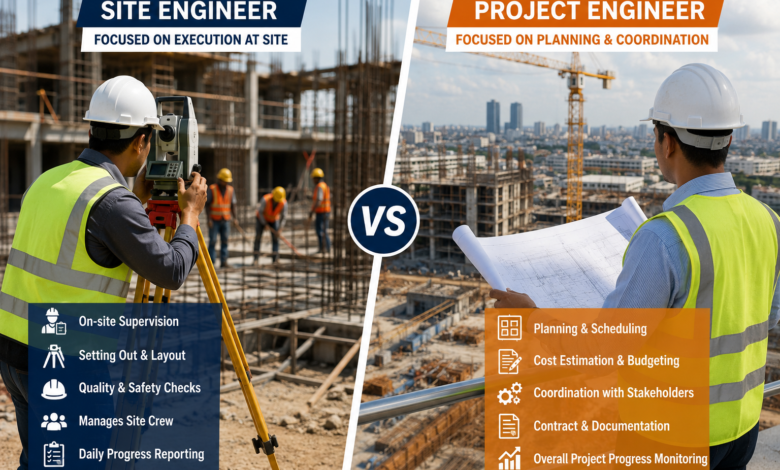
Site Engineer vs Project Engineer: 5 Essential Differences for Successful Project Delivery
The site engineer vs project engineer question comes down to scope: a site engineer sets out and supervises the physical works at one location, while a project engineer coordinates technical delivery across the whole project, from design interface to contract compliance. Both roles report through the construction management structure but sit at different levels of authority. On a typical road or building contract, a project may run three to six site engineers under a single project engineer, depending on the number of active work fronts.
Technical Snapshot: Site Engineer vs Project Engineer
| Attribute | Site Engineer | Project Engineer |
| Primary focus | On-site setting out, supervision, and quality control | Cross-project technical coordination and planning |
| Typical scope | Single work front or section | Entire project or multiple work fronts |
| Reports to | Project Engineer or Resident Engineer | Project Manager or Contracts Manager |
| Core tools | Total station, level, GPS rover, drawings register | Programme software, RFI/submittal log, cost reports |
| Entry qualification | BSc/HND Civil Engineering, graduate scheme | BSc Civil Engineering plus 3–5 years’ site experience |
| Chartership route | ICE, IStructE, or CIOB (IPD + professional review) | ICE, CIOB, or APM, chartered mid-career |
| Decision authority | Technical accuracy, day-to-day site instructions | Schedule, interface risk, design query resolution |
Getting this distinction right at the recruitment stage, and at the point of promotion, determines how efficiently a contractor can staff a road, bridge, or building programme without duplicating supervision or leaving technical gaps on site.
Introduction: Site Engineers vs Project Engineers
Every construction organogram carries both titles, yet the two are routinely confused, even by hiring managers drafting job specifications. Both roles sit inside the technical chain of command, both hold civil engineering degrees, and both spend part of their week on-site. But the site engineer vs project engineer distinction is not cosmetic; it reflects two different jobs with different spans of control and different failure modes when done badly.
This article examines the roles of the Site Engineer and the Project Engineer, then sets out five differences: scope, authority, reporting structure, qualification pathway, and the point at which one role becomes the other. Readers wanting a quick answer to the difference between a site engineer and a project engineer will find it in the Technical Snapshot above; the sections below unpack why that holds on real contracts, including the sequencing described in the road construction lifecycle, where site-level and project-level engineers constantly coordinate from design handover through to completion.
What Does a Site Engineer Do?
A site engineer is the technical presence on the ground. The UK’s official graduate careers guidance on site engineering frames the discipline as a role centred on surveying and setting out levels and positions to ensure a design can be built accurately, with technical, organisational, and supervisory input in equal measure. In practice, the site engineer is the person a foreman calls when a level looks wrong; anyone asking what a site engineer does in construction is asking what happens at this point of contact between drawing and built work.
Daily Site Responsibilities
The day-to-day content of the job is unglamorous but exacting. A site engineer checks incoming drawings against the latest revision register, confirms quantities before placing material orders, and keeps daily site diaries that later serve as the evidentiary record if a dispute arises. A missed report or an unchecked drawing revision can cascade into rework weeks later, one reason road construction quality control sits so close to the site engineer’s routine.
Materials scheduling also falls within this scope, keeping deliveries synchronised with the construction sequence, a task that grows more demanding on linear works such as roads, where drainage, sub-base, and surfacing gangs may operate on the same corridor within days of each other. Poor coordination here is a recurring theme in road construction failures.
Further Reading: Road Construction Quality Control: 6 Key Tests for Reliable Roads
Technical Supervision and Setting Out
Setting out is the site engineer’s signature technical duty. Using a total station, automatic level, or GPS rover, the site engineer transfers the design geometry from drawings onto the ground, establishing the survey control for every trade that they work from. An error of a few millimetres at the control stage propagates through kerb lines, drainage falls, and pavement levels, often surfacing only once the next layer has already been placed, which is precisely why drainage design failures so often trace back to setting-out errors rather than the design itself.
The site engineer also has day-to-day authority to stop work when a non-conformance is found and to escalate anything beyond their competence to the project engineer above them. Health and safety supervision is usually shared with the wider site team, but technical sign-off on completed work almost always sits with this role.
What Does a Project Engineer Do?
Where the site engineer’s world is bounded by a single work front, the Project Engineer’s role spans the entire contract. A project engineer focuses on the technical considerations and engineering details of a project as a whole, coordinating with multiple site engineers, subcontractors, and design consultants rather than supervising a single location. On a road scheme spanning several kilometres, the project engineer maintains a consistent technical picture across every section.
Planning and Coordination Duties
The project engineer’s week is built around programme, documentation, and interface management rather than levels and setting out. Typical duties include coordinating with the superintendent and subcontractors to schedule upcoming work, maintaining the construction schedule, and confirming that quality is maintained across all active work fronts. Document control is a substantial part of the job, managing submittals, shop drawings, and technical registers through to closeout.
Request for Information (RFI) management falls squarely within the project engineer’s purview. When a site team hits a design ambiguity or a conflict between drawings, the project engineer drafts and routes the RFI to the design team, tracks the response, and issues the clarification back to the site, a loop that, on a poorly managed contract, is often where weeks of programme are lost.
Interface with Design and Client Teams
The project engineer is also the primary technical link between the design consultants, the client’s representative, and the construction team, serving as the bridge that maintains technical accuracy from drawing to build. Contract administration increasingly falls to project engineers on internationally structured works; the mechanics are covered in Construction Frontier’s breakdown of standard contract models.
Key Differences in Scope and Authority
Having set out the roles of the Site Engineer and the Project Engineer separately, the site engineer vs project engineer comparison becomes clearer when the two are placed on the same axis: what each is authorised to decide and who each answers to.
Site-Level vs Project-Level Decision-Making
A site engineer’s authority is bounded and immediate. They can halt a pour that fails a slump test, reject a non-conforming delivery, or instruct a gang to rework a section that fails a level check, without sign-off from above, because these are technical judgements within their competence and physical presence on site. What a site engineer typically cannot do is change the programme, approve a variation with cost implications, or resolve a genuine design conflict.
A project engineer’s authority runs in the opposite direction. They rarely instruct a labour gang directly, but decide how interface risk between two contractors is managed, which design query goes to the client, and how the schedule absorbs a delay on one work front. This is the practical core of every site engineer vs project engineer responsibilities comparison, and the clearest answer to the difference between a site engineer and a project engineer: one role owns technical correctness at a point, the other owns technical coherence across the whole.
Reporting Lines and Team Structure
Reporting structures reflect this split cleanly. Site engineers typically report to a project engineer or, on larger civil works, a resident engineer representing the client. Project engineers report to a project manager or contracts manager, who carries commercial responsibility outside the project engineer’s technical remit. This mirrors the adjacent project engineer-project manager relationship one level up: the project engineer drives technical execution, while the project manager owns budget and delivery risk. A contract of any scale, therefore, has a clear vertical chain: site engineer, project engineer, and project manager, each layer widening in scope and narrowing in day-to-day technical involvement.
Reporting Lines and Span of Control: Site Engineer vs Project Engineer
| Aspect | Site Engineer | Project Engineer |
| Reports to | Project Engineer or Resident Engineer | Project Manager or Contracts Manager |
| Direct oversight of | Foremen and gangs on one work front | Multiple site engineers across the project |
| Typical span of control | One work front or section | Three to six site engineers, depending on work fronts |
| Escalates to | Project Engineer, for programme or design issues | Project Manager, for budget or client-facing issues |
| Primary counterpart | Foreman, subcontractor supervisor | Design consultant, client representative |
Required Qualifications and Career Progression
Understanding what a site engineer does in construction and what a project engineer does is only half the picture; the qualification pathway explains why one role tends to precede the other in the career path from site engineer to project engineer.
Entry Routes and Certifications
Entry to these civil engineering job roles typically requires a Bachelor of Science (BSc) or Higher National Diploma (HND) in civil or structural engineering, though apprenticeship routes remain common across African and global markets, where registration requirements vary by jurisdiction. Chartered status through ICE, IStructE, or CIOB requires a structured period of initial professional development followed by a professional review, running alongside the first years of site work. In Kenya, engineers trained abroad must complete formal registration before practising independently, a requirement covered in Construction Frontier’s guide to engineer registration in Kenya.
Further Reading: How to Register as an Engineer in Kenya: Complete Guide to Professional Registration
Project engineers hold broadly the same qualifications but are rarely appointed straight from graduation. Employers generally expect three to five years of site experience before entrusting someone with cross-project coordination, because those judgements depend on having lived with the consequences of the narrower decisions a site engineer makes daily.
Qualification and Chartership Pathway: Site Engineer vs Project Engineer
| Stage | Site Engineer | Project Engineer |
| Base qualification | BSc/HND in civil, structural, or construction-related engineering | Same base qualification, plus site track record |
| Alternative entry route | Apprenticeship or technician-to-engineer progression | Internal promotion from the site engineer role |
| Minimum experience expected | Graduate scheme or entry-level, 0–2 years | 3–5 years of demonstrated site experience |
| Professional development stage | Initial Professional Development (IPD) underway | IPD typically complete, working towards review |
| Chartership timing | Chartership pursued during site years | Often chartered mid-career, during or after this role |
| Registration body examples | ICE, IStructE, CIOB, national registration boards | ICE, CIOB, APM |
Typical Career Path Between Roles
The career path from site engineer to project engineer is the default trajectory for engineers who stay on the technical side rather than moving into commercial management. A graduate typically spends two to four years as a site engineer, building competence in setting out, supervision, and quality control while working towards chartership, before promotion follows demonstrated capability across more than one work front. From there, the two common next steps are project manager, for those drawn to the commercial side, or senior/principal engineer, for those who prefer deeper technical specialisation. Many experienced site engineers remain in that role indefinitely, valuing hands-on content over coordination-heavy work.
Compensation Comparison: What Site Engineers and Project Engineers Earn Worldwide
Role and authority explain part of the site engineer vs. project engineer comparison; pay is the part most candidates and hiring managers actually ask about first. Compensation for both roles varies substantially by region, currency, and whether a project is delivered by a multinational contractor or a local firm, but a few patterns repeat across markets: the gap between the two titles is narrower than most people assume, and it widens mainly with chartership and years of cross-project experience rather than with the job title alone.
Salaries in the US, UK, and the Gulf
Pay for both roles clusters closer together than the job titles suggest in the US and UK, while the Gulf’s tax-free packages create a wider absolute gap that widens further at senior and specialised levels.
Site Engineer vs Project Engineer Salaries: United States, United Kingdom, and the Gulf
| Region | Site Engineer | Project Engineer | Notes |
| United States | $75,000–$115,000/year (avg. ~$105,000) | $80,000–$105,000/year (avg. ~$90,000) | Construction-specific project engineer roles at larger contractors can exceed $105,000 once bonuses and profit-sharing are included |
| United Kingdom | £34,000–£43,000/year | £33,000–£45,000/year | London and infrastructure-heavy employers push both figures toward the top of the range |
| UAE / Gulf | AED 3,500–9,000/month (avg. ~AED 5,000) | AED 5,900–13,900/month (avg. ~AED 6,700–9,000) Senior/specialised AED 18,000–30,000/month | AED 30,000/month is the threshold for the UAE’s 10-year Golden Visa |
Compensation Across Africa
Local-currency salaries across Africa sit far below US, UK, or Gulf figures once converted, but the internal gap between site engineer and project engineer pay follows a similar shape, and multinational or EPC-funded projects pay materially more than locally funded ones for the same title.
Site Engineer vs Project Engineer Salaries Across Africa
| Country | Site Engineer | Project Engineer / Equivalent | Notes |
| Nigeria | NGN 150,000–280,000/month | NGN 300,000–700,000/month at senior/coordination level NGN 500,000–1,200,000/month at the project manager level | American, French, and Chinese EPC contractors pay a consistent premium over Nigerian firms for the same scope of work |
| Kenya | KES 65,000–206,000/month (avg. ~KES 132,000) | Roughly KES 40,000–280,000/month, drawn from broader civil/structural engineering bands | Clean project-engineer-specific data is harder to source than for the site engineer title; the range varies with experience and registration with the Engineers Board of Kenya |
| South Africa | R27,900–R44,200/month (avg. ~R36,700) | R16,300–R48,000/month | Reported project engineer pay is wider and, in some datasets, sits slightly below site engineer averages, a reminder that title alone is a weaker salary predictor than experience and ECSA registration |
Across every region, the same lesson from the career-path discussion above holds in salary terms too: chartership and years of demonstrated site or cross-project experience move the needle more than the job title printed on the offer letter, which is exactly why the career path from site engineer to project engineer tends to track a real increase in responsibility rather than a guaranteed jump in pay on day one.
How the Two Roles Collaborate on a Project
The roles of the Site Engineer and the Project Engineer only make sense together; the relationship is closer to a technical partnership than a strict hierarchy. On a road scheme, the site engineer sets out drainage runs and checks sub-base levels against design falls in real time, while the project engineer reconciles that work against the overall programme, flagging where a delay on one section threatens the surfacing gang’s mobilisation elsewhere. When a design ambiguity turns up in the field, the project engineer converts that observation into a formal RFI, tracks the response, and issues the resolution back to the site.
This division of labour is why both roles need to be staffed correctly from the outset. A project understaffed at the site engineer level accumulates small technical errors that surface late; one understaffed at the project engineer level accumulates coordination gaps that surface as programme slippage, a staffing balance central to the project management challenges on Africa’s infrastructure works that Construction Frontier has examined more broadly.
Technical Block: Comparing the Roles in Practice
The differences above translate into a working matrix that contractors and consultants use, formally or informally, when staffing a project team. The matrix below shows how the two roles typically divide responsibility across the functions that matter most in a live contract.
1. Comparative Responsibility Matrix
Comparative Responsibility Matrix: Site Engineer vs Project Engineer
| Function | Site Engineer | Project Engineer |
| Setting out and survey control | Owns directly | Reviews and audits |
| Daily site diaries and reporting | Produces | Consolidates across sections |
| Materials procurement scheduling | Local coordination | Overall programme alignment |
| RFI drafting and tracking | Raises field queries | Formalises, tracks, and closes RFIs |
| Design interface management | Flags discrepancies on site | Resolves with design/client teams |
| Quality control sign-off | Point-level inspection and testing | Programme-wide quality assurance |
| Programme and schedule ownership | Follows section schedule | Builds and maintains the master schedule |
| Contract administration input | Minimal, escalates issues | Direct involvement in clauses, variations |
Conclusion: Two Roles, One Delivery Chain
The distinction between a site engineer vs project engineer is not a matter of seniority in the sense most people assume; it is a matter of scope. A site engineer’s judgement is trusted at the point of construction because that is where the technical risk lives: in a level, a mix design, or a setting-out peg. A project engineer’s judgement is trusted across the whole delivery chain because that is where coordination risk lives: in a missed interface, an unresolved RFI, or a schedule conflict. A contractor that runs a project with only one of the two, overloading a project engineer with setting-out duties or leaving site engineers to manage RFIs unsupported, will pay for it in rework or delays.
The career lesson holds across these two construction engineer roles: understanding this distinction early matters more than the job title on offer. The technical grounding built as a site engineer is what makes a competent project engineer later; skipping it to chase the title early tends to produce coordinators who cannot judge whether a field problem is serious. The career path from site engineer to project engineer works because it is sequential, and the strongest project engineers on Africa’s infrastructure programmes are, almost without exception, those who spent many years on site first.
Advance Your Construction Engineering Knowledge
Explore more technical construction engineering analyses, career insights, and project delivery deep dives on Construction Frontier: Engineering Practice & Professional Development, where engineering roles, site management, construction methods, and professional best practices are examined through practical civil engineering insight.