Cable-Stayed vs Suspension Bridges: 7 Ultimate Engineering Differences for Optimal Bridge Performance
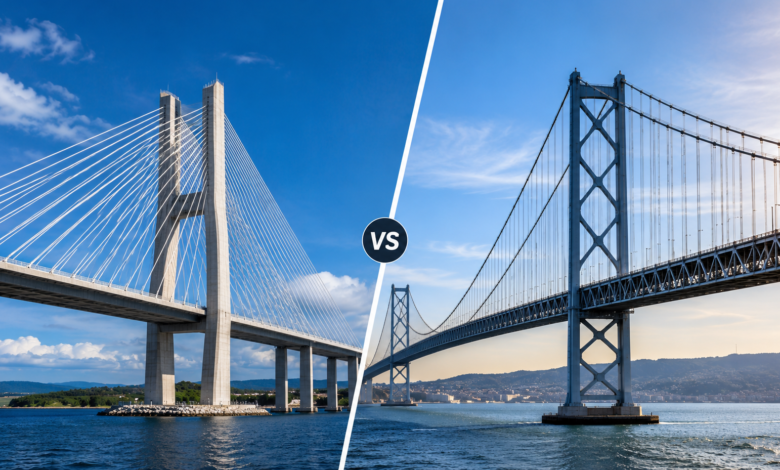
Cable-stayed vs. suspension bridges is a choice between two distinct load paths, not a hierarchy of quality: cable-stayed structures anchor stays directly into rigid towers for spans up to approximately 1,200 metres, while suspension systems route load through continuous main cables and anchorages to clear spans beyond 2,000 metres. The decision reshapes construction sequencing, foundation demand, and total project cost before the first cable is tensioned.
Technical Snapshot: Core System Specifications
| Parameter | Cable-Stayed Bridges | Suspension Bridges |
| Practical span range | Up to ~1,200 m | 600 m to over 2,000 m |
| Longest span achieved | 1,208 m (Changtai Yangtze River Bridge, China) | 2,023 m (1915 Çanakkale Bridge, Turkey) |
| Load path | Stays run directly from the deck to the tower | The main cable carries the load to the towers and anchorages |
| Anchorage requirement | Self-anchored, minimal external anchorage | Massive ground anchorages required |
| Construction method | Balanced cantilever, deck built outward from towers | Cables spun or strand-erected first; deck follows |
| Construction speed | Faster for mid-range spans | Slower, but the only option at an extreme span |
| Deck stiffness | Higher, less prone to deflection | Lower, requires stiffening girders |
The span length required by the site, not personal preference, should dictate which system wins. Cable-stayed vs. suspension bridges remains the defining structural decision on every major crossing brief issued today.
Introduction: Cable-Stayed vs. Suspension Bridges
Every major water crossing begins with the same structural fork in the road. Once a site survey fixes navigation clearance, geotechnical conditions, and target span, the project team narrows its options to two families of long-span structures: cable-stayed and suspension. Both suspend a deck from high-tension cables and rely on tall towers, yet the way each carries load to the ground differs fundamentally, driving every subsequent decision on programme, cost, and risk. Cable-stayed vs suspension bridges is the choice engineers reach when the span length pushes a crossing beyond what beam or arch construction can deliver economically.
This comparison sits alongside Construction Frontier’s wider review of the tallest bridges in the world, where several structures ranked by deck height rely on the systems examined here. Readers newer to bridge classification may also want the grounding piece on beam, arch, and truss systems, which sets out the shorter-span alternatives that cable-stayed and suspension bridges are built to surpass.
The debate between cable-stayed and suspension bridges is not a contest with a single winner. It is a site-specific calculation that involves span length, soil bearing capacity, navigation clearance, seismic exposure, and the capital budget. The difference between cable-stayed and suspension bridges becomes obvious once a project moves from concept sketch to feasibility study, because each system imposes its own geometry on tower spacing, deck depth, and foundation footprint. This article sets out the mechanics, span economics, and construction realities that separate the two systems so project teams can make the call with the rigour a lead structural engineer applies at the feasibility stage.
Structural Mechanics: How Each System Carries Load
This section breaks down the load path for each system, since everything else, from tower geometry to foundation size, follows from how each moves force from deck to ground.
Cable-Stayed Load Path: Direct, Self-Anchored Stays
In a cable-stayed bridge, individual stay cables run directly from the tower to fixed points along the deck. Each stay carries its share of deck load into the tower, which transfers the combined compression into the foundation. Because the stays pull symmetrically on either side of the tower, horizontal forces largely cancel out, so the system is self-anchored, removing the need for the enormous ground anchorages suspension bridges require. This is the biggest reason cable-stayed bridge construction has accelerated across mid-span crossings, a point examined in Construction Frontier’s piece on why cable-stayed design has become the fastest-growing bridge type.
Further Reading: Cable-Stayed Bridges: 6 Reasons They’re the Fastest-Growing Design
Suspension Load Path: Continuous Cable to Ground Anchorage
Suspension bridges work differently. A continuous main cable runs over the towers and down into anchorages buried in rock or massive concrete blocks at each end. Vertical hangers drop from this main cable to support the deck, so every increment of deck load transfers up into the cable, along its curve, and into the anchorages. Because the cable must resist enormous horizontal tension at the anchorage, suspension bridges demand foundations that dwarf those of a comparable cable-stayed structure.
This is the core of suspension bridge design, covered in more depth in the companion article on suspension bridge design and structural stability, and grasping it is the fastest way to understand the difference between cable-stayed and suspension bridges before cost or span enters the conversation.
Span Capacity and Scale: Where Each Design Wins
This section compares the practical span ceiling of each system, from the current cable-stayed world record to the longer reach that suspension geometry makes possible.
Cable-Stayed Span Limits and the Current World Record
Span length is where cable-stayed bridges produce their clearest verdict, and bridge span capacity is the variable separating a feasible cable-stayed crossing from one that must default to suspension technology. Cable-stayed systems lose efficiency as span increases, because longer stays become more flexible and cable steel weight grows faster than the deck it supports, capping economical spans at approximately 1,100 to 1,200 metres.
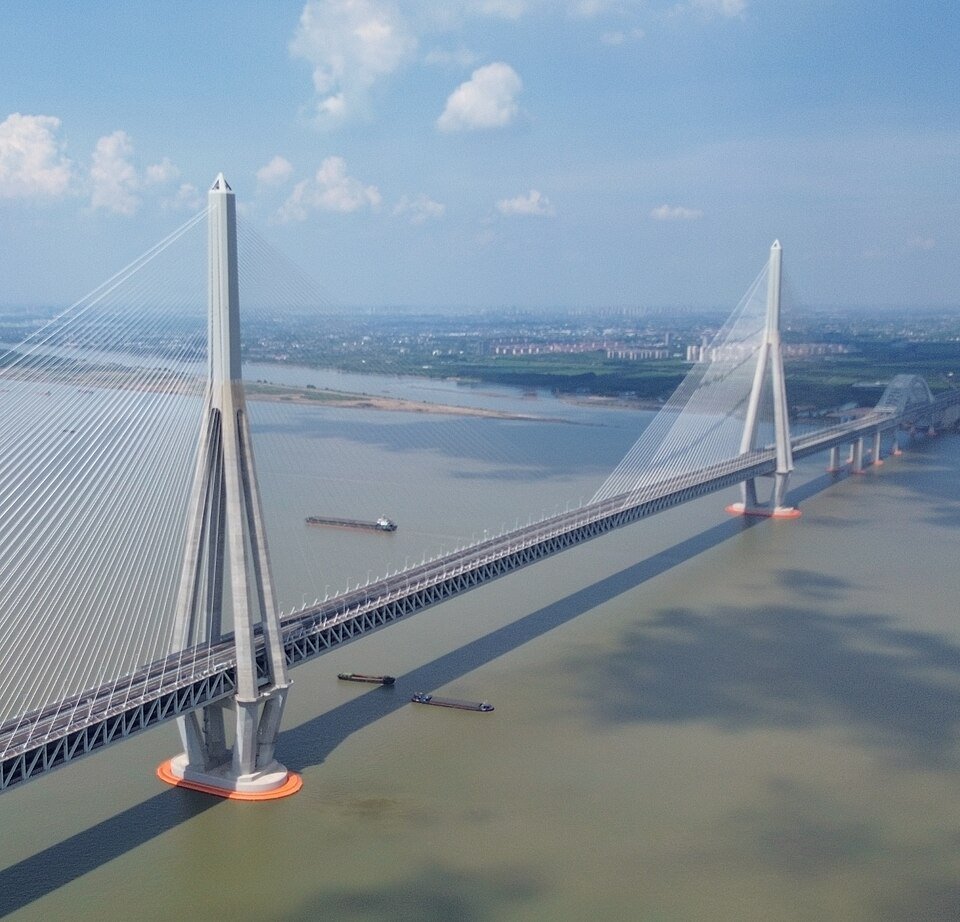
The current record holder and the longest cable-stayed bridge in the world is the Changtai Yangtze River Bridge, connecting Changzhou and Taizhou in Jiangsu province, carrying an expressway, a local road, and an intercity railway across a main span of 1,208 metres, overtaking the Russky Bridge in Vladivostok.
Suspension Span Records and Why They Scale Further
Suspension bridges scale further because the main cable’s catenary geometry distributes load more efficiently across extreme distances, which is why suspension bridge design remains the default once bridge span capacity requirements exceed what cable-stayed engineering can deliver. The 1915 Çanakkale Bridge across the Dardanelles Strait in Turkey holds the world record with a main span of 2,023 metres, edging past Japan’s Akashi Kaikyo Bridge, whose 1,992-metre span held the record for nearly a quarter of a century after opening in 1998. Both structures sit well beyond the longest cable-stayed bridge in the world by a margin that no cable-stayed optimisation has yet closed.
World Record Span Comparison
| Metric | Longest Cable-Stayed | Longest Suspension |
| Structure | Changtai Yangtze River Bridge | 1915 Çanakkale Bridge |
| Location | Jiangsu, China | Çanakkale Province, Turkey |
| Main span | 1,208 m | 2,023 m |
| Opened | 2025 | 2022 |
| Tower height | 350 m | 318 m |
Construction Speed, Cost, and Site Constraints
This section covers how each system’s construction sequence drives the programme and budget and how site geology narrows the choice between them.
Cable-Stayed Construction Sequencing
Cable-stayed bridges and suspension bridges also diverge sharply on programme and cost, often the deciding factors once span requirements fall within reach of both systems. Cable-stayed bridge construction typically uses balanced cantilever methods, where segments extend simultaneously from each tower and are stabilised by newly tensioned stays as work progresses. This requires minimal falsework, keeps the navigation channel clear, and allows contractors to work from both towers simultaneously, shortening the critical path.
Suspension Construction Sequencing and Cost Drivers
Suspension bridge construction follows a stricter sequence. Towers and anchorages must be completed first, since anchorages have to be ready before the main cable can be spun or strand-erected across the full span. Only once the main cable and hangers are in place can deck erection begin, progressing outward from the towers using travelling cranes.
This dependency, combined with the concrete volume required for gravity anchorages, extends the schedule and capital outlay well beyond those of a comparable cable-stayed programme, and multi-billion-dollar budgets are the norm rather than the exception for record suspension spans. That gap is the clearest illustration of the suspension bridge vs cable-stayed bridge cost equation at extreme scale: cable-stayed bridge construction of comparable ambition routinely lands well below equivalent suspension outlay by avoiding gravity anchorages of similar mass.
Site Geology as a Deciding Factor
Site geology narrows the choice further. Cable-stayed bridges suit locations with competent soil close to the tower positions, since self-anchoring concentrates the load there. Suspension bridges demand solid rock or engineered ground capable of resisting the anchorage’s horizontal pull, which is why record suspension spans sit across strait crossings with favourable geology on both shores. This constraint is as decisive to the suspension bridge vs. cable-stayed bridge cost equation as span length, since poor anchorage conditions can double foundation costs. Challenging terrain or seismically active zones often require specialised strategies, as outlined in the article on engineering bridges for extreme site conditions.
Construction Programme and Cost Comparison
| Factor | Cable-Stayed Bridges | Suspension Bridges |
| Build sequence | Balanced cantilever, both towers simultaneously | Towers and anchorages first, then cable, then deck |
| Falsework requirement | Minimal | Minimal at the deck stage, extensive at anchorages |
| Navigation channel impact | Stays clear throughout construction | Clear once the towers are up |
| Anchorage cost driver | Low, self-anchored | High, gravity anchorages required |
| Preferred foundation soil | Competent soil near towers | Solid rock or engineered ground at anchorages |
| Typical budget scale | Lower for comparable span | Multi-billion-dollar records span |
Wind, Seismic, and Environmental Performance
This section explains why suspension decks are more vulnerable to wind-induced flutter, and how cable-stayed deck stiffness helps under both wind and seismic loading.
Why Suspension Decks Are More Susceptible to Flutter
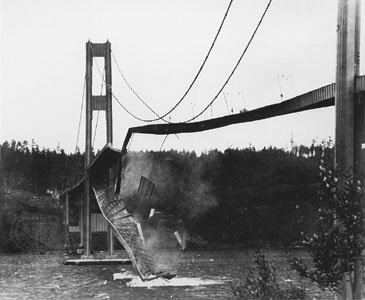
Aerodynamic behaviour is one of the most consequential differences between cable-stayed and suspension bridges, driven by decades of design refinement since the Tacoma Narrows collapse. Suspension bridge design has had to solve this directly, because a longer, lighter deck suspended from hangers rather than braced by direct stays is more susceptible to wind-induced flutter and vortex shedding. Engineers counter this with streamlined box-girder deck sections, tuned mass dampers, and wind-tunnel testing, as detailed in Construction Frontier’s review of bridge wind-load and aerodynamic engineering.
Cable-Stayed Stiffness Advantages Under Wind and Seismic Load
Cable-stayed bridges benefit from inherently greater deck stiffness, since the multiple stay cables act almost like elastic supports along the deck’s length, reducing wind-induced oscillation. This stiffness also helps under seismic loading, where a cable-stayed system’s shorter, more numerous load paths distribute ground motion more predictably than the long, continuous main cable central to suspension bridge design.
Both the Akashi Kaikyo Bridge and the 1915 Çanakkale Bridge were engineered for severe seismic and typhoon conditions because their strait locations combine deep water, active fault lines, and high wind exposure, pushing suspension technology rather than cable-stayed bridge construction, since only suspension could achieve the required clearance and span.
Aerodynamic and Seismic Performance Comparison
| Performance Factor | Cable-Stayed Bridges | Suspension Bridges |
| Deck stiffness | Higher, the stays act as elastic supports | Lower; relies on stiffening girders |
| Flutter susceptibility | Lower | Higher; requires wind tunnel testing |
| Seismic load distribution | Shorter, more numerous load paths | Concentrated through a long main cable |
| Common mitigation | Streamlined deck section, stay damping | Tuned mass dampers, twin-box girders |
| Typical deployment | Moderate wind and seismic exposure | Extreme strait crossings with high exposure |
Choosing the Right System: Site Selection Criteria
This section sets out the practical criteria that favour cable-stayed construction versus the conditions under which suspension design becomes unavoidable.
When Cable-Stayed Construction Is the Better Fit
Reducing cable-stayed bridges to suspension bridges in a single decision tree oversimplifies a choice that involves site-specific trade-offs. Cable-stayed systems generally win when the required span is under approximately 1,000 metres, the foundation soil is competent, construction speed and cost control are priorities, and the project needs to keep a navigation channel open throughout the works.
When Suspension Becomes the Only Realistic Option
Suspension systems become the only realistic option once bridge span capacity requirements exceed that threshold, where deep water or poor near-shore geology rules out intermediate piers, or the crossing must achieve exceptional vertical clearance. Hybrid cable-stayed bridge construction methods keep pushing the practical span ceiling upward, but for the extreme spans that headline global rankings, suspension bridge design retains an advantage that cable-stayed engineering has not yet closed.
Further Reading: Suspension Bridge Design: 5 Proven Principles for Structural Stability
Technical Block: Engineering Reference and Verdict
This reference block condenses the load path, span benchmarks, and cost drivers covered above into a quick-scan summary, closing with the practical verdict.
1. Load Transfer Summary
Cable-stayed bridges transfer load through direct, independent stays to a self-anchored tower system, eliminating the need for massive ground anchorages. Suspension bridge design routes load through a continuous main cable into anchorages engineered to resist enormous horizontal tension, a fundamentally different load path.
2. Span and Scale Benchmarks
The longest cable-stayed bridge in the world, the Changtai Yangtze River Bridge, holds the ceiling at 1,208 metres, while the 1915 Çanakkale Bridge holds the suspension ceiling at 2,023 metres. Akashi Kaikyo Bridge, the previous record holder at 1,992 metres, remains a benchmark for seismic-resistant suspension bridge design.
3. Programme and Cost Drivers
Cable-stayed bridge construction favours balanced cantilever methods that shorten the critical path and reduce falsework, while suspension construction is bound to a strict tower-anchorage-cable-deck sequence that extends schedule and cost, particularly where anchorage geology is unfavourable; the point where the suspension bridge vs cable-stayed bridge cost gap is felt most is on a project balance sheet.
Conclusion: Matching Structure to Site Demands
The cable-stayed vs suspension bridges decision comes down to arithmetic; no design preference can override bridge span capacity, soil bearing capacity, and navigation clearance, which set the boundaries within which a structural engineer operates. Where a crossing falls within reach of cable-stayed bridge construction, the faster sequence, lower anchorage cost, and superior deck stiffness make it the more economical, lower-risk choice in most cases.
Where the span exceeds what cable-stayed engineering can economically deliver, suspension bridge design remains the only structurally sound answer, and project teams should budget for the anchorage scale, sequencing, and aerodynamic testing that extreme suspension spans demand. This is, in the end, the practical difference between cable-stayed and suspension bridges: one optimises for speed and cost within a generous span range; the other exists to exceed it. Africa’s own strait and estuary crossings will increasingly test cable-stayed vs. suspension bridges as governments pursue longer, higher-clearance links.
Compare the World’s Most Advanced Bridge Systems
Continue exploring Construction Frontier: Engineering Fundamentals for expert technical analysis, engineering deep dives, and project reviews comparing bridge designs, structural systems, and the engineering behind the world’s most ambitious crossings.