Tallest Bridges in the World: 10 Breakthrough Designs Redefining Engineering
The tallest bridges in the world now clear the ground by more than 600 metres, a scale that did not exist in commercial bridge engineering before 2016. Nine of the ten record holders stand in China’s Guizhou and Yunnan provinces, where karst canyons up to 600 metres deep forced engineers to develop new methods for cable hoisting, tower construction, and wind-load control. This article ranks the ten tallest bridge structures on record by verified deck height, then explains the structural systems, materials, and construction sequencing that make each one possible.
Technical Snapshot: Core Project Specifications
| Metric | Value |
| Tallest bridge in the world | Huajiang Grand Canyon Bridge, Guizhou, China |
| Record deck height | 625 metres (2,051 feet) above the Beipan River |
| Bridges above 400 m are in the current top 10 | Nine |
| Dominant structural systems | Suspension and cable-stayed |
| Country with the most entries in the top 10 | China (eight of ten) |
| Tallest bridge outside Asia | Baluarte Bridge, Mexico, 403 metres |
| Oldest bridge in the current top 10 | Sidu River Bridge, opened 2009 |
| Newest bridges in the current top 10 | Huajiang Grand Canyon Bridge and Zangkejiang Bridge, opened in 2025 |
For engineers, investors, and infrastructure planners, this ranking of the tallest bridges in the world is a live record of how far cable-stayed and suspension systems can now be pushed above valley floors, and it sets the design benchmark that the next generation of mega-bridge projects will have to beat.
Introduction: Tallest Bridges in the World
Bridge height was once measured in tens of metres. Today, the tallest bridges in the world span entire mountain gorges at heights that rival those of supertall towers, and the engineering that makes this possible sits at the centre of modern structural design. A bridge counted among the world’s tallest bridges is not simply a taller version of a standard highway crossing. It is a different engineering problem entirely, one where wind load, seismic response, foundation depth, and cable geometry all scale non-linearly as the deck rises further from the valley floor.
This article sits within Construction Frontier’s broader coverage of large-span infrastructure and connects directly to the structural systems that power megabridge projects worldwide, mapping the full set of engineering approaches that make megabridges possible across geographies. Where that piece broadly covers the discipline of mega-bridge engineering, this article narrows the focus to a single, measurable question: Which structures currently hold the title of the tallest bridges on Earth, and what specific bridge-height engineering decisions let them stand that high?
The list below ranks the ten tallest bridges in the world by verified deck height, the vertical distance between the road or rail surface and the ground or water beneath it. Readers will also find structural height data, since some of the tallest bridge towers do not correspond directly to the highest deck clearances. Both measurements matter to engineers, and both are explained in detail in the section that follows.
Understanding how tall bridges are engineered requires looking beyond the height figure itself to the sequence of decisions that produced it: site selection, structural system, cable and steel specifications, foundation type, and construction method. Each bridge profiled here made distinct choices across those five categories, shaped by the geology, wind exposure, and seismic risk unique to its site. The same site conditions, wind, foundation instability, and construction access recur across nearly every project on the list, even as the specific solutions differ from crossing to crossing.
How Engineers Measure the Tallest Bridges in the World
Before ranking the world’s tallest bridges, it is important to understand what “tallest” actually means. In bridge engineering, the term is measured in two different ways, and mixing them up often leads to misleading comparisons. This is why one publication may rank a bridge differently from another, even when both are using accurate engineering data. Understanding the distinction provides a much clearer picture of how these remarkable structures are designed.
1. Deck Height: The Measurement That Defines the World’s Tallest Bridges
Deck height refers to the vertical distance from the bridge deck to the ground or water directly below. It is the measurement that captures the sheer scale of a crossing from a driver’s or passenger’s perspective, representing the drop visible beneath the roadway. For this reason, it has become the internationally recognised standard for ranking the world’s tallest bridges and is the metric used throughout this article.
2. Structural Height: Measuring the Bridge from Foundation to Tower Top
Structural height tells a different story. Instead of measuring the drop beneath the roadway, it measures the entire height of the bridge structure, from the top of its tallest tower down to the point where the foundation meets the ground. Because it focuses on the structure itself, a bridge can have an exceptionally tall profile even when its deck is relatively close to the valley floor.
Why the Two Measurements Produce Different Rankings
The difference between deck height and structural height becomes clear when comparing famous bridges around the world. The Millau Viaduct is a perfect example. Its tallest pylon rises approximately 343 metres, making it one of the tallest bridge structures ever built. However, its deck sits about 270 metres above the Tarn Valley because the pylons are founded close to the valley floor rather than on the surrounding cliffs. As a result, it ranks much higher for structural height than for deck height.
Why Guizhou’s Bridges Set Deck Height Records
Guizhou’s bridges reverse this relationship. Most are built across extraordinarily deep karst canyons, with their towers anchored directly on the canyon rims. Since the foundations already begin hundreds of metres above the valley floor, the towers themselves do not need to be exceptionally tall. Yet the distance from the deck to the ground below is immense, allowing these bridges to dominate global deck-height rankings despite having relatively modest tower heights. That is why this article uses deck height as its primary ranking while also including structural height and tower height to provide additional engineering context.
Comparing Deck Height and Structural Height
Table: Deck Height vs Structural Height, Four Reference Bridges
| Bridge | Deck Height | Tallest Tower (Structural Height) | Why the Figures Diverge |
| Huajiang Grand Canyon Bridge | 625 m | 262 m | Towers founded on canyon rims above a very deep gorge |
| Duge Bridge | 565 m | 269 m | H-towers sit on the canyon rim rather than the valley floor |
| Millau Viaduct | 270 m | 343 m | The tallest pylon is founded near the valley floor itself |
| Sidu River Bridge | 496 m | 118.2 m | Short towers sit atop an exceptionally deep gorge |
Why Suspension and Cable-Stayed Bridges Dominate the Tallest Bridge Rankings
Reaching extreme heights requires more than favourable terrain; it also demands the right structural system. Suspension and cable-stayed bridges dominate the list of the world’s tallest crossings because they can span enormous distances while keeping structural weight relatively low. This is a major advantage when every section of steel must be transported and erected hundreds of metres above a canyon.
Beam and truss bridges, by comparison, carry loads primarily through bending, requiring far more material to achieve similar spans. Their weight and cost increase rapidly at these scales, making them unsuitable for the record-breaking canyon crossings found in western China. As a result, suspension and cable-stayed designs have become the preferred engineering solution wherever the landscape demands both exceptional height and long uninterrupted spans.
Further Reading: Bridge Engineering at Scale: 7 Proven Systems Powering Megabridges Worldwide
The 10 Tallest Bridges in the World Ranked by Height
The following ranking orders structures by verified deck height, the maximum vertical drop from the bridge deck to the ground or water surface beneath the span. Each entry includes the structural system, main span, year of completion, and the specific engineering techniques that solved the site’s defining challenge, whether that was karst geology, extreme wind loading, or seismic exposure.
1. Huajiang Grand Canyon Bridge, China: 625 Metres
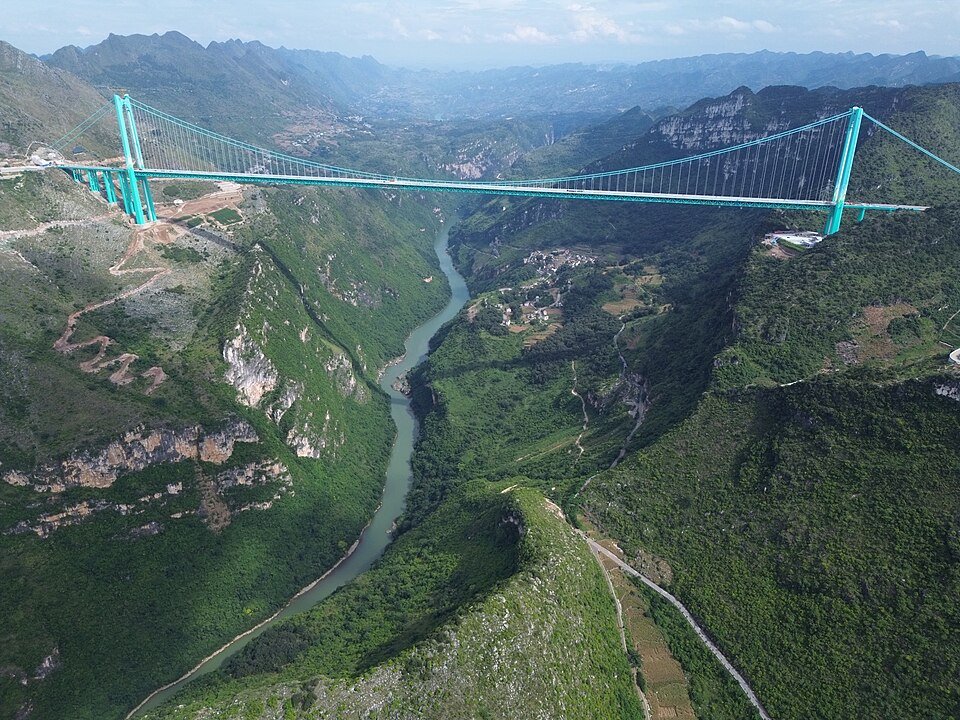
The Huajiang Grand Canyon Bridge in Guizhou Province holds the current world record for deck height at 625 metres above the Beipan River, making it not only the tallest bridge in the world but also the tallest bridge structure to open anywhere on record. The crossing links Anshun and Liupanshui across a canyon known locally as the “Earth’s Crack”, cutting a journey that once took two hours down to approximately two minutes.
Engineers selected a steel truss-suspension system for the main span, which stretches 1,420 metres between two towers of unequal height, 262 metres and 205 metres, anchored directly into the canyon rims. The steel truss superstructure weighs approximately 22,000 tonnes, and the design team used 2,000 MPa high-strength steel cables, among the strongest ever specified for a suspension main cable, to manage the loads generated at that span length. Because standard cranes could not operate safely at that altitude above the gorge, the project used an intelligent cable-hoisting system to lift and position the 93 truss segments, a technique now referenced as a benchmark for high-altitude construction of the tallest bridge structures elsewhere in China.
The karst rock beneath the towers is porous and erosion-prone, so engineers cut tunnel anchors approximately 94 metres deep into the rock at each tower to secure the main cables, and founded the towers themselves on deep pile foundations driven into more stable strata below the surface rock. A “zero-excavation” construction policy limited blasting to protect the surrounding karst formations, while Doppler LiDAR wind mapping directly informed the deck’s aerodynamic design. Construction ran from January 2022 to September 2025, a four-year build in which the team had to solve wind, foundation, and access problems simultaneously rather than in sequence.
2. Duge Bridge (Beipanjiang Bridge), China: 565 Metres
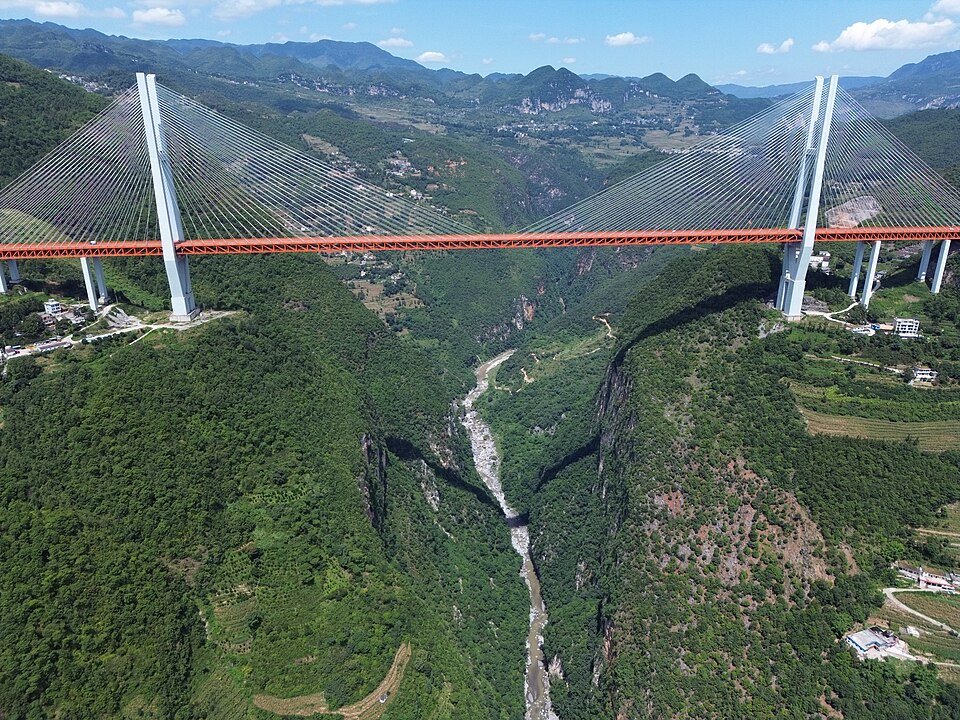
Before the Huajiang Grand Canyon Bridge opened, the Duge Bridge held the title of tallest bridge in the world for nearly a decade, and it remains the tallest cable-stayed bridge in the world to combine both height and span at this scale. Also known as the Beipanjiang Bridge, it carries the Hangzhou–Ruili Expressway across the Nizhu River gorge on the Guizhou–Yunnan border, with a deck standing 565 metres above the river, part of China’s drive to link its western provinces with coastal economic zones.
The design uses two H-shaped reinforced concrete towers of unequal height, 269 metres on the Guizhou side and 248 metres on the Yunnan side, supporting a steel truss deck through 112 pairs of stay cables arranged in a fan pattern. The main span reaches 720 metres, making it the third-longest cable-stayed span in that height class when the bridge opened in 2016. Engineers repeatedly adjusted the bridge alignment during design to avoid caverns and structural weaknesses in the surrounding karst limestone. The crossing took five years to build and cost more than 1 billion yuan, a modest budget for a structure that broke the 500-metre height barrier for the first time in bridge history.
3. Sidu River Bridge, China: 496 Metres
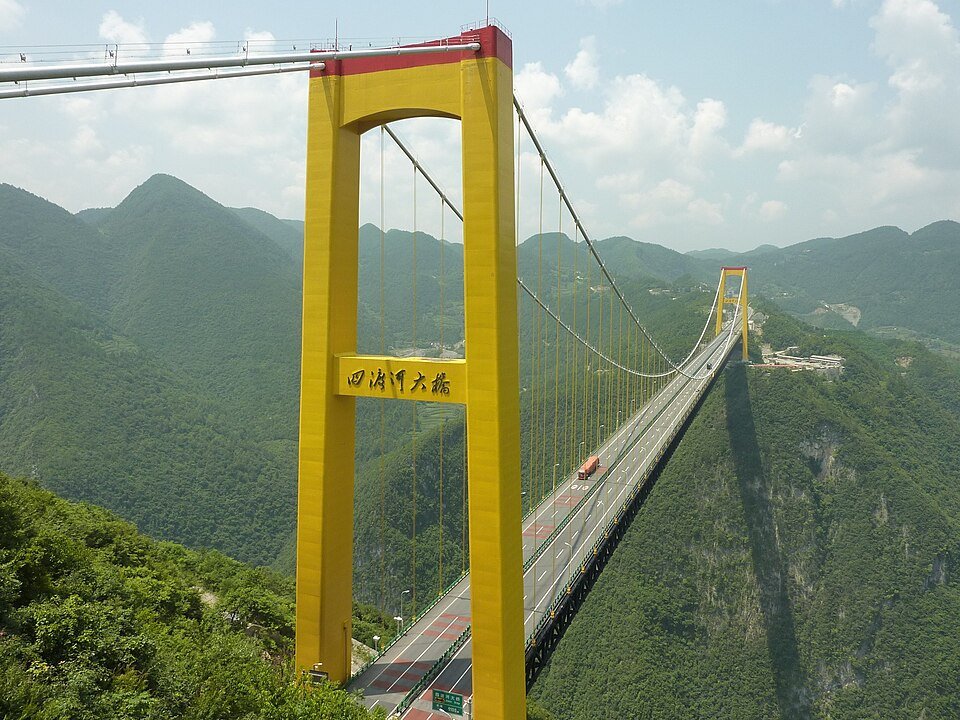
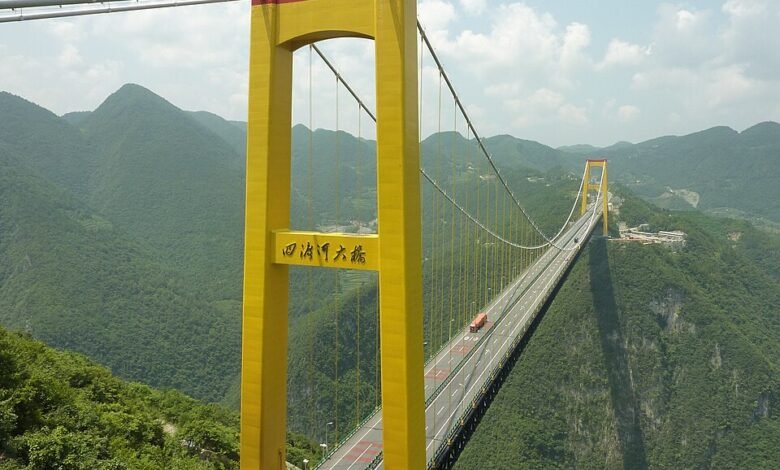
The Sidu River Bridge in Hubei province is best known in engineering circles for how its construction team solved a single, decisive problem: how to get a pilot cable across a 900-metre-wide, 500-metre-deep gorge in terrain too remote and too windy for a helicopter or blimp to fly the line safely. The answer was rocketry. On 9th October 2006, engineers launched two 1,300-metre chinlon tethers using rocket-propelled guidelines, a technique never before applied to bridge construction, landing both lines within 10 to 15 metres of their intended targets in approximately ten seconds each.
The completed structure is a suspension bridge with H-shaped concrete towers rising 118.2 metres, a truss-stiffened deck 26 metres wide, and a main span of 900 metres. Its deck sits 496 metres above the river surface, the highest point on the G50 Shanghai–Chongqing Expressway and, at the time of its 2009 opening, the highest bridge deck ever built. The rocket-cable technique pioneered on this project has since become a reference method for pilot-cable installation on other extreme-height suspension crossings, an early example of how one difficult bridge site can shift construction practice across an entire sector.
4. Puli Bridge, China: 485 Metres
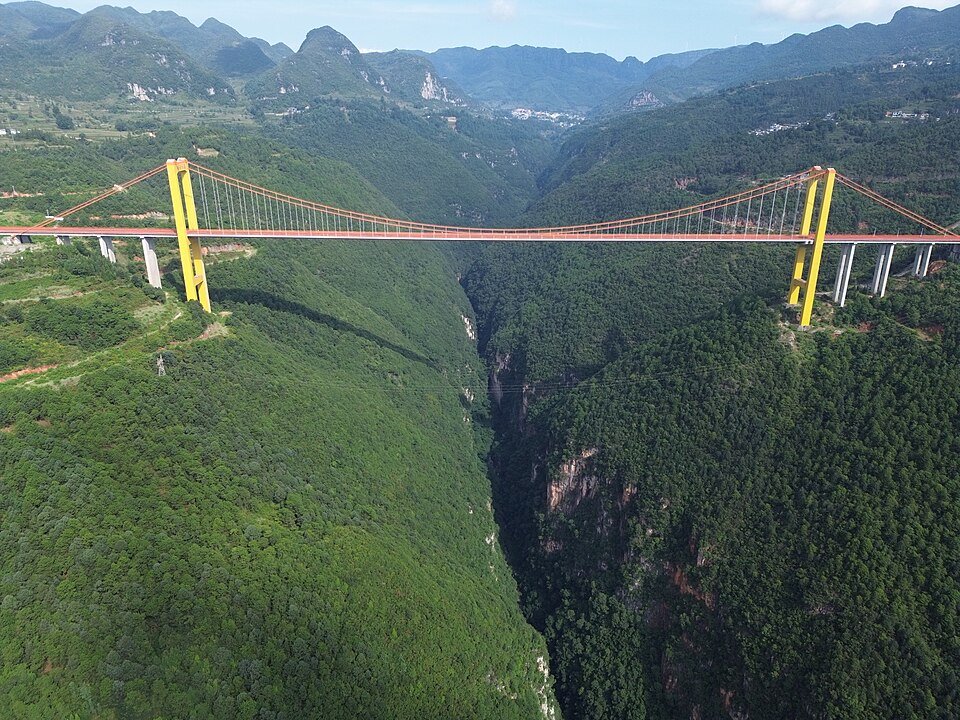
The Puli Bridge crosses a narrow gorge near Xuanwei in Yunnan province, and its 485-metre deck height made it the second bridge in history to break the 450-metre mark when it opened in 2015. Unlike the truss-stiffened decks used on most of China’s tallest bridges, Puli uses a thin, aerodynamic steel box girder connected to its suspension cables through double steel rods, a lighter, more wind-efficient profile shared with only a handful of other high-altitude Yunnan crossings.
The main span measures 628 metres against a total structure length of 1,040 metres. Engineers faced an unusual site-survey problem here: the terrain on both approach slopes was so inaccessible that building an accurate topographic model of the canyon floor proved extremely difficult, and once tower foundation stability was confirmed on the surrounding rock, the design team had limited practical need to establish the canyon’s exact base elevation. The bridge forms part of the same Hangzhou–Ruili Expressway corridor as the Duge Bridge, placing two of the world’s tallest bridges within the same regional highway project.
5. Jin’an Bridge, China: 461 Metres
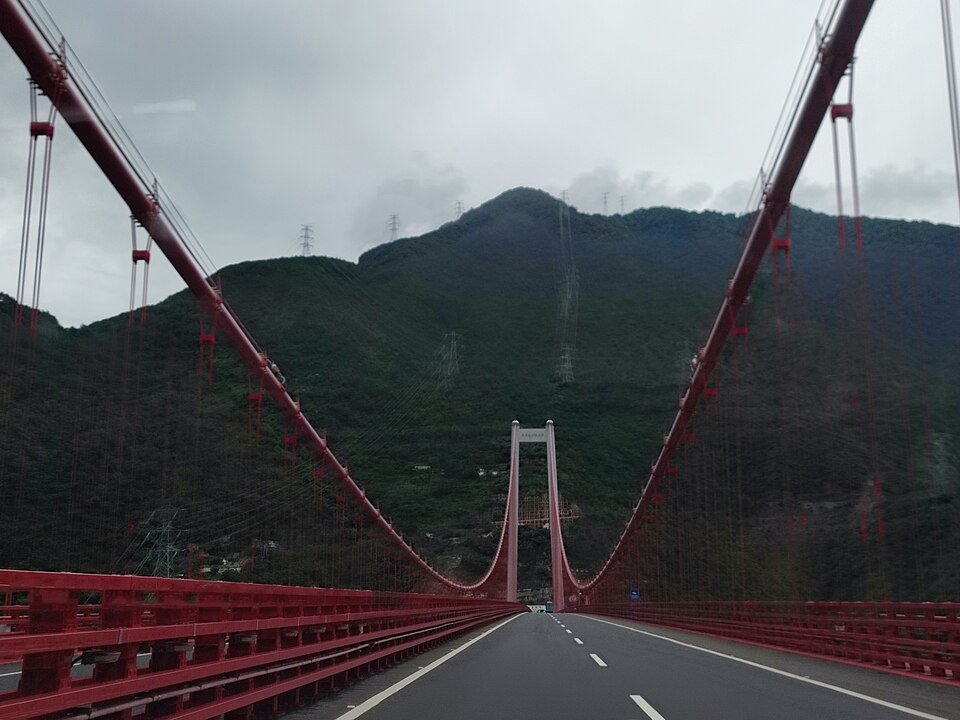
The Jin’an Bridge spans the Jinsha River in Yunnan province at a deck height of 461 metres, with a total structure length of 1,681 metres and a main span of 1,386 metres, among the longest suspension spans on this list. Opened in 2020, the bridge forms part of the Chengdu–Lijiang Expressway and connects communities across one of the upper Yangtze basin’s most rugged tributary gorges.
The scale of the main span relative to the deck height sets Jin’an apart from shorter-span, taller-deck crossings like Puli or Duge. A 1,386-metre span demands substantially higher cable tension and more sophisticated bridge aerodynamics and deck detailing to control flutter and vortex shedding across a longer unsupported length. Design teams working on the Jinsha River corridor have increasingly favoured longer, more slender suspension spans over shorter cable-stayed alternatives, since the longer span reduces the number of piers needed in geologically unstable canyon terrain.
Further Reading: Bridge Aerodynamics: 5 Powerful Solutions That Prevent Collapse
6. Yachi River Bridge, China: 434 Metres
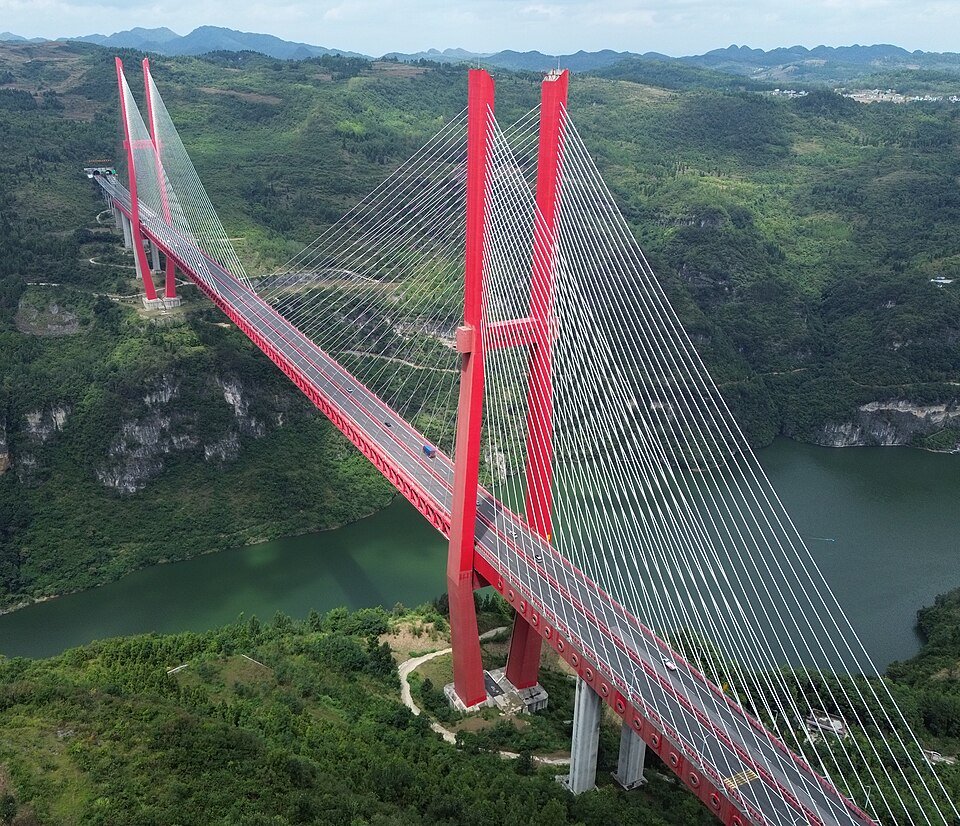
The Yachi River Bridge in Guizhou province carries an expressway across the Yachi River at a deck height of 434 metres above the original river level, though the completed Dongfeng Dam reservoir beneath the bridge now sits approximately 306 metres below the deck at typical water levels. The structure is a cable-stayed bridge with two steel towers, 258.2 metres and 243.2 metres tall, supporting a main span of 800 metres, among the longest cable-stayed spans built anywhere at this height class when it opened in 2016.
The bridge’s total length runs to 1,466.5 metres, and its steel-truss main girder was engineered specifically to manage the combined loading of an 800-metre span and severe canyon crosswinds simultaneously. Constructing towers of this height while maintaining tight geometric tolerances for cable anchorage required continuous surveying throughout the multi-year build. When it opened, few cable-stayed structures had attempted an 800-metre span at this elevation, making the Yachi River one of the tallest examples of the system anywhere, second only to Duge among China’s own entries.
7. Zangkejiang Bridge, China: 410 Metres
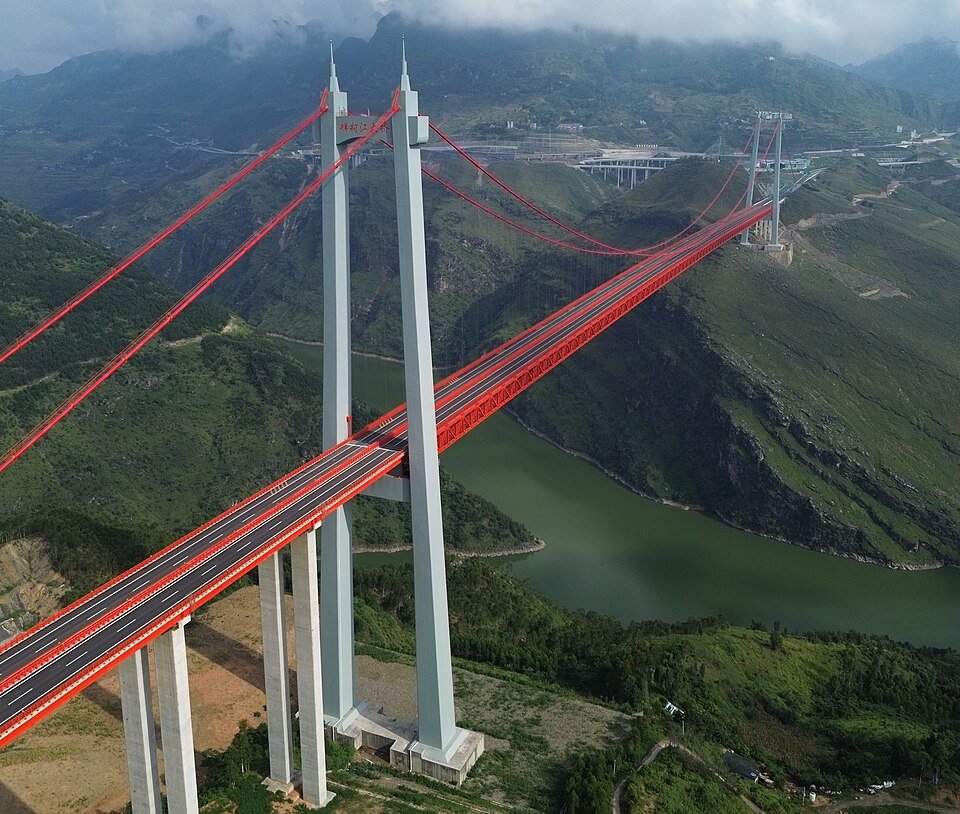
The Zangkejiang Bridge opened in 2025 on the Nayong–Xingyi Expressway, crossing the Beipan River at a deck height of 410 metres with a main span of 1,080 metres. As one of the newest entries in the current top ten, it reflects the continued pace of high-bridge construction in Guizhou province, where new expressway corridors keep pushing into increasingly deep karst terrain.
The bridge’s suspension system and span length place it firmly within the same design family as Jin’an and Sidu River, favouring a long, slender main span over the shorter, stiffer geometry used on cable-stayed structures like Duge and Yachi River. Guizhou’s transportation planning authorities have described the wind-resistance stability and unequal tower-height design used on projects like this one as areas where the province’s own design institutes have progressively displaced outside engineering consultancies, a shift worth noting for anyone tracking mega-bridge engineering trends across China’s western provinces.
8. Qingshui River Bridge, China: 406 Metres
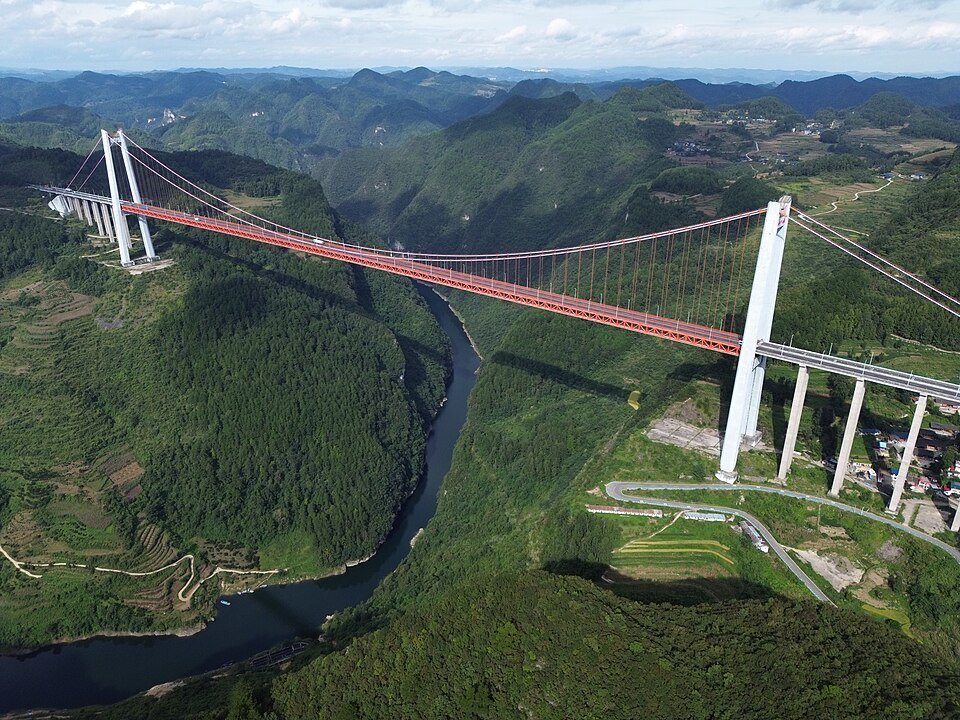
The Qingshui River Bridge crosses its namesake river in Guizhou province at a deck height of 406 metres, with a main span of 1,130 metres carried by a suspension system. Opened in 2015 as part of the Yinchuan–Baise Expressway, the bridge sits within the same dense cluster of extreme-height crossings that has made Guizhou the world’s most concentrated region for the tallest bridge structures.
Like most of the province’s high suspension bridges, Qingshui River required extensive geotechnical investigation before construction began, since karst limestone terrain is prone to hidden caverns, sinkholes, and unpredictable load-bearing capacity that can compromise tower foundations if left undetected.
The site conditions common to this entire cluster of bridges, from Qingshui River to Duge to Sidu River, reflect the same engineering solutions for extreme-environment bridge sites that govern foundation and construction method choices on unstable, high-altitude, and seismically active terrain. Qingshui River rarely draws the same attention as Huajiang or Duge, yet it belongs on any serious ranking of the world’s tallest bridges and shows how many mid-table entries this category actually contains once bridges below 400 metres are counted.
9. Baluarte Bridge, Mexico: 403 Metres
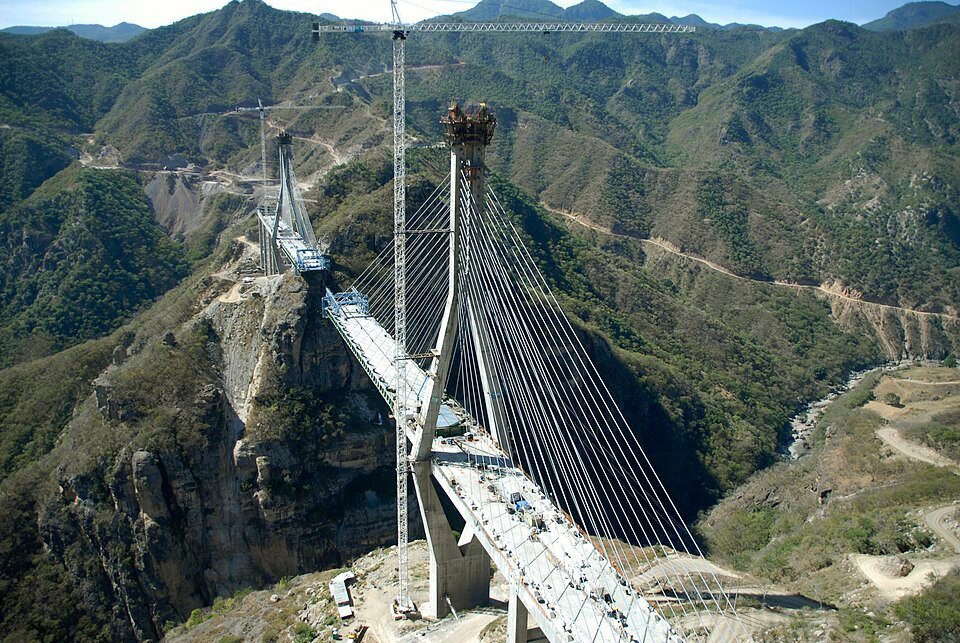
The Baluarte Bridge is the tallest bridge in the Americas and the tallest cable-stayed bridge in the world outside China, with a deck standing 403 metres above the Baluarte River on the border between Sinaloa and Durango. It carries the Durango–Mazatlán highway across the Sierra Madre Occidental, cutting travel time between the two cities from approximately 6 hours to 2.5 hours.
The bridge uses two diamond-shaped concrete pylons, each around 126 metres tall, supporting a 520-metre main span via 152 stay cables, making it the longest cable-stayed span in North America at the time of its 2013 opening. The composite steel-concrete deck was erected using the cantilever method, extending outward symmetrically from each tower rather than relying on temporary falsework across the gorge, a construction sequence essential in terrain this steep and inaccessible.
Wind tunnel testing conducted before construction identified vibration risks from hurricane-force gusts up to 180 km/h, prompting design adjustments before the deck was finalised. The project also sits in an active seismic zone, requiring an elastic structural response for a low-probability, high-magnitude design earthquake, one of the core engineering solutions for extreme-environment bridge sites that shaped the project.
10. Chenab Rail Bridge, India: 359 Metres
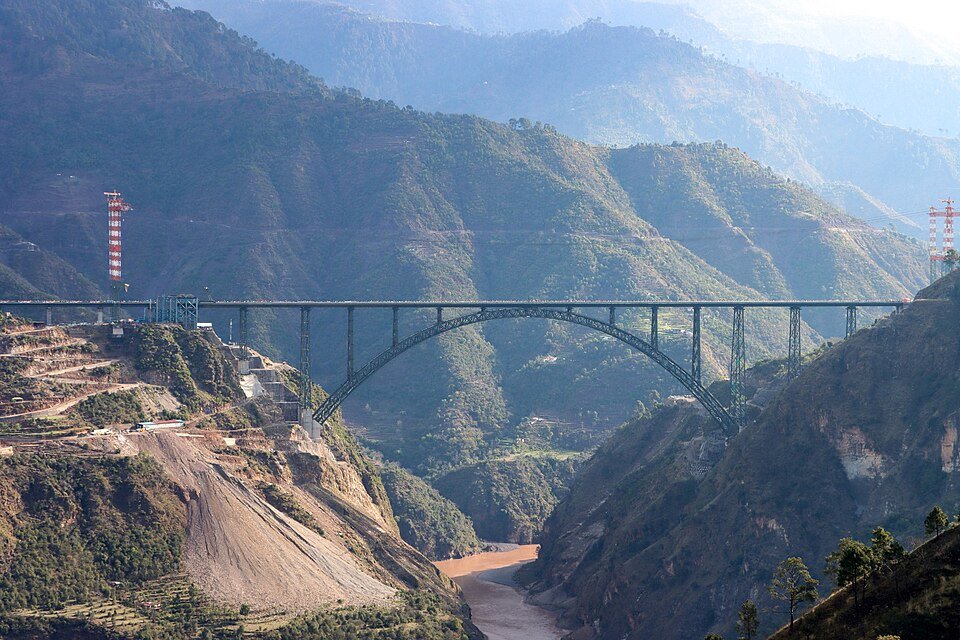
The Chenab Rail Bridge is the tallest railway bridge in the world, and the only entry in this ranking built for rail rather than road traffic. Its deck sits 359 metres above the Chenab River in Jammu and Kashmir, approximately 35 metres taller than the Eiffel Tower, and it serves as the centrepiece of the Udhampur-Srinagar-Baramulla Rail Link, connecting the Kashmir Valley to India’s national rail network.
Engineers chose a two-ribbed steel arch for the main span, which stretches 467 metres between two concrete pylons anchored into Himalayan rock. The twin-rib configuration adds structural redundancy, since damage to one rib still leaves the second carrying load, and widens the arch’s effective base to resist lateral wind and seismic forces more efficiently than a single-rib design would. The bridge was engineered to withstand wind speeds up to 266 km/h, magnitude-8 seismic activity in a Zone V high-risk earthquake region, and blast forces equivalent to approximately 40 tonnes of TNT, specifications developed with input from India’s Defence Research and Development Organisation (DRDO) alongside international structural consultants.
Construction used cable cranes spanning approximately 900 metres between opposing canyon walls to place steel trestles and 93 deck segments, each weighing around 85 tonnes, over a build that spanned from the early 2000s to completion in 2025, due to the site’s exceptional geological and logistical challenges. Chenab closes out this ranking as the clearest example of an arch system competing successfully against suspension and cable-stayed designs at extreme heights, and a reminder that the tallest bridges in the world are not exclusively a Chinese phenomenon.
Further Reading: Suspension Bridge Design: 5 Proven Principles for Structural Stability
Comparing the World’s Tallest Bridges by Height, Span, and System
Placing all ten tallest bridges in the world side by side shows how deck height, tower height, span length, and structural system interact differently at every site, since no two of these crossings solved the same combination of geology, wind exposure, and traffic demand in the same way.
Table: The 10 Tallest Bridges in the World by Deck Height, Span, and System
| Rank | Bridge | Country | Deck Height | Main Span | System | Opened |
| 1 | Huajiang Grand Canyon Bridge | China | 625 m | 1,420 m | Suspension | 2025 |
| 2 | Duge Bridge | China | 565 m | 720 m | Cable-stayed | 2016 |
| 3 | Sidu River Bridge | China | 496 m | 900 m | Suspension | 2009 |
| 4 | Puli Bridge | China | 485 m | 628 m | Suspension | 2015 |
| 5 | Jin’an Bridge | China | 461 m | 1,386 m | Suspension | 2020 |
| 6 | Yachi River Bridge | China | 434 m | 800 m | Cable-stayed | 2016 |
| 7 | Zangkejiang Bridge | China | 410 m | 1,080 m | Suspension | 2025 |
| 8 | Qingshui River Bridge | China | 406 m | 1,130 m | Suspension | 2015 |
| 9 | Baluarte Bridge | Mexico | 403 m | 520 m | Cable-stayed | 2013 |
| 10 | Chenab Rail Bridge | India | 359 m | 467 m | Arch | 2025 |
Seven of the ten tallest bridge structures in the world use suspension systems; three use cable-stayed systems, including Duge, the tallest cable-stayed bridge in the world by deck height; and one, Chenab, uses a steel arch. That distribution is not accidental. Suspension systems have the longest main spans on this list because their main cables operate purely in tension, distributing load efficiently over very long distances with comparatively light towers. Cable-stayed systems, by contrast, tend to dominate the shorter end of this span range, where their stiffer deck behaviour and simpler construction sequencing offer a practical advantage.
Table: Structural System Distribution Across the Top 10
| System | Bridges | Share of Top 10 | Average Main Span |
| Suspension | Huajiang, Sidu River, Puli, Jin’an, Zangkejiang, Qingshui River | 6 of 10 | 1,061 m |
| Cable-stayed | Duge, Yachi River, Baluarte | 3 of 10 | 680 m |
| Arch | Chenab Rail Bridge | 1 of 10 | 467 m |
Readers comparing these two systems directly should see why cable-stayed design is the fastest-growing bridge type and why the proven principles of stable suspension bridge design provide a full technical breakdown of when each system outperforms the other. Duge and Baluarte remain the two projects most commonly cited together in that comparison, precisely because they sit on opposite sides of the Pacific yet reached broadly similar heights and span solutions independently.
The Next Wave of Record-Breaking Bridges Under Construction
The current ranking will not hold its shape for long. China alone has more than a dozen bridges with deck heights above 250 metres under active construction, several of which are designed specifically to overtake the current record.
Table: Projected Deck Heights of Bridges Under Construction
| Bridge | Province | Projected Deck Height | Expected Completion | System |
| Yongchang Lancang River Bridge | Yunnan | 610 m | c. 2028 | Suspension |
| Tianmen Bridge | Guizhou | 560 m | 2026 | Suspension |
| Xiaowan Lancangjiang Bridge | Yunnan | 520 m | Late 2020s | Suspension |
| Lugu Lake Bridge | Yunnan | 493 m | Late 2020s | Suspension |
What distinguishes this next generation of bridges is not simply greater height, but a continued refinement of the same engineering systems already proven on the current top ten: higher-grade cable steel, more precise wind-tunnel-validated deck aerodynamics, and construction methods adapted specifically to karst and Himalayan-scale terrain. Guizhou and Yunnan provinces account for the overwhelming majority of these upcoming projects, reinforcing the region’s position as the global centre of gravity for this category of engineering.
Engineering Systems That Make Tallest Bridge Structures Possible
The tallest bridges in the world are not built with a single engineering breakthrough. Their success comes from combining high-strength materials, aerodynamic design, robust foundations, and innovative construction methods. While every bridge responds to different terrain and environmental conditions, these four engineering systems consistently make extreme-height crossings possible.
1. High-Strength Cable Technology
Cable technology is fundamental to every suspension and cable-stayed bridge on this list. As spans become longer and bridges rise higher above the landscape, cable forces increase significantly, making conventional steel impractical.
The Huajiang Grand Canyon Bridge illustrates this well. Its 1,420-metre main span uses 2,000 MPa high-strength steel for its main cables, among the highest tensile-strength grades ever used on a suspension bridge. Lower-grade steel would have required heavier cables, increasing the bridge’s dead load and the demands on its towers and foundations.
Every one of the tallest bridges in the world follows the same principle: stronger steel allows engineers to reduce weight while maintaining the strength needed for record-breaking spans.
2. Wind Engineering
Wind is one of the greatest challenges for the tallest bridges in the world. At these heights, aerodynamic forces can influence both structural stability and user comfort, making wind engineering in bridge structures a key part of the design process. Different bridges solve the problem in different ways. Duge Bridge, Sidu River Bridge, and Yachi River Bridge use truss-stiffened decks that allow wind to pass through the structure, reducing aerodynamic loads. Puli Bridge, by contrast, uses a streamlined box-girder deck that minimises drag with a smooth aerodynamic profile.
The Chenab Rail Bridge underwent wind-tunnel testing to verify its performance in wind speeds of up to 266 km/h. Technologies such as tuned mass dampers, deck fairings, and cable damping systems further improve stability under strong winds. Readers interested in these design approaches can explore the full range of wind engineering in bridge structures, including tuned mass dampers, deck fairings, and cable damping systems.
3. Foundation Engineering
Every bridge is only as strong as its foundations. For the tallest bridges in the world, foundation design depends heavily on local geology. Most of Guizhou’s bridges are built on karst limestone, where hidden caves and irregular rock formations require detailed geological investigations before construction begins. In several projects, engineers changed the bridge alignment after surveys identified unsuitable foundation conditions.
The Chenab Rail Bridge faced a different challenge. Its foundations were built in fractured Himalayan rock within a seismically active region, requiring continuous monitoring and adjustments during excavation. Both examples demonstrate the importance of difficult-terrain bridge engineering, where geological conditions determine foundation design and construction methods.
Further Reading: Extreme Environment Bridge Engineering: 4 Proven Global Solutions
4. Innovative Construction Methods
Building the tallest bridges in the world often requires techniques developed specifically for extreme sites. The Sidu River Bridge used rocket-fired pilot cables to establish the first connection across its deep canyon, overcoming a span beyond the reach of conventional methods. The Huajiang Grand Canyon Bridge has introduced an intelligent cable-hoisting system that safely positions heavy bridge components hundreds of metres above the canyon floor.
These solutions were created because traditional cranes, helicopters, and cable installation methods could not meet the demands of these projects. As bridge spans and heights continue to increase, construction innovation will remain as important as advances in structural design and materials.
Why China Dominates the World’s Tallest Bridge Rankings
Eight of the ten tallest bridges in the world currently stand in China, and the concentration goes deeper than that headline figure suggests: Guizhou province alone accounts for a majority of the world’s bridges above 250 metres in deck height, a density with no equivalent anywhere else on the planet. That concentration reflects three factors working together rather than any single cause.
1. Topography and Karst Canyon Terrain
Guizhou and Yunnan sit atop extensive karst plateau terrain, cut by rivers into deep, narrow canyons that make conventional road grading prohibitively expensive across long distances. A tall bridge that crosses a canyon in a single span is frequently cheaper and faster to build than a road that switches back down one side and up the other. As a result, China’s western expressway network has consistently favoured height over route length wherever canyon geometry allows it.
2. Sustained Institutional Investment
China’s national expressway expansion has continued for more than two decades, giving domestic design institutes and state-owned construction firms, including Guizhou Road and Bridge Group and China Railway Major Bridge Engineering Group, repeated opportunities to refine their expertise across dozens of successive high-bridge projects. Design and construction knowledge that would take decades to accumulate elsewhere has rapidly compounded through this continuous pipeline of similar projects within a single province.
3. Growth of Domestic Engineering Expertise
Guizhou’s transportation planning and design institutes have progressively assumed technical leadership of suspension bridge projects previously led by external consultancies. According to Chinese engineering literature on projects such as the Huajiang Grand Canyon Bridge, this transition has embedded specialised expertise in wind-resistant stability, unequal-tower-height design, and karst foundation engineering within the region, allowing local teams to lead increasingly complex bridge projects rather than relying on imported expertise.
Technical Block: Engineering Standards Behind the World’s Tallest Bridges
Three engineering standards recur across every project profiled in this ranking of the tallest bridges in the world, regardless of country, structural system, or completion date. The sections below break down how load is managed at extreme height, how foundations are matched to unpredictable ground conditions, and how construction sequencing adapts to terrain that conventional access methods cannot reach.
1. Load Management at Extreme Height
Every bridge in this ranking manages three interacting load categories: dead load from the structure’s own mass, live load from traffic, and environmental load from wind and seismic activity. As deck height increases, environmental load grows disproportionately relative to the other two, since wind speed and turbulence intensity both increase with height above the ground. This is why the tallest bridge structures on this list specify cable steel grades, deck aerodynamics, and tower stiffness far beyond what a standard highway bridge would require at a fraction of the height.
2. Foundation Depth and Ground Investigation
Tower foundations for these ten bridges range from deep pile foundations driven through unstable surface rock into stable strata, as used at Huajiang, to tunnel anchors bored tens of metres into canyon walls to secure suspension main cables. In every case, the foundation design followed extensive geotechnical survey work specific to that site’s rock type, since karst limestone, Himalayan schist, and Mexican volcanic terrain each present different risks of hidden voids, fault lines, or load-bearing variability that a generic foundation design could not safely accommodate.
Table: Foundation Type by Site Geology
| Bridge | Bedrock Type | Foundation Approach | Primary Risk Addressed |
| Huajiang Grand Canyon Bridge | Karst limestone | Deep pile foundations plus 94 m tunnel anchors | Porous, erosion-prone rock |
| Duge Bridge | Karst limestone | Realigned tower siting after survey | Hidden caverns beneath planned tower locations |
| Chenab Rail Bridge | Himalayan schist | Concrete pylons anchored into fractured rock | Seismic activity and rock fracturing |
| Baluarte Bridge | Volcanic terrain | Cantilever-erected pylons, seismic-rated foundations | Active seismic zone loading |
3. Construction Sequencing in Inaccessible Terrain
Because the canyons beneath these bridges are frequently too steep, too deep, or too remote for conventional access, every project on this list developed a construction sequence tailored to its specific site constraints. Cantilever erection, cable-hoisting systems, rocket-fired pilot cables, and cable-crane transport across the gorge all appear across these ten projects, each selected because standard crane-based construction could not reach the required height or span safely.
Conclusion: What the Tallest Bridges in the World Reveal About Modern Engineering
The current ranking of the world’s tallest bridges is not static. Every entry on it has been broken by a newer, taller structure within the past two decades, and China’s western provinces continue to plan and build bridges that will eventually overtake Huajiang’s current record. What the ranking demonstrates more durably than any single height figure is how quickly extreme-height bridge engineering has matured as a discipline: rocket-fired pilot cables, 2,000 MPa cable steel, intelligent cable-hoisting systems, and karst-specific foundation methods did not exist as standard practice twenty years ago, and now they define an entire class of megaprojects.
For engineers, investors, and infrastructure planners tracking this sector, the practical lesson is that height alone no longer differentiates a project. The bridges that matter now are those that pair record-breaking heights with genuine construction innovation, verified through load testing, wind-tunnel validation, and long-term structural health monitoring. That combination, rather than the height figure in isolation, is what will decide which of the next generation of tallest bridge structures earns a lasting place among the world’s tallest bridges.
Explore More of Bridge Engineering
Discover how the world’s tallest bridges compare with other landmark crossings in Construction Frontier: Engineering Fundamentals, featuring expert technical analysis, engineering deep dives, and project reviews.