Cable-Stayed Bridges: 6 Unique Reasons They’re the Fastest-Growing Design
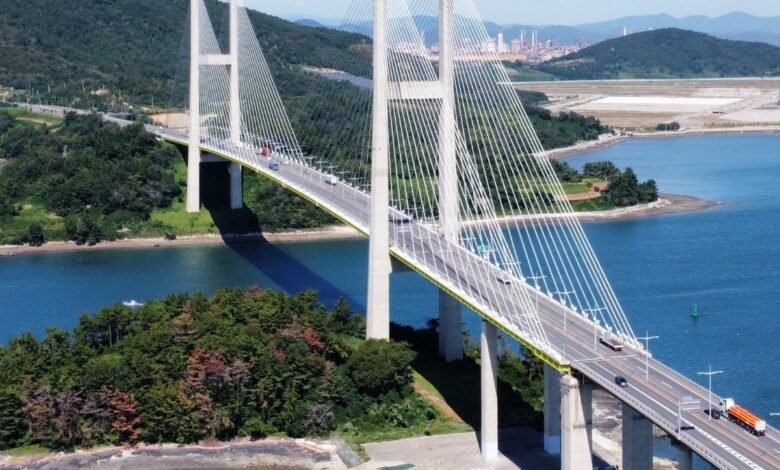
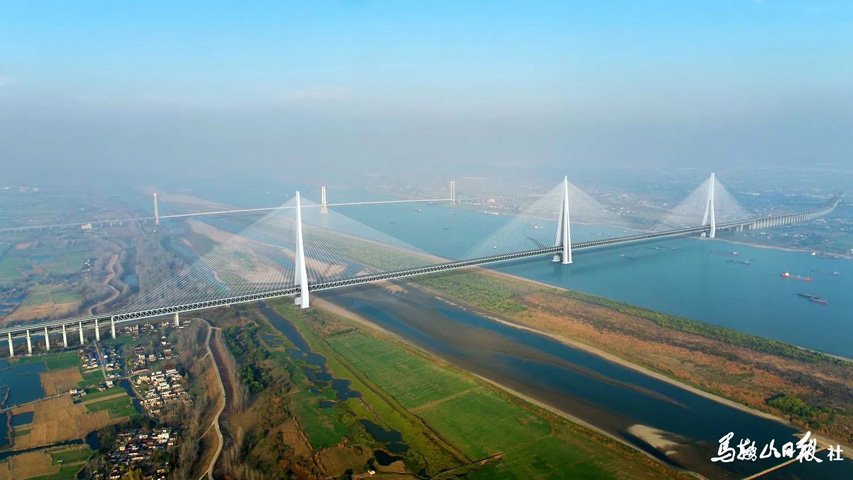
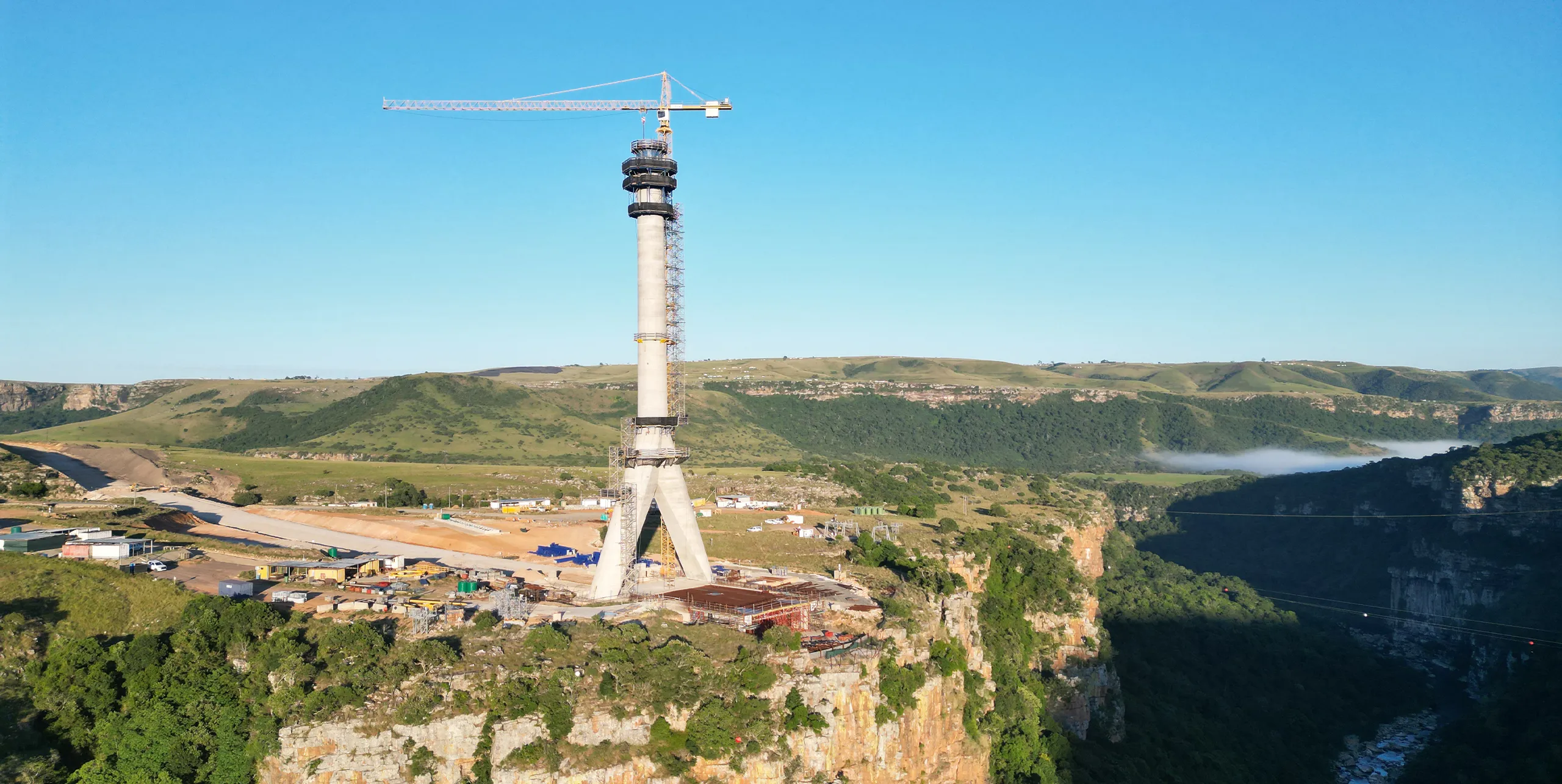
Cable-stayed bridges have become the default engineering solution for river, strait, and gorge crossings spanning roughly 200 to 1,200 metres, a span range that covers most of the world’s modern long-span crossing needs. China’s Changtai Yangtze River Bridge now holds the world record for cable-stayed bridges with a 1,176-metre main span, a mark engineers expect to fall again as bridges such as the triple-towered Ma’anshan Yangtze River Rail-Road Bridge near completion. Africa’s own contribution, the Msikaba Bridge in South Africa’s Eastern Cape, follows the same design logic as the 580-metre gorge crossing on the N2 Wild Coast Toll Road.
Technical Snapshot: Core Cable-Stayed Bridges Specifications
| Specification | Detail |
| Bridge Type | Cable-stayed |
| Practical Span Range | Roughly 110 m to 1,180 m |
| World Record Main Span | 1,176 m (Changtai Yangtze River Bridge, China, 2025) |
| Core Components | Pylons, stay cables, deck |
| Common Cable Patterns | Fan, semi-fan, harp |
| Common Pylon Shapes | H, A, inverted Y, diamond |
| First Modern Cable-Stayed Bridge | Strömsund Bridge, Sweden (1956) |
| Notable African Example | Msikaba Bridge, South Africa (580 m main span) |
Growth in cable-stayed bridge construction is not a trend; it is a structural response to what most crossings actually require. For engineers and investors weighing long-span options, cable-stayed bridge design now outcompetes both suspension and heavy-girder solutions across the exact span range where most infrastructure demand actually lies.
Introduction: Cable-Stayed Bridges
Every bridge type wins its share of the market by solving a specific structural problem better than the alternatives. Cable-stayed bridges have quietly taken over the middle ground of long-span engineering, and the reasons are mechanical rather than fashionable. While our guide to the world’s tallest bridges surveys the full range of record-breaking structures, this article focuses on one design type: why cable-stayed bridges now dominate new construction on nearly every continent.
The numbers back up the claim. Of the bridges currently under construction with spans above 500 metres, the overwhelming majority use cable-stayed bridge engineering rather than suspension cables or trussed girders. China’s Yangtze River crossings account for most of that volume, but the pattern repeats from the Detroit River to the Eastern Cape coastline.
Anyone tracking why cable-stayed bridges are growing in popularity across so many markets at once will find the same answer wherever they look: the economics of cable-stayed bridge engineering simply outperform the alternatives once a crossing exceeds a few hundred metres. That also explains why so many of the longest cable-stayed bridges in the world have been completed in the last two decades rather than being evenly distributed across the design type’s seventy-year history.
What Makes Cable-Stayed Bridge Design Different
A cable-stayed bridge looks similar to a suspension bridge from a distance, but the load path underneath the deck works in a fundamentally different way. Getting this distinction right matters because it explains every advantage covered later in this article. The cable-stayed vs. suspension bridge comparison is one of the most common questions engineers face from clients weighing options for a new crossing, and the answer always starts with these basic cable-stayed bridge design principles.
Deck, Pylons, and Stays: The Three-Part System
Cable-stayed bridge design relies on three structural elements working in direct tension and compression. The pylons, usually built of concrete or steel, rise from the foundations and carry the entire structure’s compressive load straight down to the piers. Stay cables run directly from the pylons to anchorage points along the deck, each one acting as an independent support rather than part of a continuous curve, with the tensile forces in the cables putting the deck into horizontal compression.
The deck itself, whether a steel box girder or a composite steel-concrete section, spans between these cable anchorage points much like a beam resting on a dense row of elastic supports. Every member in a cable-stayed bridge is loaded axially rather than in bending, the same efficiency principle that makes trusses lighter than solid beams, covered further in our article on beam, arch, and truss bridge systems.
Further Reading: Beam, Arch, and Truss Bridges: 3 Essential Systems for Stronger Bridge Design
Cable-Stayed vs Suspension Bridges: Where the Line Falls
The difference between cable-stayed and suspension bridges comes down to how the cables transfer load to the ground. A suspension bridge hangs its deck from two continuous main cables that drape between towers and anchor into massive concrete or rock blocks at each end, and the anchorages must resist the full horizontal pull of that curve. A cable-stayed bridge is self-anchored: each stay cable runs directly from pylon to deck, and the horizontal forces cancel out within the structure itself rather than needing to be resisted by external anchor blocks.
That single distinction between cable-stayed and suspension bridges is the root cause of nearly all the cost and schedule advantages discussed in this article. Suspension bridges still win on spans beyond roughly 1,200 metres, where their continuous cable geometry becomes unavoidable, a threshold explored further in our piece on suspension bridge design principles. Framed as a straight cable-stayed vs suspension bridge decision, the choice usually comes down to span length first and site geology second.
Cable-Stayed vs Suspension Bridges: Structural Comparison
| Factor | Cable-Stayed Bridge | Suspension Bridge |
| Load path | Self-anchored; cables run directly from pylon to deck | Continuous main cable draped between towers |
| Ground anchorage | Not required; forces balance within the structure | Massive concrete or rock anchor blocks at each end |
| Practical span range | Roughly 110 m to 1,180 m | Roughly 500 m to 2,023 m+ |
| Deck stiffness | High; dense array of individually anchored cables | Lower; cables carry the load through widely spaced hangers |
| Typical erection method | Balanced cantilever, self-supporting at each stage | Cable spinning followed by deck hanging |
| Material use on mid-range spans | Generally lower | Generally higher |
| Best suited for | 200 m to 1,200 m crossings | Spans beyond approx. 1,200 m |
Six Reasons Cable-Stayed Bridges Are the Fastest-Growing Bridge Design
The advantages of cable-stayed bridge design are not abstract. Each one maps to a specific line item on a project balance sheet or construction schedule, which explains why procurement teams increasingly default to this structural system whenever the span falls within its working range. Taken together, these cable-stayed bridge advantages are the real explanation behind why cable-stayed bridges are growing in popularity on every continent rather than staying confined to the Chinese river-crossing programme that first proved the model at scale.
1. Self-Anchoring Removes the Need for Massive Ground Anchorages
Because a cable-stayed bridge resolves its own horizontal forces internally, it does not need the enormous concrete or rock anchor blocks that suspension bridges require at each end. Those anchorages on a large suspension bridge can each weigh more than the steel in the main span, and they demand suitable geology on both banks. A cable-stayed bridge sidesteps that requirement almost entirely, which is one of the clearest advantages of cable-stayed bridge design over suspension alternatives, particularly on sites with weak or variable foundation conditions. It is also the single biggest item on any list of cable-stayed bridge advantages, since foundation and anchorage works routinely account for a large share of total project cost on long-span crossings.
2. Balanced Cantilever Construction Cuts Time and Risk
Cable-stayed bridge construction methods rely heavily on balanced cantilevering, in which deck segments extend outward from each pylon in matched pairs and are held in place by the very stay cables that will carry permanent loads. Each new segment is supported the moment its cable is tensioned, following a sequence in which one cable and a section of deck are added in each direction before the process repeats until the sections meet in the middle, so there is no need for falsework, temporary piers, or mid-air cable spinning of the kind suspension bridges require.
This is a decisive point among cable-stayed bridge construction methods: the erection sequence and the final structural system are one and the same, which shortens programmes and removes an entire category of temporary works risk over water or deep gorges.
3. Lower Material Use Across the Sweet-Spot Span Range
Between approximately 200 and 1,100 metres, a cable-stayed bridge typically uses less steel and concrete than a suspension bridge of comparable length, because the deck itself contributes to overall stiffness instead of relying purely on cable sag. Below that range, beam and truss systems remain more economical, as detailed in our coverage of beam, arch, and truss bridges.
Cable-stayed bridges occupy the gap where neither a simple girder nor a full suspension system is the efficient choice, which is precisely the span band where most river and strait crossings actually fall. This is one of the core cable-stayed bridge design principles that shapes procurement decisions long before a single pylon is drawn: match the structural system to the span, and the material savings follow automatically.
Further Reading: Beam, Arch, and Truss Bridges: 3 Essential Systems Powering Design
4. Superior Stiffness for Rail and Heavy Freight Loading
A cable-stayed bridge’s dense array of individually anchored cables provides the deck with far more direct support points than a suspension bridge’s widely spaced hangers, resulting in noticeably less deflection under concentrated live loads. This is another point where the cable-stayed vs suspension bridges comparison favours cable-stayed bridges outright: cable-stayed bridges simply deflect less per tonne of live load than suspension bridges of equivalent span.
That stiffness has made cable-stayed bridge towers and their supporting cable systems the preferred solution for combined road-and-rail crossings. The Ma’anshan Yangtze River Rail-Road Bridge, currently under construction with a six-lane highway on its upper deck and a two-track high-speed railway plus metro line below, will rise on three towers reaching approximately 334, 345, and 334 metres once complete, surpassing the Millau Viaduct as the tallest bridge structure in the world.
5. Cable-Stayed Bridge Towers Deliver Landmark Aesthetics on a Budget
Cable-stayed bridge towers are visually distinctive by nature. The fan and semi-fan cable arrangements that radiate from a single point near the top of the pylon create an instantly recognisable silhouette, and clients increasingly specify cable-stayed bridge design for exactly that reason on crossings near cities, ports, or tourist routes. Unlike suspension bridges, where the aesthetic impact comes from the sheer scale of the main cable, a cable-stayed bridge achieves landmark status through the geometry of its towers and stays, often at a fraction of the material cost.
6. Adaptability to Difficult Terrain and Sensitive Sites
Because cable-stayed bridge construction avoids the need for temporary supports in the main span, it is well-suited to deep gorges, protected waterways, and environmentally sensitive terrain where placing falsework on the valley floor is impractical or prohibited. South Africa’s Msikaba Bridge is the clearest African example of this advantage in action: engineers chose a cable-stayed bridge over a 580-metre gorge specifically so that construction would leave the pristine gorge floor, almost 200 metres below, untouched, with each half advancing from its own bank. The same adaptability applies to projects facing extreme cold, seismic activity, or corrosive marine air, covered in our article on extreme environment bridge engineering.
Cable-Stayed Bridge Construction Methods in Practice
Understanding cable-stayed bridge construction methods in the abstract is one thing; seeing how engineers choose between the available configurations on a live project is another. Two decisions dominate every cable-stayed bridge design brief: how the cables are arranged, and what shape the towers take. Both decisions sit at the heart of cable-stayed bridge engineering practice, and both are driven as much by the available on-site construction methods as by pure structural optimisation.
Choosing a Cable Arrangement: Fan, Semi-Fan, or Harp
Engineers choose between three cable-stayed bridge configurations. In a fan arrangement, all stay cables converge at a single point near the top of the pylon, producing the most material-efficient geometry but creating anchorage congestion as cable counts rise, limiting the fan pattern to moderate spans. A harp arrangement spaces cables evenly up the pylon in parallel lines, favoured for its clean aesthetic, even though it increases the bending moment in the tower.
A semi-fan arrangement, which concentrates cables in the upper part of the pylon and steepens their angle closer to the tower, splits the difference and was the configuration chosen for the world-record-setting Sutong Yangtze River Bridge, which explains why semi-fan geometry now dominates the longest cable-stayed bridges in the world.
Cable Arrangement Comparison: Fan, Semi-Fan, and Harp
| Arrangement | Cable Geometry | Structural Trade-Off | Typical Application |
| Fan | Cables converge at a single point near the pylon top | Most material-efficient per cable, but anchorage congestion limits it to moderate spans | Shorter to medium spans with fewer cables |
| Semi-Fan | Cables concentrate in the upper pylon and steepen closer to the tower | Balances anchorage spacing against the bending moment | Record-setting long spans, including the Sutong Yangtze River Bridge |
| Harp | Cables run parallel, evenly spaced up the pylon | Cleanest aesthetic, but higher bending moment in the tower | Projects prioritising visual symmetry over material savings |
Cable-Stayed Bridge Towers: Shapes That Match the Cable Geometry
Cable-stayed bridge towers come in a handful of established shapes, each suited to a particular cable arrangement and loading condition, and the choice between them is one of the more visible cable-stayed bridge design principles at play on any given crossing. The H-shaped tower, with two near-vertical legs joined by a crossbeam, resists lateral and torsional load well and pairs naturally with harp or fan arrangements on wide decks. The A-shaped tower converges its legs at the top, channelling cable forces axially into the foundation with minimal bending, making it a strong match for fan geometries.
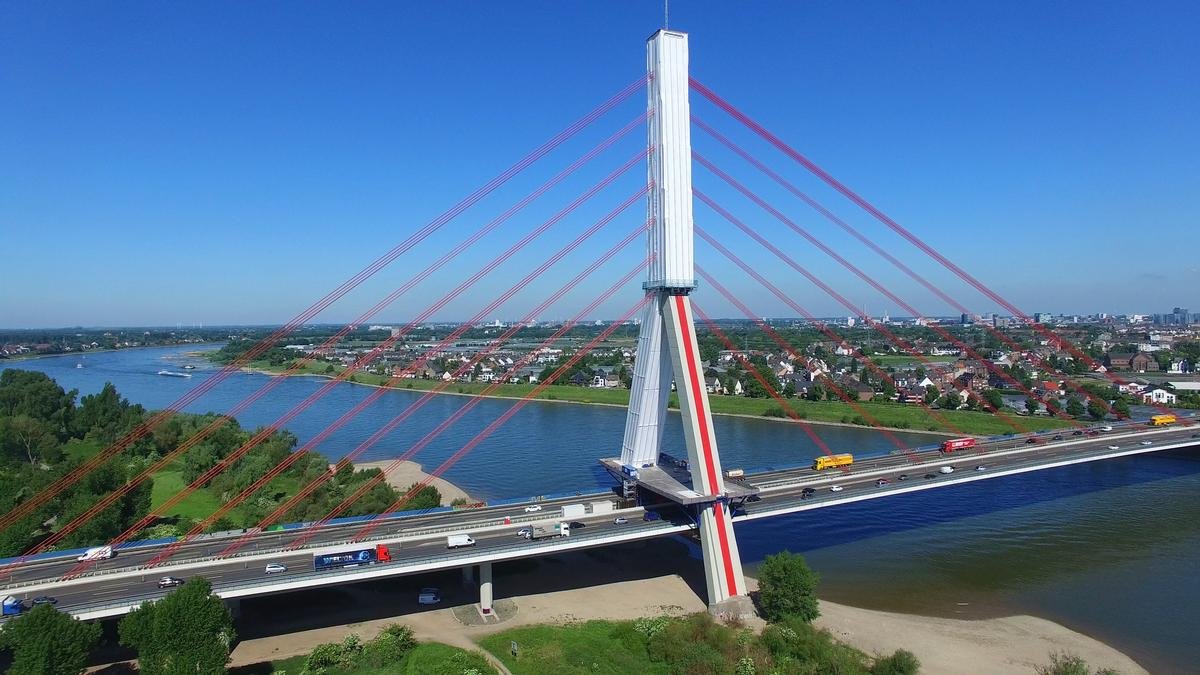
The inverted-Y tower, first used on the Flehe Bridge in Düsseldorf and now standard on many of the tallest crossings, including Msikaba, splits a single shaft into two legs at deck level, combining torsional stiffness with a narrower footprint. Diamond-shaped towers suit sites where deck width varies significantly along the crossing.
Matching cable-stayed bridge towers to the right cable pattern is not a cosmetic exercise; it is one of the clearest cable-stayed bridge advantages available to a design team, since the right pairing reduces steel tonnage in both the tower and the stay system.
Cable-Stayed Bridge Pylon Shapes and Applications
| Tower Shape | Structural Behaviour | Pairs Best With | Notable Example |
| H-Shape | Two near-vertical legs joined by a crossbeam; strong lateral and torsional resistance | Harp or fan arrangements on wide decks | Dames Point Bridge, USA |
| A-Shape | Legs converge at the top, channelling cable forces axially with minimal bending | Fan geometries | Various moderate-span crossings worldwide |
| Inverted-Y | Single shaft splits into two legs at deck level; combines stiffness with a narrower footprint | Long-span, high-clearance crossings | Msikaba Bridge, South Africa |
| Diamond | Splayed profile that adapts to changing deck width | Sites with variable deck geometry | Selected multi-lane and railroad hybrids |
Technical Block: Where Cable-Stayed Bridge Records Are Heading
The record for the longest cable-stayed bridge span has moved five times since the Strömsund Bridge opened in 1956 with a 182-metre main span, and the pace of change has accelerated rather than slowed. Tracking the longest cable-stayed bridges in the world over that period is really a history of cable-stayed bridge engineering catching up with, and then overtaking, what suspension design could offer at a fraction of the cost.
Record Spans and What the Pipeline Looks Like
The Changtai Yangtze River Bridge now holds the longest span of any cable-stayed bridge at 1,176 metres, having displaced the Russky Bridge in Vladivostok, which held the record at 1,104 metres from 2012 until 2025. That record will not stand for long. The Guanyinsi Yangtze River Bridge is under construction with a 1,160-metre span, and the Ma’anshan Yangtze River Rail-Road Bridge will push the main span to 1,120 metres across two navigation channels.
Beyond China, the Gordie Howe International Bridge between Detroit and Windsor and Russia’s Lena Bridge near Yakutsk both demonstrate that cable-stayed bridge construction is scaling up on multiple continents at once, not just along the Yangtze corridor. Every list of the longest cable-stayed bridges in the world published in the next five years will need a fresh edit, which says as much about the pace of cable-stayed bridge engineering as any single record does. Wind behaviour on these taller towers is now a first-order design concern, a subject our article on bridge aerodynamics and wind-load engineering addresses directly.
Longest Cable-Stayed Bridges: Record Holders and Pipeline
| Bridge | Location | Main Span | Status |
| Changtai Yangtze River Bridge | Jiangsu, China | 1,176 m | Completed 2025 (current world record) |
| Guanyinsi Yangtze River Bridge | Hubei, China | 1,160 m | Under construction |
| Ma’anshan Yangtze River Rail-Road Bridge | Anhui, China | 1,120 m | Under construction, triple-tower rail-road-metro deck |
| Russky Bridge | Vladivostok, Russia | 1,104 m | Completed 2012 (former world record) |
| Sutong Yangtze River Bridge | Jiangsu, China | 1,088 m | Completed 2008 |
| Gordie Howe International Bridge | Detroit–Windsor, USA/Canada | 853 m | Under construction |
| Msikaba Bridge | Eastern Cape, South Africa | 580 m | Under construction |
Conclusion: The Default Choice for Modern Long-Span Crossings
Cable-stayed bridges have earned their growth the hard way, through decades of projects that proved the design cheaper to build, faster to erect, and stiffer in service than the alternatives across the span range that most crossings actually need. The self-anchoring principle that removes the need for massive ground anchorages, combined with balanced cantilever erection that turns permanent cables into temporary works, gives cable-stayed bridge construction a structural and commercial edge that suspension bridges cannot match below roughly 1,200 metres and that beam or truss systems cannot match above roughly 200 metres.
That advantage is not confined to China’s river-crossing programme. Msikaba Bridge shows African infrastructure planners reaching the same conclusion for a gorge crossing on the Wild Coast, and procurement teams from Detroit to Yakutsk are specifying cable-stayed bridge design for engineering economics rather than trend-following.
Anyone still asking why cable-stayed bridges are growing in popularity needs only compare a project’s anchorage bill, construction schedule, and maintenance forecast against a suspension alternative of the same length; the advantages of cable-stayed bridge design show up in every column. As span records continue to climb toward the 1,200-metre ceiling, cable-stayed bridges will keep absorbing projects that once defaulted to suspension design, cementing their position as the fastest-growing bridge type in modern cable-stayed bridge construction.
Explore More of Bridge Engineering
Cable-stayed bridges are transforming long-span construction worldwide. Explore Construction Frontier: Engineering Fundamentals for expert technical analysis, engineering deep dives, and project reviews covering bridge design, structural systems, construction methods, and record-breaking bridge megaprojects.