Bridge and Tunnel Megaprojects: 9 Remarkable Engineering Feats Driving the Future of Infrastructure
Bridge and tunnel megaprojects represent the outer edge of what civil engineering can achieve, from the 57-kilometre Gotthard Base Tunnel carved through the Swiss Alps to the 625-metre-high Huajiang Grand Canyon Bridge suspended over a Chinese gorge. This article profiles nine of the world’s greatest bridge projects and large-scale tunnel engineering achievements, examining the design decisions, construction methods, and cost structures that enabled each.
Technical Snapshot: Nine Bridge and Tunnel Megaprojects at a Glance
| Gotthard Base Tunnel | 57.09 km, the world’s longest and deepest rail tunnel, with a final cost of CHF 12.2 billion |
| Hong Kong-Zhuhai-Macau Bridge | 55 km bridge-tunnel system, USD18.8 billion, includes a 6.7 km immersed tunnel |
| Akashi Kaikyō Bridge | 1,991 m central span, world’s longest suspension span for 24 years, USD 3.6 billion |
| Øresund Link | 15.9 km combined bridge, island, and tunnel, approximately USD 3.7 billion |
| Channel Tunnel | 50.5 km undersea rail tunnel linking the UK and France, GBP 4.65 billion original cost |
| Strait of Messina Bridge | Proposed 3,300 m single-span suspension bridge, EUR 13.5 billion budget |
| Brenner Base Tunnel | 64 km binational Alpine rail tunnel, EUR 10.5 billion projected cost |
| Huajiang Grand Canyon Bridge | 625 m deck height, 1,420 m main span, world’s highest bridge |
| Fehmarnbelt Fixed Link | 18 km immersed tunnel under construction, EUR 10 billion, opening targeted 2029 |
Introduction: Bridge and Tunnel Megaprojects
Every generation of engineers inherits a shortlist of crossings that earlier generations considered impossible. Today, that list is being rewritten by bridge-and-tunnel construction megaprojects that combine immersed-tube tunnelling, deep Alpine boring, and record-breaking suspension spans within a single decade.
This pillar article sits within Construction Frontier’s wider examination of mega-infrastructure in bridges and tunnels. Readers who want a fuller technical grounding in how these crossings are actually built should consult our related article on 10 undersea tunnel engineering construction methods, which breaks down the construction techniques referenced throughout this article.
Nine projects anchor this review of the world’s greatest bridge projects and large-scale tunnel engineering: the Gotthard Base Tunnel, the Hong Kong-Zhuhai-Macau Bridge, the Akashi Kaikyō Bridge, the Øresund Link, the Channel Tunnel, the Strait of Messina Bridge, the Brenner Base Tunnel, the Huajiang Grand Canyon Bridge, and the Fehmarnbelt Fixed Link. Together, they illustrate how bridge and tunnel megaprojects address geology, geography, and economics at a continental scale.
Defining Bridge and Tunnel Megaprojects in the Modern Era
A bridge-and-tunnel megaproject is generally defined by three characteristics: a construction cost exceeding USD 1 billion, a multi-decade planning and delivery timeline, and an engineering challenge with no direct precedent at the time the project is approved. Major bridge and tunnel engineering projects rarely fail because of a single technical hurdle. They succeed or fail based on how well financing, geology, politics, and construction sequencing are integrated from the outset.
The nine case studies that follow were selected because each one pushed a different boundary. Some extended the maximum span length achievable with suspension cables. Others proved that immersed tube tunnelling could cross open straits previously considered too deep or too exposed. A handful of bridges and tunnels were combined into a single corridor, switching between structural types as geography, shipping lanes, and aviation corridors demanded. Reviewed together, they form a working catalogue of how large-scale tunnel engineering and long-span bridge design have evolved since the late twentieth century.
1. The Gotthard Base Tunnel: Switzerland’s Alpine Breakthrough
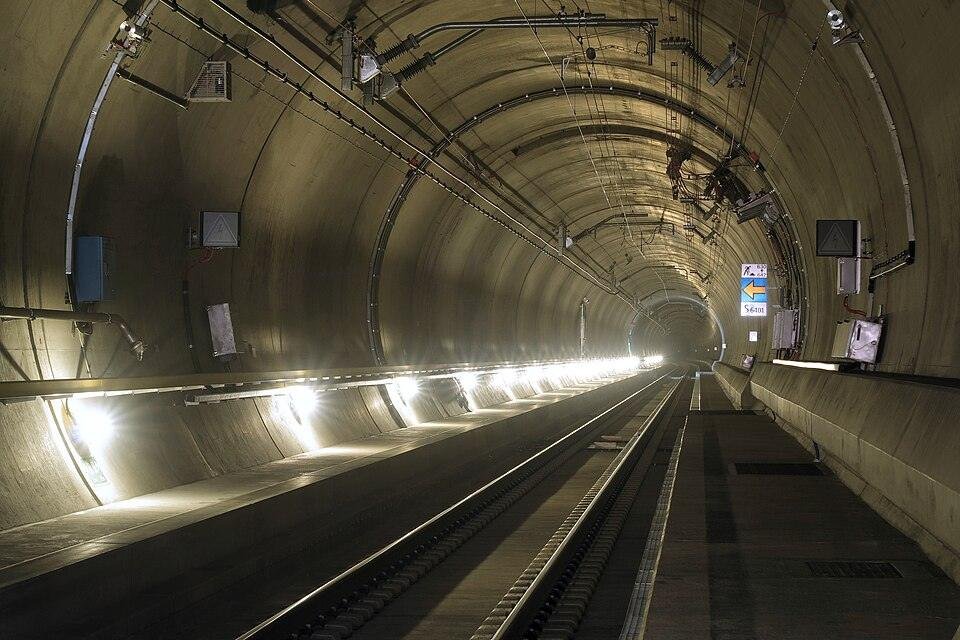
The Gotthard Base Tunnel is the centrepiece example among bridge and tunnel megaprojects built to solve a transport bottleneck rather than to set a single headline record. Running 57.09 kilometres between Erstfeld and Bodio, it is the world’s longest railway tunnel and, at a maximum overburden of roughly 2,300 metres, also its deepest.
Switzerland’s voters approved the New Railway Link through the Alps programme in 1992, and excavation began in earnest under AlpTransit Gotthard AG, a subsidiary of Swiss Federal Railways. Four Herrenknecht gripper tunnel boring machines, each over 400 metres long when fully equipped, handled roughly 80 percent of the excavation through hard granite and gneiss; the remaining 20 percent, through weaker sedimentary zones, was advanced by conventional drill-and-blast methods.
Two single-track tubes run in parallel, connected by cross passages every 325 metres for emergency egress, with multifunction stations at Sedrun and Faido allowing trains to switch tubes during maintenance or incident response. Rock temperatures reached 44 degrees Celsius at the deepest sections, forcing engineers to design ventilation and cooling systems capable of operating continuously over a tunnel length that exceeds the distance between most major European city pairs.
Construction took 17 years from the start of preparatory works and excavated roughly 28.2 million tonnes of rock, much of which was recycled into the concrete lining. The final cost reached approximately CHF 12.2 billion, including financing charges and inflation, against an original 1998 budget of CHF 9.7 billion. Since opening in 2016, the tunnel has increased freight capacity on the Rotterdam-to-Genoa corridor from roughly 180 to 260 trains per day while cutting the trans-Alpine passenger journey by around 40 minutes, demonstrating how large-scale tunnel engineering can convert a geological obstacle into a permanent economic asset.
2. The Channel Tunnel: Engineering Breakthroughs Beneath the English Channel
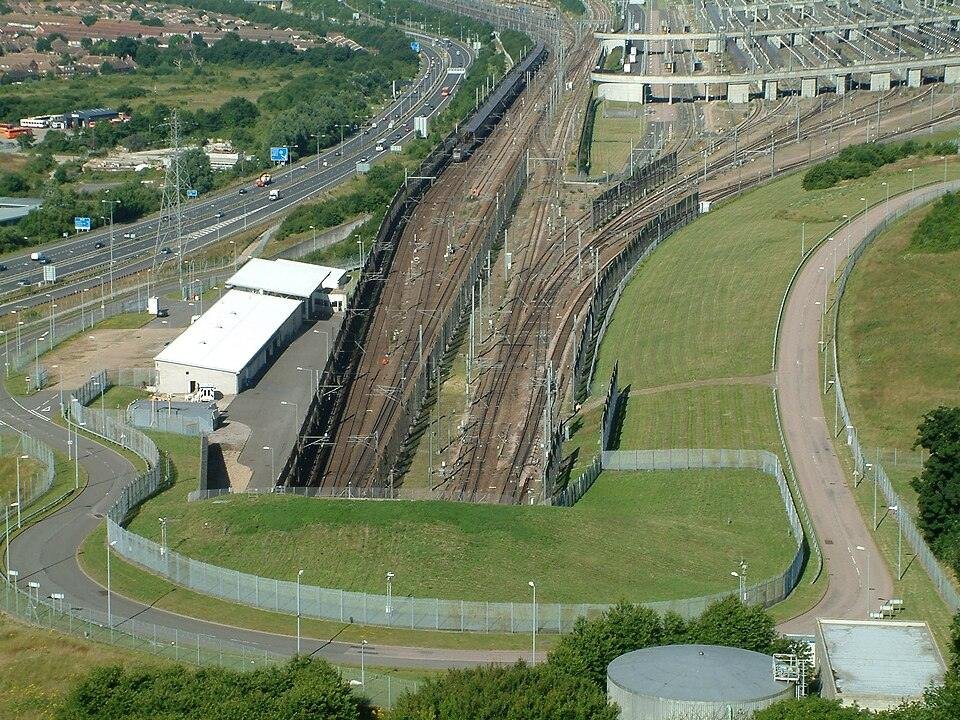
No discussion of bridge and tunnel megaprojects is complete without the Channel Tunnel, the 50.5-kilometre rail link between Folkestone in England and Coquelles in France that proved a long, deep undersea bore could be delivered as a binational infrastructure project. Our article about the construction of the Channel Tunnel, which covers its engineering breakthroughs beneath the English Channel, details the construction sequencing, but several facts are essential to this overview.
Eleven tunnel boring machines, working from both the English and French coasts simultaneously, excavated three parallel bores: two rail tunnels and a smaller service tunnel used for ventilation, drainage and emergency access. The English and French drives met beneath the seabed in 1990, with a horizontal alignment error of less than 36 centimetres over a combined 38-kilometre undersea section. This tolerance remains a textbook reference for precision in large-scale tunnel engineering.
The project was privately financed through Eurotunnel, and construction costs roughly doubled from the original GBP 4.65 billion estimate due to design changes, safety upgrades following fire-risk reviews, and financing costs incurred during a longer-than-planned construction period from 1988 to 1994. The chalk marl geology beneath the Channel proved well suited to tunnel-boring-machine excavation, but the project’s financial structure left Eurotunnel managing substantial debt for years after opening.
Today, the tunnel carries Eurostar passenger services and Eurotunnel Le Shuttle vehicle trains, moving both people and freight beneath one of the world’s busiest shipping lanes without interrupting maritime traffic at the surface. The Channel Tunnel remains one of the most ambitious bridge-tunnel engineering projects completed in the twentieth century, and its financing lessons continue to shape how governments structure newer bridge and tunnel megaprojects such as the Fehmarnbelt Fixed Link.
Further Reading: Channel Tunnel: 10 Proven Engineering Breakthroughs Behind the World’s Most Iconic Cross-Border Link
4. The Øresund Link: A Bridge That Becomes a Tunnel
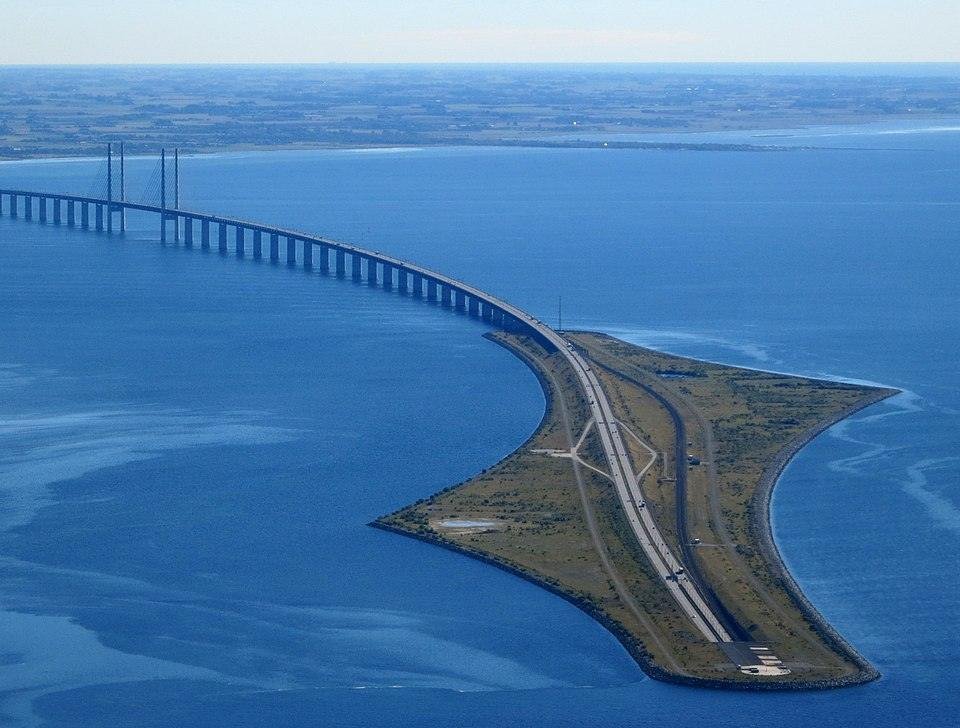
The Øresund Link, connecting Copenhagen in Denmark to Malmö in Sweden, demonstrates how bridge and tunnel megaprojects often switch structural form mid-crossing to satisfy competing constraints. The 15.9-kilometre link combines a 7.85-kilometre cable-stayed bridge, the 4-kilometre artificial island of Peberholm, and a 3.51-kilometre immersed tunnel beneath the Drogden shipping channel.
Engineers chose the tunnel section specifically to avoid two conflicts that a continuous bridge could not resolve: interference with aircraft approaching nearby Copenhagen Airport, and obstruction of a strait used heavily by both commercial shipping and seasonal ice floes. The tunnel was assembled from 20 prefabricated concrete elements, each 176 metres long and weighing around 55,000 tonnes, floated into position and sunk into a dredged trench on the seabed. This method has since become standard reference practice for large-scale tunnel engineering worldwide.
The Øresund Bridge section carries four road lanes above two rail tracks on a single-girder deck supported by twin 204-metre cable-stayed towers, with a main span of 491 metres and a vertical clearance of 57 metres for ships. Construction ran from 1995 to 1999 and finished three months ahead of schedule despite the discovery of 16 unexploded Second World War bombs on the seabed during dredging.
Total cost reached approximately DKK 30.1 billion, or roughly USD 3.7 billion at the time, and was financed jointly by the Danish and Swedish governments and repaid through tolls. The link now carries a fibre-optic data backbone alongside road and rail traffic, and its successful combination of bridge, island, and tunnel has directly informed the design of the Fehmarnbelt Fixed Link discussed later in this article.
5. The Hong Kong-Zhuhai-Macau Bridge: Engineering Across the Pearl River Delta
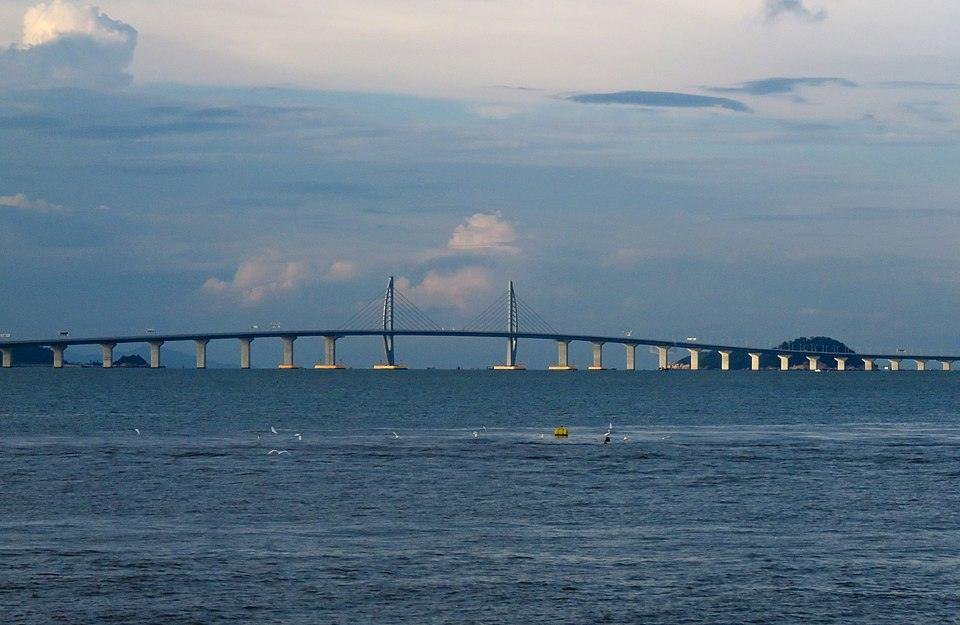
Few bridge and tunnel construction megaprojects illustrate hybrid design as clearly as the Hong Kong-Zhuhai-Macau Bridge. The 55-kilometre crossing links three jurisdictions across the Pearl River estuary using a sequence of structural types: three cable-stayed bridges, a 6.7-kilometre immersed-tube tunnel, and four artificial islands that manage the transitions between them.
The 29.6-kilometre Main Bridge section, built by mainland Chinese authorities, carries the most demanding engineering load. Its cable-stayed spans range from 280 to 460 metres, and the structure was designed to withstand magnitude-8 earthquakes and typhoon winds of up to 340 kilometres per hour, conditions typical of the South China Sea but rarely combined in a single design brief. The undersea tunnel section, built to keep the busy Lingding shipping channel open during construction and operation, remains the longest immersed tunnel ever built for road traffic.
Two artificial islands, nicknamed the Blue Dolphin and White Dolphin islands for the dolphin-shaped towers that mark the bridge-to-tunnel transitions, were reclaimed specifically to manage this changeover and to protect the endangered Chinese white dolphin population in the estuary. Construction began in December 2009 and was completed in February 2018, after roughly 9 years of work involving more than 420,000 tonnes of steel plate.
The total project cost reached approximately ¥127 billion, or roughly USD 18.8 billion, funded by a mix of government contributions from Beijing, Guangdong, Hong Kong, and Macau, as well as bank financing. The bridge is designed for a 120-year service life and now carries cross-border traffic that previously required a multi-hour ferry crossing, cutting the journey between Hong Kong and Zhuhai to around 45 minutes and reinforcing its status as one of the largest bridge-and-tunnel infrastructure projects in the world.
3. The Akashi Kaikyō Bridge: World’s Longest Suspension Span
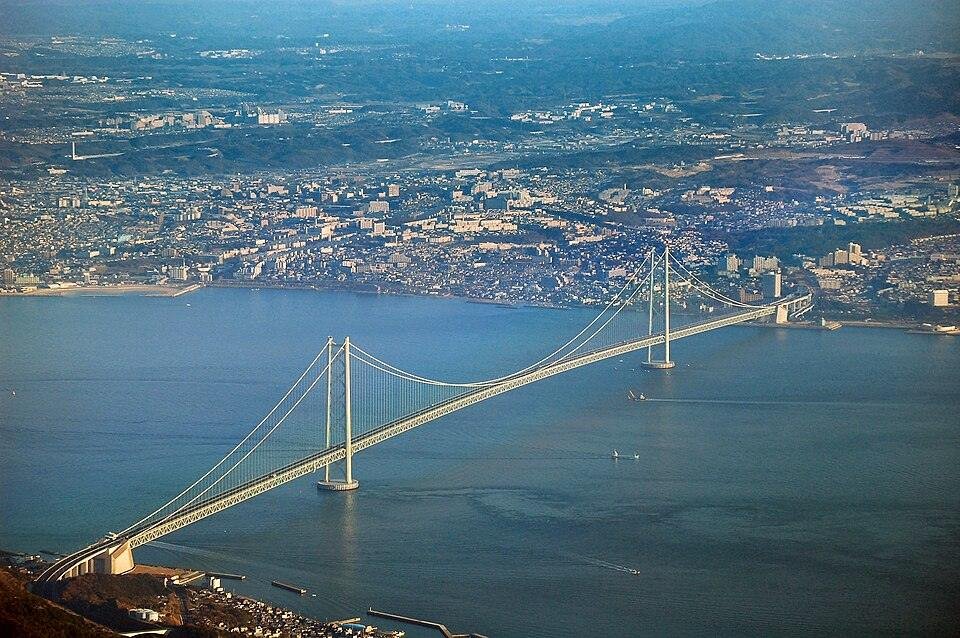
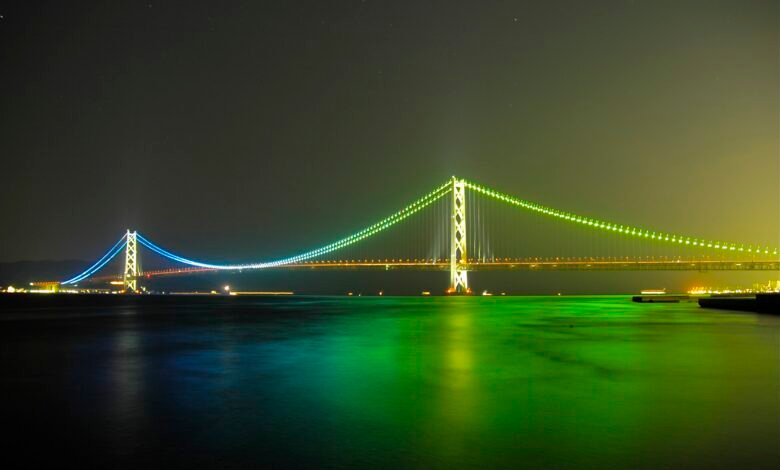
Japan’s Akashi Kaikyō Bridge remains one of the most cited examples among iconic bridge and tunnel infrastructure projects worldwide, holding the record for the longest central suspension span on Earth for nearly a quarter of a century. Its 1,991-metre central span, flanked by two 960-metre side spans, crosses the Akashi Strait between Kobe on Honshu and Iwaya on Awaji Island.
The bridge exists because of repeated maritime disasters on the strait, including the 1955 Shiun Maru ferry sinking that killed 168 people and pushed the Japanese government toward a permanent fixed crossing. Design studies conducted through the 1960s and 1970s recommended a central span of 1,950 to 2,050 metres to balance construction costs with the need to keep the strait fully navigable for shipping beneath the deck.
Two main towers rise 282.8 metres above the strait, anchored by cables containing roughly 300,000 kilometres of wire across 36,830 individual strands per cable. The original 1,990-metre span design had to be revised mid-construction after the 1995 Great Hanshin earthquake shifted the partially built towers apart by approximately one metre, lengthening the final span to 1,991 metres without requiring a redesign of the foundations already in place.
Engineers built the bridge to withstand winds of up to 286 kilometres per hour and earthquakes measuring up to magnitude 8.5, using a dual-hinged stiffening girder system and tuned mass dampers tuned to the structure’s resonance frequency. Completed in 1998 after a decade of construction at a total cost of roughly USD 3.6 billion, the Akashi Kaikyō Bridge remains a benchmark whenever engineers discuss the seismic design achievements of the world’s greatest bridge megaprojects.
6. The Strait of Messina Bridge: Europe’s Most Ambitious Crossing
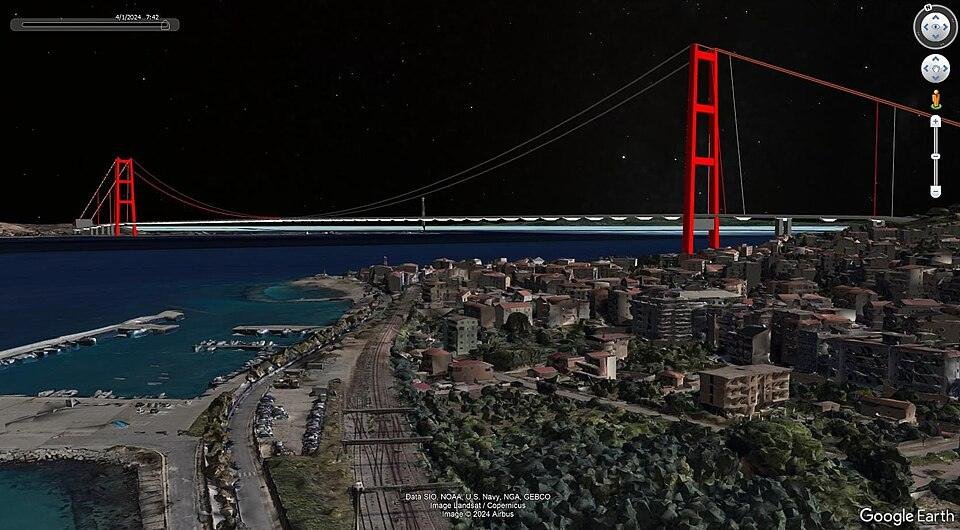
The Strait of Messina Bridge, intended to link Sicily to mainland Italy across one of the Mediterranean’s most seismically active straits, represents a different category among bridge and tunnel megaprojects: a project repeatedly approved, defunded, and revived over five decades. Our dedicated article, the Mega Strait of Messina Bridge in Italy, traces the verified data behind the current design.
As currently approved, the bridge would carry a single 3,300-metre suspension span, making it the longest in the world by a significant margin over the Çanakkale 1915 Bridge. The design must reconcile two demanding constraints: the strait sits on an active seismic fault zone capable of producing earthquakes above magnitude 7, and the crossing must withstand wind speeds exceeding 250 kilometres per hour, generated by the strait’s funnel effect.
Stretto di Messina SpA, the public body overseeing the project, has worked with contractor Webuild Group and undergone review by Italy’s CIPESS infrastructure committee, with a current budget estimate of roughly EUR 13.5 billion. The project’s history of cancellation and revival, most notably a 2013 suspension followed by a 2023 to 2024 relaunch under updated seismic and aerodynamic standards, illustrates how political continuity can matter as much as engineering feasibility for the largest bridge and tunnel infrastructure projects in the world.
If completed, the Strait of Messina Bridge would close one of the last major gaps in southern Europe’s road and rail network, connecting Sicily directly to the mainland high-speed corridor for the first time. Engineers studying the project closely are watching how its seismic isolation systems and deep caisson foundations compare with those used on the Akashi Kaikyō Bridge, given the broadly similar offshore conditions both projects had to address.
Further Reading: Strait of Messina Bridge: 7 Remarkable Engineering Challenges Behind Italy’s Most Ambitious Megaproject
7. The Brenner Base Tunnel: Deep Alpine Crossing for the Twenty-First Century
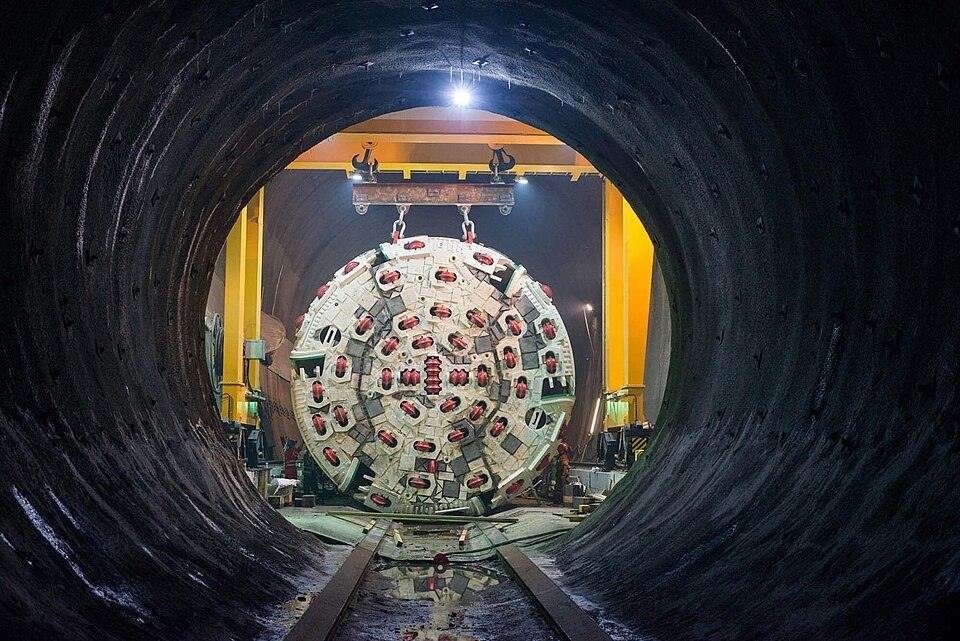
The Brenner Base Tunnel, under construction between Innsbruck in Austria and Fortezza in Italy, extends the same Alpine base-tunnel logic that made the Gotthard Base Tunnel possible into a binational governance structure managed jointly by Austria and Italy. Construction details, including the tunnel boring machine fleet and ground-freezing techniques used in fault zones, are covered in our Brenner Base Tunnel review article.
At a projected 64 kilometres, including its access tunnel, the Brenner Base Tunnel will overtake the Gotthard Base Tunnel as the world’s longest railway tunnel once complete. The project is managed by BBT SE, a joint venture structured to give Austria and Italy equal governance over a single cross-border construction programme. This arrangement has had to navigate differing national procurement rules, safety codes, and labour regulations throughout delivery.
Construction lots have advanced through fault zones, requiring ground-freezing techniques to stabilise unstable rock before boring could proceed, alongside conventional tunnel-boring-machine excavation through more stable sections. Progress through 2025 has confirmed the tunnel’s main bores will connect in multiple lots, with the full opening still targeted for the early 2030s and a current projected cost of approximately EUR 10.5 billion, shared between the two governments and European Union infrastructure funding.
Once operational, the Brenner Base Tunnel will remove a significant Alpine bottleneck on the Munich-to-Verona freight corridor, shifting substantial truck traffic off the Brenner Pass motorway and reducing the steep gradients that currently limit train length and speed on the existing surface line. Its binational governance model, similar in spirit to the joint Danish-Swedish structure behind the Øresund Link, has become a reference case for how future cross-border bridge and tunnel megaprojects might be financed and managed.
8. The Huajiang Grand Canyon Bridge: Engineering at Record Height
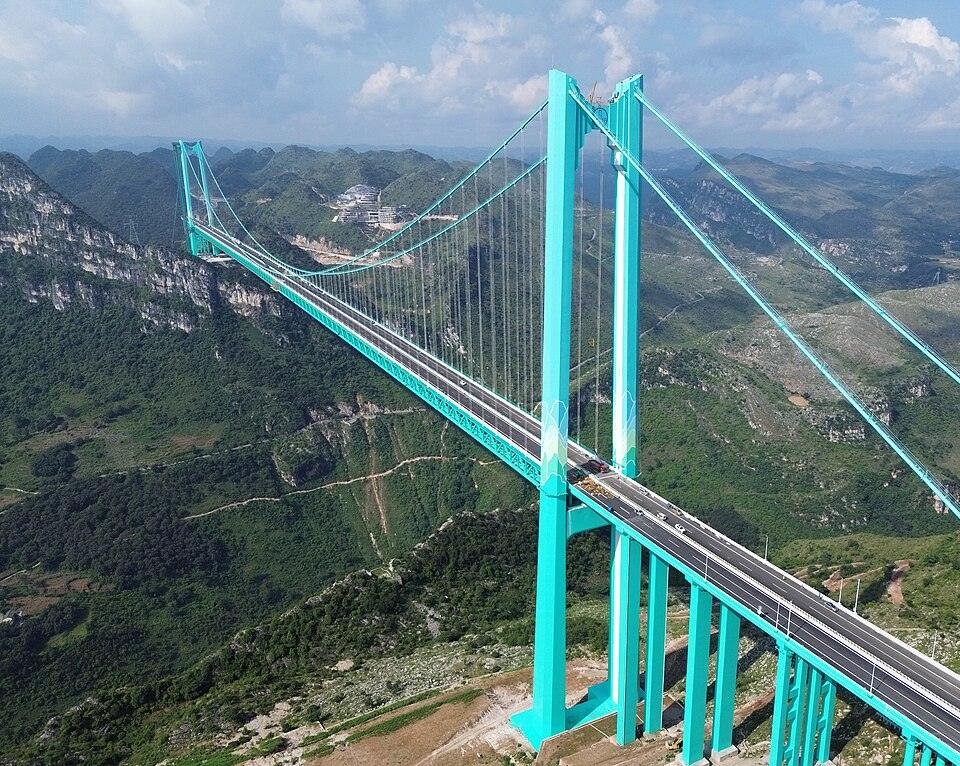
Opened in September 2025, the Huajiang Grand Canyon Bridge in China’s Guizhou province is the most recent addition among the world’s greatest bridge projects. Currently, it holds the title of the world’s highest bridge. Its deck sits 625 metres above the Beipan River, roughly nine times the height of San Francisco’s Golden Gate Bridge above water.
The bridge spans the Huajiang Grand Canyon, an 80-kilometre karst gorge nicknamed the Earth’s Crack, with a main suspension span of 1,420 metres, supported by two towers measuring 262 and 205 metres, respectively. Engineers selected a steel truss suspension system rather than a standard suspension deck specifically to manage the severe crosswind turbulence generated by the canyon’s depth, embedding fibre-optic sensors directly into the main cables to monitor stress, temperature, and humidity in real time.
Construction began in January 2022 and ran for roughly three years and eight months, using satellite positioning and drone-guided survey work to achieve millimetre-level placement accuracy more than 600 metres above the canyon floor. A load test in August 2025, using 96 trucks carrying a combined weight exceeding 3,300 tonnes, confirmed the structure’s performance ahead of opening to traffic.
Beyond its primary transport function, cutting the canyon crossing time from two hours to roughly two minutes, the bridge has been designed as a tourism asset, with a glass observation deck, a high-speed elevator to a café positioned roughly 800 metres above the valley floor, and a dedicated bungee jumping platform. The project demonstrates how modern bridge and tunnel megaprojects increasingly combine pure transport infrastructure with deliberate destination design, a pattern likely to recur in future African megaprojects seeking to combine connectivity with tourism revenue.
9. The Fehmarnbelt Fixed Link: Europe’s Next Mega Tunnel
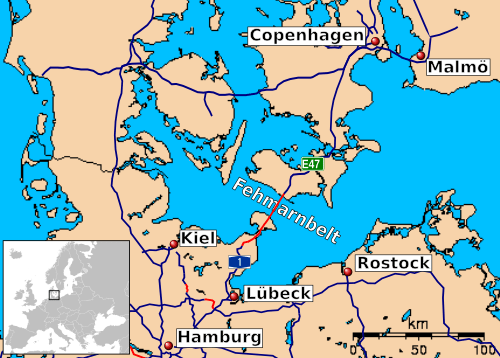
The Fehmarnbelt Fixed Link, currently under construction between Denmark and Germany, will become Europe’s longest immersed road and rail tunnel once it opens, and it is profiled alongside several comparable European crossings in our detailed article on the next generation of Europe’s mega tunnels.
At approximately 18 kilometres, the tunnel will connect the Danish island of Lolland to the German island of Fehmarn beneath the Baltic Sea, replacing a ferry crossing that currently takes around 45 minutes with a fixed rail and motorway link expected to take roughly seven minutes by train and ten minutes by car. Like the Øresund Link before it, the project relies on the immersed tube method, with prefabricated concrete elements cast onshore in a purpose-built factory before being floated out and sunk into a dredged trench on the seabed.
The current project budget stands at approximately EUR 10 billion, financed primarily by the Danish state with support from the European Union’s Trans-European Transport Network programme, reflecting the corridor’s importance to freight movement between Scandinavia and continental Europe. Completion is currently targeted for 2029, after which the Fehmarnbelt link is expected to increase road traffic on the existing Øresund Link by an estimated 1,000 vehicles per day.
As the most advanced of the next-generation undersea tunnel engineering projects currently under construction in Europe, the Fehmarnbelt link offers a useful preview of how immersed tunnel techniques refined at the Øresund Strait and in the Hong Kong-Zhuhai-Macau Bridge project continue to scale upward in length and complexity, reinforcing the case for treating bridge and tunnel megaprojects as a continuously evolving engineering discipline rather than a series of isolated achievements.
Further Reading: Europe Mega Tunnels: 8 Remarkable Next-Generation Projects Redefining Cross-Border Infrastructure
Comparing the World’s Greatest Bridge and Tunnel Megaprojects: Engineering Approaches
Placed side by side, these nine bridge and tunnel megaprojects offer a useful lens for ranking the world’s greatest bridge and tunnel megaprojects’ engineering approaches by cost efficiency, technical risk, and delivery timeline. The table below summarises how each project was financed and how long it took from approval to opening, before the subsections that follow examine financing, technical precedent, scale, and regional implications in turn.
| Gotthard Base Tunnel | Public financing, Swiss state. 17 years of construction, opened in 2016. |
| Hong Kong-Zhuhai-Macau Bridge | State-backed, tri-jurisdictional funding. 9 years of construction, opened in 2018. |
| Akashi Kaikyō Bridge | Public financing, Honshu-Shikoku Bridge Authority. 10 years of construction, opened in 1998. |
| Øresund Link | Public, binational toll-backed financing. 5 years of construction, opened in 2000. |
| Channel Tunnel | Private concession, Eurotunnel. 6 years of construction, opened in 1994. |
| Strait of Messina Bridge | Public financing, Stretto di Messina S.p.A., under relaunched approval, not yet built. |
| Brenner Base Tunnel | Binational public financing, BBT SE. Under construction, targeted for the early 2030s. |
| Huajiang Grand Canyon Bridge | State financing, Guizhou provincial authorities. 3.7 years of construction, opened in 2025. |
| Fehmarnbelt Fixed Link | Public financing, Danish state, and EU support. Under construction, targeted 2029. |
Financing Models and Delivery Risk
Every bridge and tunnel megaproject, from construction cost and design reviews, eventually returns to the same question: should a government finance the crossing directly or transfer construction risk to a private concession that recovers its investment through tolls? The Akashi Kaikyo Bridge and the Hong Kong-Zhuhai-Macau Bridge were funded largely through public and state-backed financing. In contrast, the Channel Tunnel’s private financing model left its operator carrying debt well beyond the original projection. Any bridge-and-tunnel megaproject construction cost and design assessment commissioned today, including for proposed African sea crossings, should carefully weigh these historical financing outcomes before settling on a delivery model.
Records and Technical Precedents
Among the most ambitious bridge and tunnel megaprojects completed in the past three decades, three stand out for solving a problem that had no direct precedent at the time of approval: the Akashi Kaikyo Bridge’s 1,991-metre span, the Channel Tunnel’s 50.5-kilometre undersea bore, and the Gotthard Base Tunnel’s 2,300-metre rock overburden. Each of these most ambitious bridge tunnel engineering projects required purpose-built equipment, extended testing programmes, and, in two cases, an entirely new regulatory framework before construction could begin.
Scale, Investment, and Tourism Value
Viewed as a single body of work, these nine bridge-and-tunnel megaprojects also represent some of the largest in the world, both in length and total investment. The Hong Kong-Zhuhai-Macau Bridge and the Brenner Base Tunnel alone account for close to USD 30 billion in combined construction value, underscoring why governments increasingly treat the largest bridge and tunnel infrastructure projects in the world as long-term economic assets rather than simple transport links. The same logic increasingly applies to mega-infrastructure projects, such as bridges and tunnels proposed across Africa, where a single crossing can reshape regional trade flows for a century.
Three of the nine projects, the Huajiang Grand Canyon Bridge, the Hong Kong-Zhuhai-Macau Bridge and the Akashi Kaikyo Bridge, have also become recognised tourism destinations in their own right, joining a select group of iconic bridge and tunnel infrastructure projects worldwide that attract visitors specifically to experience the engineering rather than simply to cross it. This dual identity, functional infrastructure, and global landmark is becoming a deliberate design objective rather than an accidental byproduct for newer iconic bridge and tunnel infrastructure projects worldwide, still in planning.
Implications for Africa’s Bridge and Tunnel Pipeline
Africa’s own pipeline of major bridge and tunnel engineering projects remains comparatively young by global standards, but the financing lessons from Europe and Asia apply directly. Public-private partnership structures similar to those used at the Oresund Link and the Brenner Base Tunnel offer a tested template for major bridge and tunnel engineering projects spanning national borders on the continent, particularly where two governments must share both cost and operating responsibility for a single crossing.
Mega-infrastructure in bridges and tunnels also depends heavily on the depth and quality of geotechnical survey work completed before construction begins. Every project reviewed in this article, from the Brenner Base Tunnel’s fault-zone ground freezing to the Huajiang Grand Canyon Bridge’s wind-tunnel testing, spent years on site investigation before the first tunnel boring machine or bridge tower foundation was approved. This pattern holds across virtually all mega-infrastructure in bridges and tunnels currently under construction worldwide, and it is a discipline African project sponsors are increasingly adopting as local seismic and hydrological data sets improve.
Bridge and tunnel megaprojects: engineering challenges and solutions of this scale ultimately depend on a sponsor’s willingness to fund decades of preparatory investigation before a single metre of tunnel is bored or a single bridge tower is poured. Every case in this review of bridge and tunnel megaprojects: engineering challenges and solutions confirms that the most expensive mistakes are almost always made during planning, not during construction. Treating bridge and tunnel megaprojects: engineering challenges and solutions as a planning discipline first, rather than purely a construction discipline, remains the clearest lesson this body of work offers to the next generation of engineers, financiers, and policymakers evaluating similar bridge and tunnel construction megaprojects on new corridors.
For African infrastructure planners studying these precedents, the practical takeaway is straightforward: the world’s greatest bridge projects succeeded because sponsors matched the engineering ambition to a financing structure capable of absorbing decades of cost and political risk. The next wave of bridge-and-tunnel construction megaprojects, wherever they are built, will be judged by the same standard.
Lessons for the Next Generation of Bridge and Tunnel Megaprojects
The nine case studies in this article on bridge and tunnel megaprojects are not simply a list of records. Read together, they form a practical playbook that engineers, financiers, and policymakers can apply to the next wave of bridge and tunnel megaprojects, wherever they are proposed. The following subsections draw out the recurring lessons on reference precedent, financing discipline, public perception, and sponsor strategy.
Building a Reference Library for Future Projects
Engineers writing technical retrospectives on the world’s greatest bridge and tunnel megaprojects’ engineering achievements tend to circle back to the same handful of case studies cited throughout this article, precisely because so few crossings combine record-breaking scale with full public cost transparency. Treating these nine schemes as the current benchmark for the world’s greatest bridge and tunnel megaproject engineering practice gives planners on other continents, including across Africa, a realistic cost and schedule baseline rather than an aspirational one.
Any serious bridge and tunnel megaproject construction cost and design study commissioned for a new African sea crossing should begin by benchmarking against the nine projects covered here, since bridge and tunnel megaproject construction cost and design decisions made at the feasibility stage tend to lock in roughly 70 to 80 percent of a project’s eventual financial outcome before construction even begins.
Financing Discipline as the Common Denominator
Among the most ambitious bridge tunnel engineering projects completed since 1990, the financing structure proved just as decisive as geology in determining final delivery cost, and the most ambitious bridge tunnel engineering projects completed on schedule were, almost without exception, those backed by stable, long-term public financing rather than short-term private debt.
This recurring pattern is exactly what the earlier technical block in this article means by ‘bridge and tunnel megaprojects: engineering challenges and solutions’. The engineering challenges are rarely unique, but the solutions only work when matched to a financing model built for a multi-decade horizon, which is the core argument running through this entire bridge-and-tunnel megaprojects: engineering challenges and solutions review.
From Infrastructure to Icon
Several of the nine crossings reviewed here, most notably the Akashi Kaikyo Bridge, the Hong Kong-Zhuhai-Macau Bridge and the Huajiang Grand Canyon Bridge, have entered popular culture as iconic bridge and tunnel infrastructure projects worldwide in a way that pure transport statistics rarely capture, and that visibility has measurably increased public and political support for funding further iconic bridge and tunnel infrastructure projects worldwide in the regions where they were built.
A Practical Framework for Sponsors
Project sponsors evaluating new major bridge and tunnel engineering projects rarely start from a blank page. The nine schemes profiled in this article form a working reference library, and any team scoping major bridge and tunnel engineering projects today can compare proposed span lengths, ground conditions, and financing structures directly against known precedents. This is precisely why Construction Frontier treats mega-infrastructure in bridges and tunnels as a continuous editorial beat rather than a one-off news category, since it evolves through incremental engineering gains rather than sudden leaps.
When industry commentators rank the world’s greatest bridge projects, they typically weigh four factors: span or length record, seismic and wind resilience, financing structure, and long-term economic return. Applying that same framework consistently across future proposals, rather than judging each new scheme in isolation, is the clearest way to keep the world’s greatest bridge projects list honest and comparable from one decade to the next.
Finally, it is worth reiterating that bridge and tunnel construction megaprojects succeed only when patient, well-structured financing matches engineering ambition. Every one of the bridge-and-tunnel construction megaprojects reviewed here took at least a decade from approval to opening, and most took considerably longer. Sponsors who accept that timeline upfront, rather than underestimating it for political convenience, give their own bridge-and-tunnel construction megaprojects the best chance of completing close to budget.
Construction Frontier will continue tracking the world’s largest bridge and tunnel infrastructure projects as new milestones are reached, particularly as African governments begin scoping their own largest projects along the continent’s busiest trade and migration corridors. The construction methods proven at Gotthard, Akashi, Hong Kong-Zhuhai-Macau, Øresund, the Channel, Messina, Brenner, Huajiang, and Fehmarnbelt now form the shared technical vocabulary for that next chapter of bridge and tunnel megaprojects, wherever in the world they are eventually built.
Taken together, this body of work confirms that the world’s greatest bridge and tunnel megaproject engineering case studies share more in common across continents than the headlines about any single record usually suggest, and that the largest bridge and tunnel infrastructure projects in the world keep proving the same financing and geological lessons in new geographic settings.
A final point worth stressing for any team scoping a bridge and tunnel megaproject construction cost and design package, or reviewing a list of the most ambitious bridge and tunnel engineering projects completed elsewhere, is that documentation discipline during construction pays for itself many times over once a structure enters its decades of operational life, which is exactly the pattern this bridge and tunnel megaprojects: engineering challenges and solutions review has tried to demonstrate across all nine iconic bridge and tunnel infrastructure projects worldwide covered above.
Technical Block: Engineering Challenges and Solutions Behind Bridge and Tunnel Megaprojects
When reviewed together, these nine case studies of bridge and tunnel megaprojects reveal recurring engineering challenges that any such programme must address, regardless of geography. The following subsections summarise the three challenge categories that determined success or delay across all nine projects, before closing with the implications for project sponsors planning the next generation of large-scale tunnel engineering and long-span bridge construction.
1. Geological and Seismic Engineering Challenges
Five of the nine bridge and tunnel megaprojects profiled here, the Gotthard Base Tunnel, the Akashi Kaikyō Bridge, the Strait of Messina Bridge, the Brenner Base Tunnel, and the Huajiang Grand Canyon Bridge, were built in active seismic or geologically unstable zones. Engineers responded with dual-hinged stiffening girders, tuned mass dampers, ground-freezing techniques in fault zones, and deep caisson foundations rated for magnitude-8 events, proving that seismic resilience can be engineered into bridge and tunnel megaprojects without abandoning record-breaking span or length ambitions.
2. Cost, Financing, and Economic Structuring
The construction costs and design decisions of bridge and tunnel megaprojects are inseparable. Privately financed projects such as the Channel Tunnel carried higher financial risk and ultimately higher debt burdens than publicly financed equivalents, such as the Gotthard Base Tunnel or Øresund Link, which spread costs across national budgets and recovered investment over decades of toll revenue. The binational governance models used at the Brenner Base Tunnel and the Øresund Link, which split costs and decision-making evenly between two states, have become the preferred template for newer projects, including the Fehmarnbelt Fixed Link.
3. Materials and Construction Methods Innovation
Immersed tube tunnelling, first proven at scale on projects like the Øresund Link, now underpins the Hong Kong-Zhuhai-Macau Bridge’s undersea section and the Fehmarnbelt Fixed Link currently under construction. Tunnel boring machine technology advanced from the Channel Tunnel’s eleven-machine fleet to the Gotthard Base Tunnel’s four gripper machines capable of working continuously through hard granite. Suspension bridge cable technology, meanwhile, progressed from the Akashi Kaikyō Bridge’s 36,830 strands per cable to the fibre-optic sensor-embedded cables now standard on projects such as the Huajiang Grand Canyon Bridge.
Conclusion: Turning High-Risk Megaprojects into Successful Crossings
Bridge and tunnel megaprojects continue to expand in scale, ambition, and technical sophistication, and the nine projects reviewed here, drawn from Switzerland, China, Japan, Scandinavia, the English Channel, Italy, and the Alps, demonstrate that no single engineering discipline holds a monopoly on innovation. Engineers and investors evaluating the next wave of major bridge and tunnel engineering projects, including those proposed across Africa’s emerging infrastructure corridors, can draw directly on the financing structures, geological solutions, and construction methods proven across this body of work.
For a broader survey of how undersea engineering specifically continues to evolve, readers can consult our article on undersea tunnels and sea crossings, which places these nine bridge and tunnel megaprojects within the wider cluster of sea crossing engineering covered on Construction Frontier. What ultimately separates a successful crossing from a stalled one is rarely the underlying technology, since tunnel boring machines, immersed tube elements, and suspension cable systems are now mature, well-documented tools available to any sufficiently resourced sponsor.
The deciding factor is almost always the strength of the financing structure and the political patience to see a multi-decade programme through to completion, exactly the pattern visible across the Gotthard Base Tunnel, the Øresund Link, and the Brenner Base Tunnel. As Africa’s own infrastructure ambitions grow, the nine bridge and tunnel megaprojects profiled in this article offer a tested reference point for engineers, financiers, and policymakers preparing to deliver the continent’s own version of these landmark crossings.
Explore the World’s Greatest Bridge and Tunnel Engineering Projects
The future of global connectivity is being shaped by extraordinary bridges, tunnels, and megaprojects built across the world’s most challenging environments. Continue exploring Construction Frontier: Global Mega Projects’ technical deep dives into record-breaking crossings, advanced construction methods, and the engineering decisions behind the infrastructure transforming how people and economies connect.