Huajiang Grand Canyon Bridge: Engineering the World’s Highest Bridge, 625m, in China’s Guizhou Province
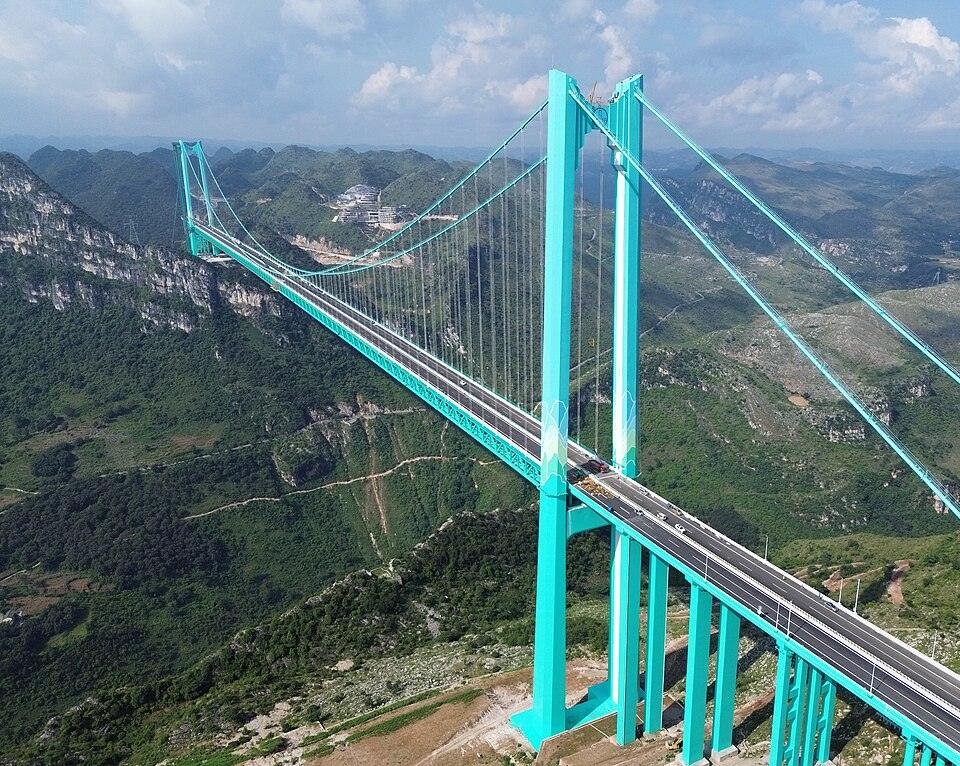
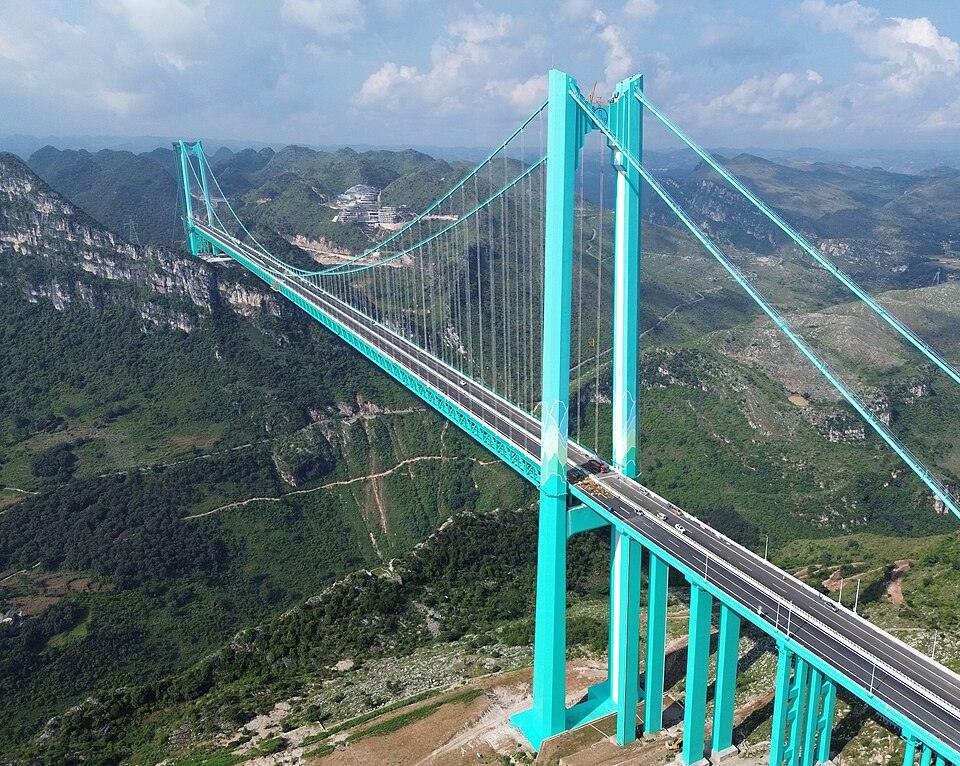
The Huajiang Grand Canyon Bridge in Guizhou Province, China, opened on 28 September 2025 as the world’s highest bridge, with its deck soaring 625 metres above the Beipan River. Constructed in just over three years at a cost of 2.1 billion RMB, the 2,890-metre suspension structure carries the S57 Liuzhi-Anlong Expressway across a canyon known locally as the Earth Crack, slashing a two-hour mountain crossing to under two minutes. It holds two simultaneous world records: the greatest deck height of any bridge ever built and the longest main span of any bridge constructed in mountainous terrain.
Technical Snapshot: Huajiang Bridge Core Project Specifications
| Specification | Detail |
| Official Name | Huajiang Grand Canyon Bridge (花江峡谷大桥) |
| Location | Guanling County–Zhenfeng County, Guizhou Province, China |
| Height Above River | 625 metres (2,051 ft) — world record |
| Total Length | 2,890 metres |
| Main Span | 1,420 metres — world record for mountainous terrain |
| Bridge Type | Steel truss-stiffened suspension bridge |
| North Tower Height | 262 metres above the foundation |
| South Tower Height | 205 metres above the foundation |
| Steel Truss Weight | Approximately 22,000 metric tons (93 segments) |
| Cable Wire Tensile Strength | 2,000 MPa (40,000 wires per cable) |
| Structural Sensors | 2,380 FBG sensors for continuous real-time monitoring |
| Lanes | 4 lanes (dual carriageway) |
| Construction Start | 18 January 2022 |
| Opened | 28 September 2025 |
| Construction Cost | 2.1 billion RMB (approx. USD 290 million) |
| Contractor | Guizhou Road & Bridge Group Co., Ltd. |
| Patents Generated | 21 (17 invention patents, 4 utility model patents) |
The Huajiang Grand Canyon Bridge closes the final gap in the S57 Liuzhi-Anlong Expressway and confirms Guizhou’s position as the world’s foremost proving ground for extreme-altitude bridge engineering. It builds directly on the technical lineage established by its predecessor on the same river, the Beipanjiang Bridge, and represents the state of the art for the discipline examined in The World’s Greatest Bridge and Tunnel Megaprojects: Engineering at the Limits of Possibility.
Introduction: The Huajiang Grand Canyon Bridge and the World’s Highest Bridge Record
The Huajiang Grand Canyon, carved by the Beipan River through Guizhou’s limestone plateau, drops nearly 1,000 metres from canyon rim to riverbed in places. Engineers studying the crossing for the S57 Liuzhi-Anlong Expressway surveyed the gorge five to ten kilometres upstream and downstream before confirming a site. The terrain left no room for compromise: the deck elevation had to be at least 1,100 metres above sea level to clear the canyon walls, placing the structure 625 metres above the river below.
No bridge in history has been built at this height. The Huajiang Grand Canyon Bridge superseded the Beipanjiang Bridge, which sat 60 metres lower on the same river system and held the world record from 2016. For readers working through the world’s greatest bridge and tunnel megaprojects, the Huajiang structure represents the current outer boundary of what bridge engineering has achieved: 625 metres of clearance, a 1,420-metre suspended span, and a three-and-a-half-year construction programme in one of the world’s most technically demanding environments. This article examines how that boundary was reached.
Structural Design: Why a Suspension Bridge Was the Only Viable Solution
The design team evaluated every viable structural system before selecting a steel truss-stiffened suspension bridge. A cable-stayed configuration would have demanded a central tower approaching 500 metres to achieve the necessary span, a height that exceeds current global construction limits for tower structures. Beam and arch designs are limited to spans of approximately 330 and 600 metres, respectively, both well short of what the canyon width demanded. Suspension bridging with a stiffened steel truss was the only configuration that balanced span capacity, structural stability, and construction feasibility at this crossing.
The main span of 1,420 metres is 10 metres longer than the Humber Bridge in the United Kingdom, which held the world record for the longest suspension bridge span for 17 years. At the Huajiang Canyon, the span length was not a design ambition: it was the minimum required to clear the gorge. The asymmetric canyon walls drove a further design constraint. The steeper north slope required a tower 262 metres tall, while the south tower reaches 205 metres, producing an asymmetric configuration that demanded separate stability calculations for each side of the suspended span.
The steel truss deck comprises 93 prefabricated reinforced steel segments with a combined weight of approximately 22,000 metric tonnes, equivalent to the structural steel in three Eiffel Towers. Each segment was manufactured off-site and transported by road convoy to the canyon edge before installation. The suspension cables are each composed of 40,000 high-strength steel wires with a tensile strength of 2,000 megapascals per wire, a specification derived directly from the load calculations for a 1,420-metre span at this altitude and under Guizhou’s wind loading conditions.
Structural Design: Huajiang vs. Previous Guizhou Height Records
| Bridge | Height Above River | Main Span |
| Huajiang Grand Canyon Bridge (2025) | 625 metres | 1,420 metres |
| Beipanjiang Bridge/Duge (2016) | 565 metres | 720 metres |
| Pingtang Bridge (2020) | 305 metres | 1,450 metres |
| Liuguanghe Bridge (2019) | 297 metres | 800 metres |
| Millau Viaduct, France (2004) | 343 metres | 342 metres (longest span) |
Construction Methodology: Precision Engineering 600 Metres Above the Ground
Building the world’s highest bridge in 43 months required construction systems that did not exist before the project began. The Huajiang programme generated 21 patents, including 17 invention patents covering structural, mechanical, and monitoring innovations developed by Guizhou Road & Bridge Group specifically to address problems posed by the canyon environment. Several of these techniques have since been incorporated into China’s national bridge engineering standards.
1. Site Survey and Foundation Engineering
Engineers conducted aerial surveys using drone technology across a ten-kilometre corridor of the Beipan River canyon before confirming the crossing location. The canyon walls are composed of porous, erosion-prone limestone, requiring specialised foundation anchoring solutions for both towers. The north tower’s 262-metre height imposed exceptional compressive and lateral loads on the foundation system, requiring rock anchors and bearing designs specifically developed for the site’s geological profile.
2. Tower Construction and BeiDou Positioning
Both towers rose from opposite canyon walls using China’s BeiDou Navigation Satellite System for real-time positioning during construction. BeiDou provided 3D spatial tracking at millimetre-level precision throughout the pour sequence, a critical requirement given that a structural deviation of even a few centimetres at tower base level would propagate to span-level geometric errors that no subsequent adjustment could correct. Wind speeds in the canyon regularly exceeded force 12 on the Beaufort scale during construction, requiring the team to develop purpose-built heavy-duty climbing scaffolding capable of operating under sustained extreme wind loading.
3. Fourth-Generation Intelligent Cable Hoisting System
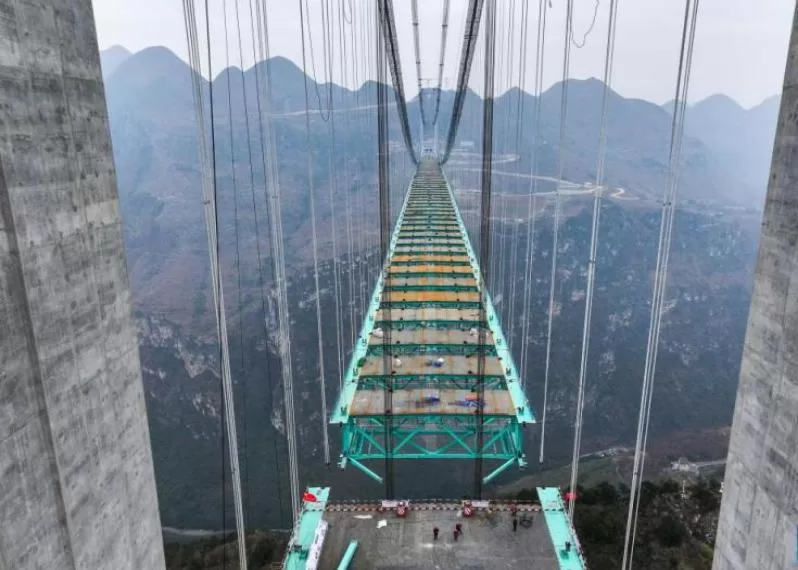
The Huajiang team developed the fourth-generation intelligent cable hoisting system to install the suspension cables and steel truss segments 600 metres above the valley floor. The system integrates high-definition cameras (LiDAR), BeiDou satellite positioning, and Internet of Things (IoT) connectivity to execute millimetre-precision assembly without requiring workers to operate freely in the open canyon airspace. The lifting and docking process was reduced by one hour per segment compared to previous-generation systems. The complete 93-segment steel truss was assembled in 73 days, a construction rate that required the hoisting system to perform flawlessly across every lift.
4. Steel Truss Assembly and Incremental Erection
The 93 steel truss segments arrived by road convoy and were lifted into position using the intelligent hoisting system from both canyon ends simultaneously, closing toward a central connection joint. BIM modelling provided the three-dimensional positional reference for every lift, with Doppler LiDAR scanning confirming actual structural geometry against the digital model before each segment was fixed in place. Fibre Bragg grating sensors were embedded in three of the 217 cable strands during installation to enable live monitoring of cable force distribution from the day of commissioning.
5. Load Testing and Commissioning
A rigorous five-day load test in August 2025 deployed 96 heavy trucks across the bridge in pre-defined configurations to simulate real-world traffic stress. Engineers measured deflection and vibration responses against the structural model predictions throughout the test programme. Successful completion cleared the bridge for public opening on 28 September 2025.
Construction Challenge Matrix: Conditions and Engineering Responses
| Challenge | Specific Condition | Engineering Response |
| Canyon wind loading | Force 12+ Beaufort winds during construction phases; crosswind turbulence is unpredictable in the U-shaped gorge | Purpose-built heavy-duty climbing scaffolding rated for extreme wind; all-weather intelligent hoisting system with real-time abort protocols |
| Asymmetric tower heights | North slope steepness required a 262 m tower; south tower 205 m; asymmetric loads on suspension geometry | Separate stability and load calculations per tower; asymmetric cable geometry modelled in BIM before any steel was placed |
| Foundation geology | Porous, erosion-prone limestone on both canyon walls; conventional anchoring is insufficient | Site-specific rock anchoring systems per tower; geological survey extended 10 km upstream and downstream to confirm optimal crossing location |
| High-altitude truss assembly | 93 steel segments, each up to 215 tons, lifted 600 m above the valley floor | Fourth-generation intelligent cable hoisting with BeiDou positioning and HD camera monitoring; 73-day truss assembly programme |
| Material logistics | No road access for heavy plant; narrow mountain tracks to both canyon walls | Prefabrication off-site; road convoy delivery to canyon edge; helicopter supplementary logistics for equipment and personnel |
| Environmental protection | Fragile canyon ecosystem; construction waste management at altitude | Drone aerial survey replacing ground-clearing; recycled construction waste materials; wind-solar complementary lighting system installed post-completion |
Engineering Innovations: 21 Patents and New National Standards
The Huajiang Grand Canyon Bridge generated 21 patents across structural, mechanical, digital, and environmental categories. Several of these innovations have been incorporated directly into China’s national bridge engineering standards, establishing the project not merely as a record-setter but as a technical reference point that will shape the next generation of high-altitude bridge construction.
The fourth-generation intelligent cable hoisting system is the programme’s most significant mechanical advance. Previous generations of cable hoisting required manual verification of positioning at each stage of the lift, limiting precision and exposing workers to open-air conditions at extreme heights. The fourth-generation system uses BeiDou satellite positioning, high-definition cameras, and IoT connectivity to enable fully monitored, one-click hoisting with millimetre-level accuracy, eliminating the need for manual verification and reducing each lift cycle by 1 hour.
The 2,000-megapascal suspension cable wire specification advances the tensile strength standard for main cable wires beyond previous project benchmarks. Each of the bridge’s two main cables comprises 40,000 individual wires at this specification, delivering the load-carrying capacity required for a 1,420-metre span without increasing the cable diameter to a point that would compromise the structure’s aerodynamic performance. Research on high-performance steel wire applications in long-span suspension bridges documents the development of China’s bridge engineering materials capability that produced this specification.
The 2,380-sensor fibre Bragg grating monitoring network provides continuous real-time data on temperature, humidity, and stress across the entire structure. Unlike conventional strain gauge systems, FBG sensors are immune to electromagnetic interference and maintain calibration accuracy across extreme temperature ranges, making them the correct choice for a mountain bridge exposed to 25-degree-plus thermal gradients between deck level and valley floor. Structural health monitoring frameworks for cable-stayed bridges provide the academic basis for the predictive maintenance architecture implemented by the Huajiang system.
Doppler LiDAR scanning provided structural geometry verification at each stage of the steel truss installation, confirming the actual assembly position against the BIM model before any segment was permanently fixed. This closed-loop verification system, combining satellite positioning, laser scanning, and digital modelling, reduced the risk of cumulative geometric error across 93 sequential lifts, a risk that would have been unmanageable using conventional survey methods at this altitude and in these wind conditions.
Innovation Summary: Key Technologies and Their Structural Function
| Technology | Function at Huajiang | Standard / Patent Status |
| Fourth-generation intelligent cable hoisting | Millimetre-precision segment lifting at 600 m height; 1-hour reduction per lift cycle; 73-day full truss assembly | New national bridge engineering standard |
| BeiDou satellite positioning | Real-time 3D spatial tracking during tower construction and truss assembly; millimetre-level accuracy | Incorporated into China’s infrastructure construction standards |
| 2,000 MPa cable wire specification | 40,000-wire main cables providing load capacity for 1,420 m span without aerodynamic penalty from increased cable diameter | Invention patent |
| 2,380-sensor FBG monitoring network | Continuous real-time temperature, humidity, and stress data from commissioning; electromagnetic-interference immune | 17 invention patents; new national standard |
| Doppler LiDAR geometry verification | Structural geometry confirmed against the BIM model at each of 93 truss lifts; eliminates cumulative error risk | Utility model patent |
| Wind-solar complementary lighting | Post-completion lighting system eliminating grid dependency in a remote gorge environment; reduces operational carbon footprint | Utility model patent |
Regional and Economic Impact: Guizhou’s Connectivity Transformation
Guizhou Province covers 92% of its territory with mountain terrain and has historically ranked among China’s poorest provinces. Before the Huajiang Grand Canyon Bridge, crossing the Beipan River canyon between the Liuzhi Special District and Anlong County required either a two-hour mountain road detour or the use of deteriorating switchback routes. The bridge reduces the crossing time to under two minutes, a 60-fold reduction in journey time that transforms the region’s economic geography.
The S57 Liuzhi-Anlong Expressway, which the Huajiang bridge completes, integrates previously isolated townships into Guizhou’s provincial expressway network and connects the Qianxinan prefecture directly to Guiyang, Anshun, and the province’s economic centres. World Bank analysis of infrastructure-driven development in China’s western regions confirms that connectivity infrastructure of this type directly reduces the cost of goods distribution, opens new markets for local producers, and enables economic activity patterns that geographic isolation would otherwise make structurally impossible.
Zhang Yin, deputy director of Guizhou’s transport department, stated at the bridge’s opening that the structure would make enormous improvements to regional transportation conditions and inject new impetus into regional economic and social development. Local officials project growth in tourism, logistics, and commercial activity across the communities now connected by the expressway corridor. Guizhou already hosts over 32,000 bridges, up from approximately 2,900 in the 1980s, and the province’s aggressive bridge construction programme has accompanied a sustained reduction in rural poverty across the same period.
The bridge also improves access to Guizhou’s expanding data centre sector. The province’s cool temperatures and rich geological resources make it a cost-effective location for heavy-duty server infrastructure, and expressway connectivity to the region’s data centre clusters has strategic value for China’s digital economy development programme.
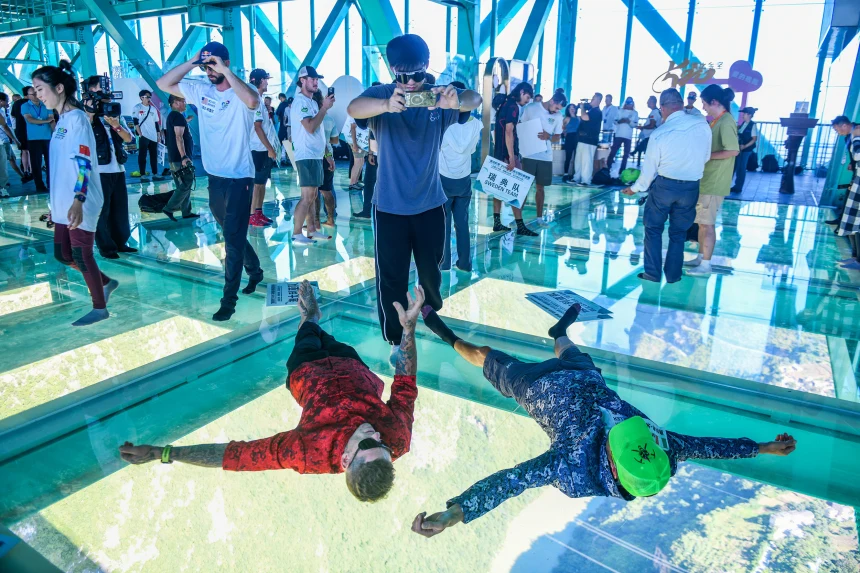
Tourism is a third economic dimension. The Huajiang Grand Canyon Bridge incorporates a 207-metre panoramic sightseeing elevator built into the main tower, a 1,000-square-metre glass observation hall with a direct vertical view of 600 metres to the river, glass-bottom walkways beneath the deck, and plans for the world’s highest bungee jumping platform. Even before these attractions fully opened, thousands of visitors arrived at the canyon daily following the bridge’s inauguration. The dual mandate of infrastructure and destination is deliberate government policy, part of Guizhou’s transportation-plus-tourism integration programme.
A Global Benchmark: What Huajiang Establishes for Bridge Engineering
The Huajiang Grand Canyon Bridge holds both the height record and the mountainous-terrain span record simultaneously. No previous bridge has achieved both at once. The combination matters technically because longer spans at greater heights impose compounded aerodynamic, structural, and construction challenges that neither record alone does. The project’s engineering responses to those compounded challenges, documented across 21 patents and incorporated into national standards, now constitute the reference specification for the next generation of extreme-altitude bridge projects.
The IABSE Special Issue on Recent Structures and Research in China documents how China’s bridge engineering industry completed the transition from international follower to global leader across three phases. The Huajiang Grand Canyon Bridge sits at the frontier of that third phase: not adapting international techniques to Chinese conditions but generating original solutions with no international precedent to draw on.
For engineers and investors assessing comparable terrain challenges in mountainous regions of Africa, Southeast Asia, and South America, the Huajiang project demonstrates that extreme altitude and extreme span can be solved simultaneously, that the construction timeline need not extend beyond three to four years even in logistically hostile terrain, and that the resulting structure can serve both transport and economic development objectives within the same budget envelope. Ninety of the world’s 100 highest bridges are in Guizhou Province. That concentration is not a coincidence: it is the product of methodology, institutional commitment, and accumulated technical knowledge that the Huajiang project represents at its current peak.
Conclusion: The World’s Highest Bridge and the Engineering Logic Behind It
The Huajiang Grand Canyon Bridge did not simply set a height record. It resolved a crossing problem that the terrain of Guizhou’s Beipan River canyon had made structurally unsolvable by any prior construction method. The 625 metres of clearance is a consequence of the canyon’s geology, not a target the project chased. The engineering team’s task was to build the bridge that the canyon required and to do so in under four years, at 2.1 billion RMB, generating the technical innovations necessary to make it safe.
Twenty-one patents and incorporation into national standards confirm that the project succeeded on both counts. The fourth-generation intelligent hoisting system, the 2,000-megapascal cable wire specification, and the 2,380-sensor FBG monitoring network are not engineering curiosities. They are the tools that made this specific structure buildable, and that will make the next generation of comparable projects more achievable than this one was.
The Beipanjiang Bridge held the world record for nine years before Huajiang superseded it on the same river. The next record will also come from Guizhou or from an engineer who studied what Guizhou built. That is the real measure of what the Huajiang Grand Canyon Bridge contributes to the global infrastructure canon: not the number, but the knowledge.
Explore More Bridge and Infrastructure Megaprojects
The Huajiang Grand Canyon Bridge demonstrates how modern engineering continues to push the limits of height, scale, and structural innovation. Explore more record-breaking bridges, tunnels, and infrastructure megaprojects from around the world with Construction Frontier: Mega Projects, your source for in-depth engineering and construction insights.