Fehmarnbelt Tunnel: 7 Proven Reasons This $11BN Mega-Link Will Transform Scandinavia
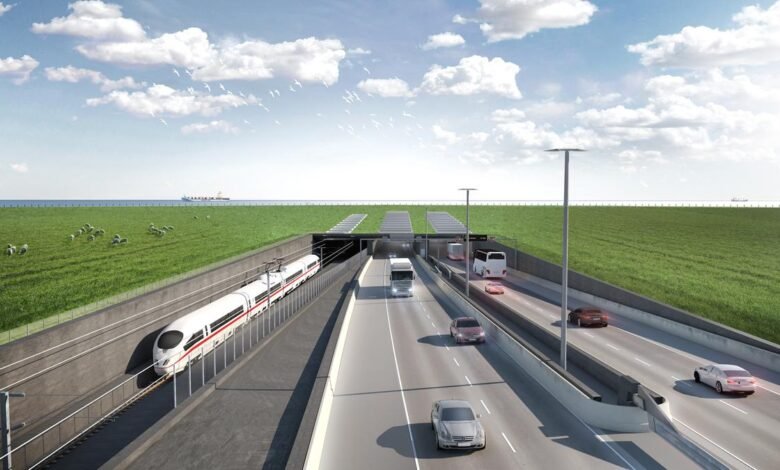
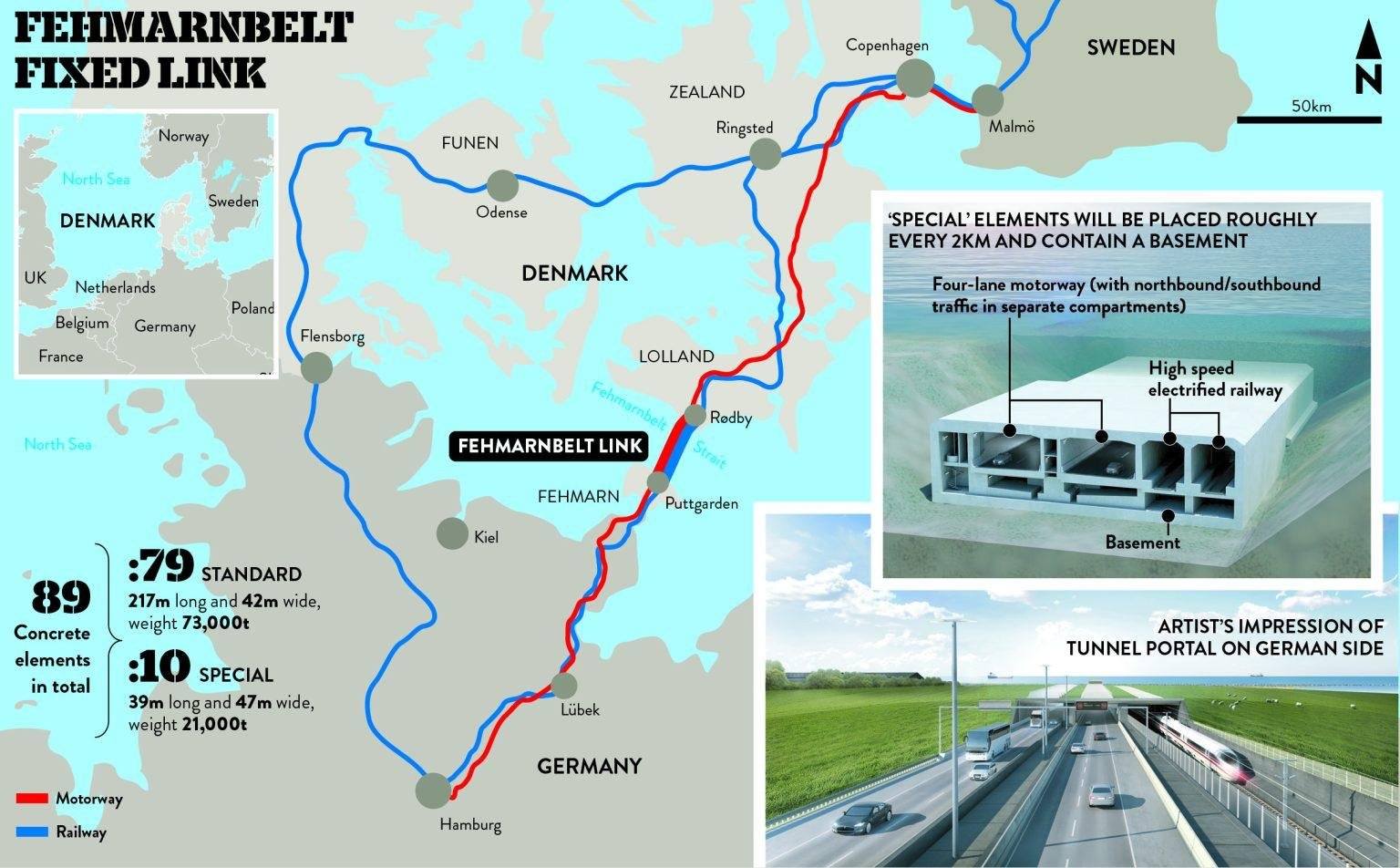
The Fehmarnbelt Tunnel is an 18-kilometre immersed tube tunnel under construction beneath the Baltic Sea, linking Rodbyhavn on the Danish island of Lolland with Puttgarden on the German island of Fehmarn. At a total project cost exceeding 10 billion euros, the Fehmarnbelt Fixed Link will become the world’s longest immersed-tube tunnel and Europe’s longest undersea road and rail tunnel on completion. The Fehmarnbelt Tunnel length and specifications, covering 18 km across five corridors at 40 m depth, include 89 precast elements and define a Denmark-Germany tunnel that cuts the Copenhagen-Hamburg rail journey from 4 hours 40 minutes to 2 hours 30 minutes. The Fehmarnbelt Fixed Link is the largest single infrastructure investment currently active in Europe.
Technical Snapshot: Fehmarnbelt Tunnel Core Project Specifications
| Parameter | Specification |
| Tunnel type | Immersed tube tunnel (five-corridor precast concrete) |
| Fehmarnbelt Tunnel length and specifications | 18 km coast to coast; 40 m max depth; 42 m total width |
| Number of tunnel elements | 89 (79 standard + 10 special) |
| Standard element | 217 m long x 42 m wide x 73,500 t |
| Tunnel corridors | 2 motorway tubes + 2 rail tubes + 1 service tube |
| Rail | Double-track electrified railway |
| Road | Four-lane motorway |
| Tunnel budget | 7.4 billion euros (coast to coast) |
| Total project cost | Approx. 10 billion euros |
| EU CEF funding | 540 million euros (CEF 2, rail component) |
| Trench completed | April 2024 |
| First element cast | May 2024 |
| First immersion expected | Spring 2026 |
| Target opening | Post-2029 (revised schedule pending) |
| Client | Femern A/S, a subsidiary of Sund & Baelt |
| Design life | 120 years |
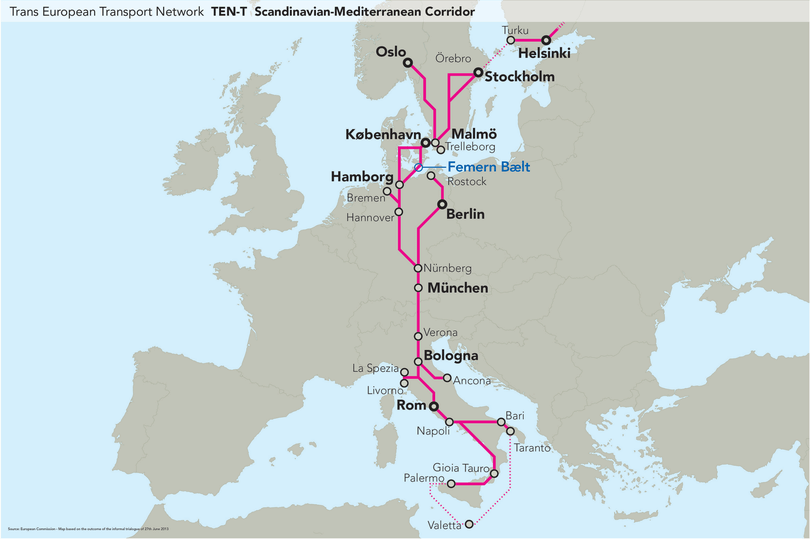
The Fehmarnbelt Fixed Link anchors the EU’s Scandinavian-Mediterranean TEN-T core corridor, closing a structural bottleneck that has constrained rail freight between Central Europe and Scandinavia for decades. When operational, the Fehmarnbelt Tunnel will shift the competitive calculus for road hauliers, ferry operators, and logistics networks across the Baltic. This Denmark-Germany tunnel is a century-scale investment in European connectivity.
Introduction: Fehmarnbelt Tunnel in Scandinavia
Four hundred kilometres of Baltic coastline separate Copenhagen from Hamburg by road. The Fehmarnbelt Tunnel compresses that geography into a seven-minute rail crossing. No infrastructure project on the current European programme changes the freight economics of an entire subcontinent as directly as the Fehmarnbelt Fixed Link, which connects the Nordic market to the continental rail network, removes a 160-kilometre freight detour, and closes the only missing link on the Scandinavian-Mediterranean TEN-T corridor. This is not a regional bypass; it is a structural rerouting of how Europe moves goods and people.
Construction began on 1 January 2021. The first of 89 precast elements was immersed in April 2025. The Denmark-Germany tunnel is being built, and it is being built on schedule for its method even as its programme extends. The immersed tube technique it deploys is one of ten proven construction methods examined in undersea tunnel engineering construction; the Fehmarnbelt Tunnel is where that method reaches its maximum scale. This article examines seven reasons the Fehmarnbelt Fixed Link will transform Scandinavian connectivity: engineering method, construction scale, project challenges, travel-time impact, financing structure, strategic corridor role, and technical innovation.
(Source: Femern A/S)
1. Why an Immersed Tube Tunnel, Not a Bored Tunnel
The Fehmarnbelt Tunnel length and specifications, 18 kilometres of five-corridor precast concrete at 40 metres depth, make the method selection decision consequential. Engineers evaluated TBM boring and the immersed tube method across more than a decade of feasibility work before the 2008 state treaty fixed the alignment. That decision is foundational to understanding Fehmarn Belt crossing engineering. The seabed beneath the Fehmarnbelt consists primarily of soft glacial till, clay, and sand, with Ice Age granite boulders; one recovered during dredging weighed approximately 70 tonnes.
TBMs in soft, waterlogged, mixed-face ground carry elevated risks of cutter-head blockage and face instability. The Fehmarn Belt crossing engineering case for the immersed tube method rests on two compounding advantages: parallel workstreams compress the programme, and the most complex fabrication work occurs in a controlled land environment rather than offshore. Analysed as a Fehmarn Belt crossing engineering decision, the immersed tube method carries lower operational risk and a shorter construction programme than any credible TBM alternative.
How Does an Immersed Tube Tunnel Work: The Fehmarnbelt Workflow
How does an immersed tube tunnel work at the scale of the Fehmarnbelt Tunnel? The Fehmarnbelt Tunnel length and specifications demand a seven-step factory-to-seabed sequence. Engineers cast each element in the purpose-built giga-factory at Rodbyhavn on Lolland, covering approximately 500 hectares across five parallel production lines. Each standard element measures 217 metres in length, 42 metres in width, and weighs 73,500 tonnes. Once fitted with temporary bulkheads, each element floats to the work harbour for interior fit-out, then proceeds to the immersion zone.
How does an immersed tube tunnel work once an element reaches the trench? Ballast tanks are flooded, lowering the element to the pre-dredged seabed. Pontoons IVY 1 and IVY 2 support the element during transport and descent; the Maya pontoon pre-levels a gravel bed; the NP460 spreader locks stone along the sides. Global Navigation Satellite System (GNSS) positions each element to within 12 millimetres. Hydraulic jacks then compress a Gina rubber gasket against the previously placed element; crews pump the inter-bulkhead water out, and Baltic hydrostatic pressure permanently seals the joint.
How does an immersed tube tunnel work across 18 kilometres? How does an immersed tube tunnel work when each immersed tube tunnel in Scandinavia weighs 73,500 tonnes? The answer is the same each time: parallel factory production, precision ballasting, GNSS guidance, and hydrostatic sealing. That seven-step sequence, engineered for this immersed tube tunnel in Scandinavia project, repeats 89 times.
| Phase | Activity | Key Equipment |
| 1. Trench preparation | 18 km trench dredged to 40 m; gravel bed levelled | 70+ vessels at peak; Maya pontoon |
| 2. Element casting | 89 precast elements on 5 parallel production lines | Rodbyhavn giga-factory |
| 3. Float-out | Elements towed to work harbour; interior fit-out | Tugboats; basin infrastructure |
| 4. Immersion | Element lowered; GNSS positioning to 12 mm | IVY 1 and IVY 2 pontoons |
| 5. Joining | Gina gasket compressed; water pumped out; seal formed | Hydraulic jacks; dewatering pumps |
| 6. Backfilling | A stone protection layer placed over the element | NP460 spreader; Wismar pontoon |
Where the Seikan Tunnel in Japan demonstrates what TBM boring achieves in hard igneous rock at 240 metres depth, the Fehmarnbelt Tunnel addresses the opposite challenge: shallow, soft, sediment-dominated ground where open-trench prefabrication carries lower geological risk. Method selection in undersea tunnelling is always geology-led.
2. Scale, World Records, and the 89-Element Assembly
On completion, the Fehmarnbelt Tunnel will claim two concurrent world records: the longest immersed tube tunnel in Europe, carrying both road and rail, and the global record for the longest immersed tube tunnel, surpassing the 9.7-kilometre Marmaray tunnel in Turkey. The longest immersed tube tunnel in Europe’s classification signals strategic centrality within the TEN-T framework to sovereign infrastructure investors, multilateral lenders, and global contractors. According to Femern A/S, all six production lines at the Rodbyhavn factory are now casting elements.
The Denmark to Germany undersea tunnel project requires casting and immersing 89 concrete elements: 79 standard and 10 special elements weighing approximately 21,000 tonnes each. The Denmark-to-Germany undersea tunnel project is a procurement and logistics operation without precedent in immersed tube construction history. Completing the Denmark to Germany undersea tunnel project at its full 18-kilometre length requires the Fehmarnbelt Fixed Link team to immerse a further 88 elements after the first; the longest immersed tube tunnel in Europe record will be secured at the final jointing.
The Fehmarnbelt Tunnel will hold both the longest immersed tube tunnel in Europe records simultaneously on opening: longest by length and longest combined road-rail immersed tube structure. The Fehmarnbelt Tunnel’s length and specifications, covering 18 km across five corridors with 89 elements, give the Denmark-to-Germany undersea tunnel project a dual-record status as Europe’s longest road and rail tunnel undersea that the industry will reference for decades.
3. Engineering Challenges on the Fehmarnbelt Tunnel
The Fehmarnbelt Fixed Link engineering challenges span geotechnical, regulatory, environmental, and operational dimensions. Addressing these Fehmarnbelt Fixed Link engineering challenges at this scale offers direct lessons for the next generation of immersed tube projects in shallow, mixed-geology, environmentally sensitive marine corridors.
Trench Dredging: Geology and Scale
Dredging the 18-kilometre trench required three years and up to 70 vessels simultaneously at peak activity. The seabed ranged from soft clay to hard limestone, with Ice Age granite boulders creating unpredictable obstruction. The completed dredging produced almost 15 million cubic metres of soil, stone, and sand, which will be reused to create approximately 300 hectares of new nature areas. Trench completion in 2024 validated the entire dredging methodology.
The IVY Delay and Revised Programme
The Fehmarnbelt Tunnel construction cost and completion date are under revision as a direct consequence of delays to the custom-built immersion vessel IVY. IVY is a prototype for 73,500-tonne elements at water depths averaging 30 metres, roughly double the Oresund Tunnel element placement depth. According to Sund and Baelt, IVY’s approval ran almost two years behind the original plan. Despite this, the first tunnel element was successfully immersed in April 2025, a significant milestone for the Fehmarnbelt Fixed Link.
The revised Fehmarnbelt Tunnel construction cost and completion date will be published once sufficient elements are in place to confirm the full programme. The Fehmarnbelt Tunnel construction cost and completion date revision does not alter structural or commercial viability; the user-financed debt model absorbs cost increases through an extended repayment period. The 2029 opening target is no longer realistic; the German Federal Ministry of Transport now indicates a 2031 timeline.
The Fehmarnbelt Tunnel construction cost and completion date revision reflect post-contract German regulatory conditions, the COVID-19 pandemic, and the complexity of a first-of-its-kind vessel class. Each of these Fehmarnbelt Fixed Link engineering challenges originated in conditions that postdated the 2016 construction contracts. The Fehmarnbelt Tunnel construction cost and completion date delay extend the repayment period; the project’s financial model was designed to carry it.
Environmental Compliance in German Waters
German federal court approval in November 2020 imposed strict compliance conditions on all work in the Fehmarn Belt area: continuous sediment monitoring, real-time marine wildlife tracking, underwater noise controls, and habitat compensation through new stone reef creation. The noise restrictions proved more stringent than the 2016 contract provisions, creating a regulatory gap requiring ongoing negotiation with German authorities. This constraint affected IVY testing and contributed to the programme delay. Managing this environment is itself a Fehmarnbelt crossing engineering discipline and one of the most consequential Fehmarnbelt Fixed Link engineering challenges the project has faced.
4. The Travel-Time Transformation Across the Baltic
The transport economics of the Fehmarnbelt Tunnel rest on a single measurable outcome: compression of journey time across the Baltic. The current crossing depends on a 45-minute ferry voyage, extending the effective delay beyond 90 minutes at peak season. The Denmark-Germany tunnel eliminates that dependency. The Hamburg-Copenhagen rail journey reduces from four hours and forty minutes to two hours and thirty minutes once the Fehmarnbelt Fixed Link and its hinterland upgrades are fully operational. The belt crossing itself takes seven minutes by train.
Hinterland works are essential to realising the full journey-time benefit. Germany is double-tracking and electrifying the 11.4-kilometre Puttgarden-Fehmarnsund section at a 200 km/h design speed. On the Danish side, a new 110-kilometre double-track line from Ringsted to Rodby is on schedule for 2029. Once both sides are complete, the Fehmarnbelt Fixed Link will operate one passenger train and two freight trains per direction per hour.
| Journey | Current | Post-Tunnel | Reduction |
| Rodbyhavn to Puttgarden (train) | ~60 min (ferry + wait) | 7 minutes | ~53 min |
| Rodbyhavn to Puttgarden (road) | ~60 min (ferry + wait) | 10 minutes | ~50 min |
| Copenhagen to Hamburg (rail) | 4 hrs 40 min | 2 hrs 30 min | ~2 hrs 10 min |
| Road crossing: Scandinavia to Central Europe | Up to 90 min delay | Ferry eliminated | Up to 60 min |
The Denmark-to-Germany undersea tunnel project eliminates a 160-kilometre freight train detour via Storebelt for cargo between Scandinavia and Central Europe. Germany-Scandinavia trade flows exceed 100 billion euros annually; shifting freight to electrified rail reduces both cost and CO2 emissions. The Denmark-Germany tunnel corridor directly supports the EU’s freight decarbonisation targets. As Europe’s longest undersea road and rail tunnel, the Fehmarnbelt Tunnel produces zero direct rail emissions, replacing diesel ferry voyages and heavy truck movements across an additional 160 kilometres of road.
5. Financing: User-Funded, State-Guaranteed, EU-Supported
The Fehmarnbelt Fixed Link is financed without direct cost to Danish taxpayers. Under the 2008 bilateral treaty, Denmark assumed sole financial responsibility for the coast-to-coast Fehmarnbelt Tunnel and its Danish approach infrastructure; Germany finances its hinterland connections independently. Denmark’s model follows the Great Belt Fixed Link and Oresund Link precedents: state-guaranteed loans raised on international capital markets are repaid from tunnel toll revenues. The European Commission confirmed compliance with EU state aid rules in March 2020, classifying the project as an Important Project of Common European Interest.
The EU’s Connecting Europe Facility (CEF) has granted more than 1.28 billion euros across two budget periods for the rail component. The CEF 2 allocation alone totals 540 million euros, covering element production, immersion, tunnel portals, power supply, and environmental monitoring. The project demonstrated a socio-economic return of 4.1% to 4.7% in the EU cost-benefit analysis. Any increase in Fehmarnbelt Tunnel construction cost and completion date extends the repayment period; toll revenues from Europe’s longest road and rail tunnel undersea flow regardless of the opening year, and the Fehmarnbelt Fixed Link financial model remains viable.
6. The TEN-T Corridor: Closing the Scandinavian Gap
The Fehmarnbelt Tunnel is the northernmost physical closure of the Scandinavian-Mediterranean TEN-T corridor, a 7,500-kilometre rail spine connecting Oslo and Stockholm to Valletta via Hamburg, Munich, and Naples. As the longest immersed tube tunnel in Europe, this immersed tube tunnel in Scandinavia converts the corridor from a patchwork of national segments into a competitive intermodal network. The European Commission regards the Fehmarnbelt Fixed Link as one of the five most important cross-border projects on the entire TEN-T network.
The STRING megaregion connecting Hamburg, Copenhagen, Malmo, and Gothenburg captures the most immediate economic benefit; Denmark gains disproportionately as the transit node between Nordic markets and the continent. Europe’s longest road and rail tunnel undersea carries a specific environmental implication: electrified freight trains traversing the Fehmarnbelt Tunnel produce zero direct emissions, replacing diesel ferry voyages across an additional 160 kilometres of road. As the longest immersed tube tunnel in Europe, this immersed tube tunnel in Scandinavia delivers measurable CO₂ reductions from day one of operation.
Europe’s longest road and rail tunnel undersea is simultaneously an economic and environmental infrastructure asset. The Denmark-Germany tunnel closes the TEN-T corridor and shifts the modal balance of Baltic freight trade from diesel road and ferry to electrified rail. Europe’s longest road and rail tunnel undersea supports EU transport sector decarbonisation targets in a way no alternative crossing could.
7. Engineering Innovation: Prefabrication, Precision, and Digital Systems
The Fehmarnbelt Tunnel advances the state of the art in three engineering disciplines simultaneously. For engineers evaluating how an immersed tube tunnel works at scale, the Rodbyhavn factory is the primary answer: five parallel casting lines across a 500-hectare facility produce 73,500-tonne elements with a 120-year design life, decoupling element production from the immersion schedule. The Denmark to Germany undersea tunnel project is consequently as much a manufacturing programme as a construction one, with quality control standards exceeding what any offshore environment permits.
GNSS-guided precision immersion achieves 12-millimetre placement tolerance at 30 metres depth; BIM digital twin modelling, deployed across the full Fehmarnbelt Fixed Link alignment, supports clash detection, construction simulation, and regulatory filing. Together, these innovations establish the Fehmarnbelt Fixed Link as the global reference project for immersed tube tunnel construction in Scandinavia at large sections. How does an immersed tube tunnel work with this precision? IVY, the custom immersion pontoon, is the answer: a purpose-built vessel class the industry did not previously possess.
The Eysturoy Tunnel in the Faroe Islands, the world’s first undersea traffic roundabout, demonstrates what bored tunnelling achieves in hard basalt at moderate depths. The Fehmarnbelt Tunnel operates in the contrasting engineering register: immersed, shallow, factory-prefabricated. Both projects confirm that method selection in undersea tunnelling is geology-led, not preference-led.
Further Reading: Eysturoy Tunnel: The Bold Engineering Breakthrough Behind the World’s First Undersea Roundabout
| Innovation | Technical Detail | Industry Significance |
| Five parallel casting lines | 89 elements concurrently across a 500-ha factory | First, at this element scale; decouples casting from immersion pace |
| Gina gasket sealing | Hydrostatic pressure compresses the rubber gasket to a permanent watertight seal | 120-year design life; adapted from Oresund at 4.6x element mass |
| IVY immersion vessel | Purpose-built prototype for 73,500 t elements at 30 m depth | New vessel class; design template for future large-section IMT tunnels |
| GNSS precision positioning | 12 mm tolerance on seabed placement via embedded sensors | Benchmark for IMT element alignment in open-water conditions |
| BIM digital twin | Full 3D model for clash detection, simulation, and regulatory filing | Largest single BIM application for IMT tunnel design in Europe |
Technical Assessment: Programme, Method, and Outlook
The Fehmarnbelt Tunnel is navigating a genuinely difficult construction period. The IVY delay is confirmed; the 2031 revised opening replaces the original 2029 target; and a full revised schedule is pending. These are real setbacks. They are also normal features of first-generation megaprojects: prototype vessels, novel geology, and post-contract regulatory evolution are inherent risks at this scale. The Fehmarnbelt Fixed Link engineering challenges documented throughout are consequential; none are project-ending.
None of these delays reflects an error in Fehmarn Belt crossing engineering judgement; each originated in conditions that postdated the 2016 contracts. The immersion of the first element in April 2025 confirmed that the Fehmarn Belt crossing engineering fundamentals are sound.
Tunneling Method Validation
The immersed tube method was the correct choice for the Fehmarnbelt Tunnel. Mixed glacial geology, shallow water depth, and the programme benefits of parallel workstreams combine in favour of prefabricated construction over TBM boring. The immersed tube tunnel in Scandinavia, a precedent at Oresund, confirms this method’s durability; the Fehmarnbelt extends it to a scale the industry has not previously built. The Fehmarnbelt Tunnel length and specifications set the ambition; the successful first immersion in April 2025 confirms the engineering logic.
When the full Fehmarnbelt Tunnel length and specifications are assembled in the seabed, those 18 kilometres will validate the immersed tube tunnel in Scandinavia method at a scale it has never been tested before and will define the benchmark for every large-section immersed tube project that follows.
Conclusion: Engineering a New Geography for Northern Europe
The Fehmarnbelt Tunnel will not merely shorten a journey. It will redraw the logistics map of northern Europe for the next century, shifting freight from diesel ferry and road to electrified rail, cutting the Hamburg-Copenhagen rail corridor by two hours and ten minutes, and anchoring the Scandinavian-Mediterranean TEN-T spine as a functioning network rather than a political aspiration. The Fehmarnbelt Fixed Link engineering challenges encountered during construction, from prototype vessel delays to post-contract regulatory conditions, have tested the schedule. None has touched the engineering logic.
This Denmark-Germany tunnel will open, carry its forecasted trains and vehicles, and repay its state-guaranteed debt from toll revenue, exactly as the Storebelt and Oresund links did before it. The first element is on the seabed. Eighty-eight follow. The Fehmarnbelt Tunnel is not a question of whether. It is a question of when, and when is closer than the revised schedule suggests.
Discover More World-Class Tunnel Megaprojects
The Fehmarnbelt Tunnel showcases how bold engineering can transform regional connectivity and economic growth. Explore more world-class tunnel projects, transport megaprojects, and infrastructure innovations shaping the future of global mobility at Construction Frontier: Global Mega Projects.