Strait of Messina Bridge: 7 Remarkable Engineering Challenges Behind Italy’s Most Ambitious Megaproject
The Strait of Messina Bridge is Italy’s proposed single-span suspension bridge linking Sicily to the Calabrian mainland across a 3,300-metre main span that would make it the longest suspension bridge in the world. Italy’s interministerial investment committee, CIPESS, approved the definitive project on 6th August 2025 at a total cost of EUR 13.5 billion, targeting completion in 2032. The Messina Bridge would end Sicily’s dependence on ferry crossings and complete the Scandinavian-Mediterranean Corridor of the Trans-European Transport Network, fully integrating Italy’s largest island into the European rail network.
Technical Snapshot: The Strait of Messina Bridge, Italy
|
Project |
Strait of Messina Bridge (Ponte sullo Stretto di Messina) |
|---|---|
|
Location |
Torre Faro, Sicily, to Villa San Giovanni, Calabria, Italy |
| Main span |
3,300 m (the longest suspension bridge in the world) |
|
Total deck length |
3,666 m |
| Tower height |
399 m |
| Cost | EUR 13.5 billion, funded by the Italian state |
| Target completion | 2032 |
| General Contractor | Eurolink consortium, led by Webuild Group |
| Status | Final design approved; new CIPESS resolution required (June 2026) |
The Strait of Messina Bridge is the most technically complex fixed crossing currently under design in Europe. Its suspended span exceeds Turkey’s 1915 Çanakkale Bridge by nearly one kilometre, placing the Sicily mainland bridge crossing beyond the range of any verified engineering precedent. Every structural discipline involved, from cable design to foundation mechanics, operated at scales requiring physical testing rather than interpolation from existing structures.
Introduction: How Italy’s Messina Bridge Fits Europe’s Fixed Crossing Programme
Italy has debated a fixed link across the Strait of Messina since the 1860s. The government passed enabling legislation in 1971. Eurolink, led by Webuild, won the construction tender in 2005. A final design was completed in 2011, then shelved when the project was cancelled in 2013. The Meloni government revived the Messina Bridge through a March 2023 decree, commissioning an updated final design approved in early 2024.
The Strait of Messina Bridge anchors the southern end of the TEN-T Scandinavian-Mediterranean Corridor, the same freight and passenger spine that the Brenner Base Tunnel serves at the Alpine crossing in the north. Without the Messina Bridge, Sicily and Calabria remain disconnected from the European rail network; with it, Italy completes a corridor running from Helsinki to Palermo. Among the bridge-and-tunnel megaprojects at the frontier of engineering possibility, the Strait of Messina Bridge stands alone: the only proposed crossing with a span length without historical precedent.
CIPESS approved the definitive project in August 2025. Italy’s Court of Auditors rejected the resolution in October 2025, citing violations of EU procurement and habitat directives. Parliament passed enabling legislation in May 2026, resetting the administrative pathway. Construction has not started. The Sicily mainland bridge crossing remains the most contested infrastructure project in Italy’s recent history. The seven engineering challenges below define what the Strait of Messina Bridge design solved and what remains in dispute. How the Strait of Messina Bridge will be engineered and built, and when it will open, depends on resolving those institutional disputes, not the structural ones.
Challenge 1: Engineering a Suspended Span with No Precedent
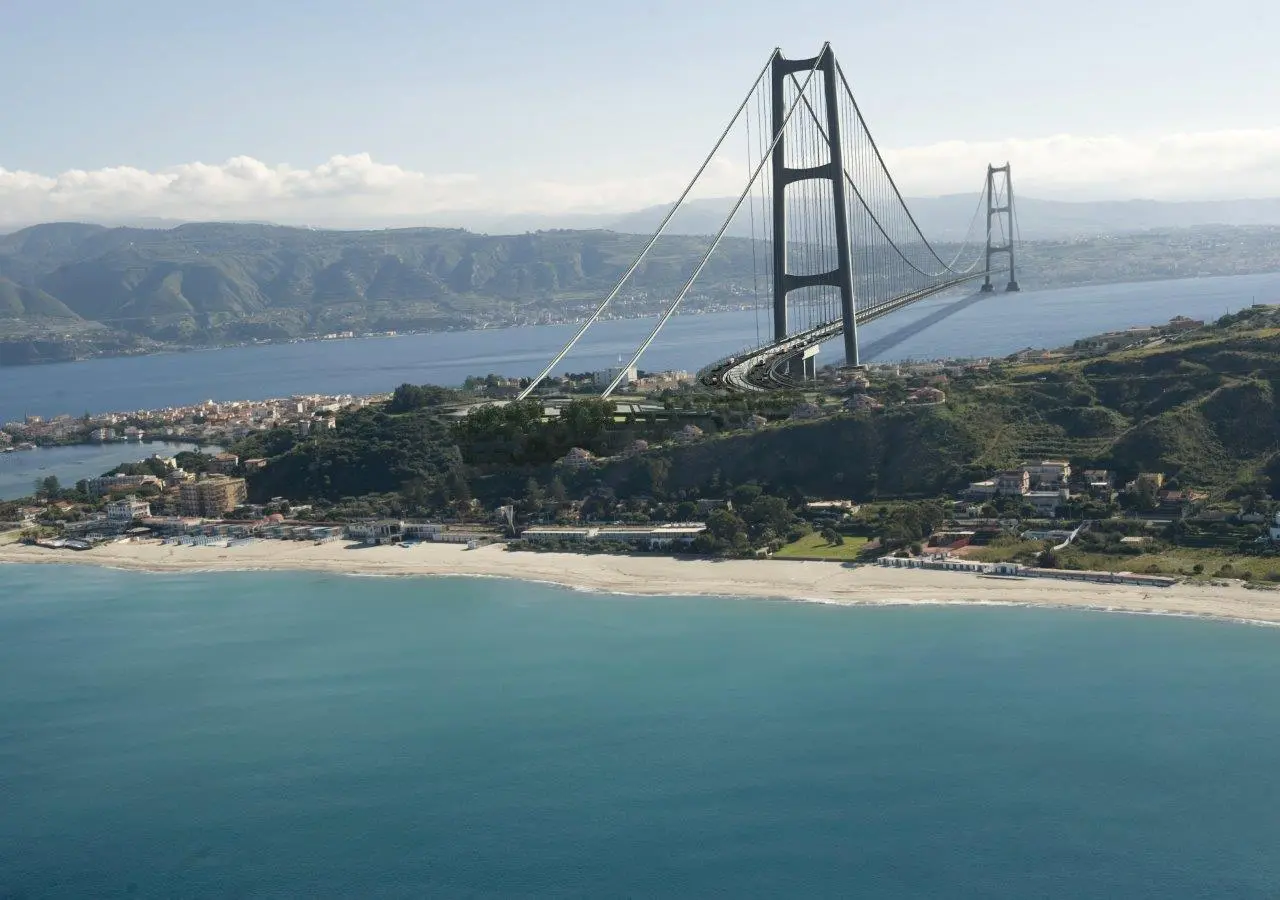
No suspension bridge has ever been built with a main span of 3,300 metres. Turkey’s 1915 Çanakkale Bridge, the world’s longest at 2,023 metres, opened in 2022. The Strait of Messina Bridge exceeds it by 63 per cent. At this scale, cable dynamics, aerodynamic response, and deck deflection all change character. The engineering literature on spans beyond 2,500 metres is largely theoretical. The Eurolink design team closed that gap through physical testing and independent expert review. The result, if delivered, will be the longest suspension bridge in the world and a defining proof of concept for how an infrastructure megaproject can extend engineering science beyond existing precedent.
Span Geometry and Cable Configuration
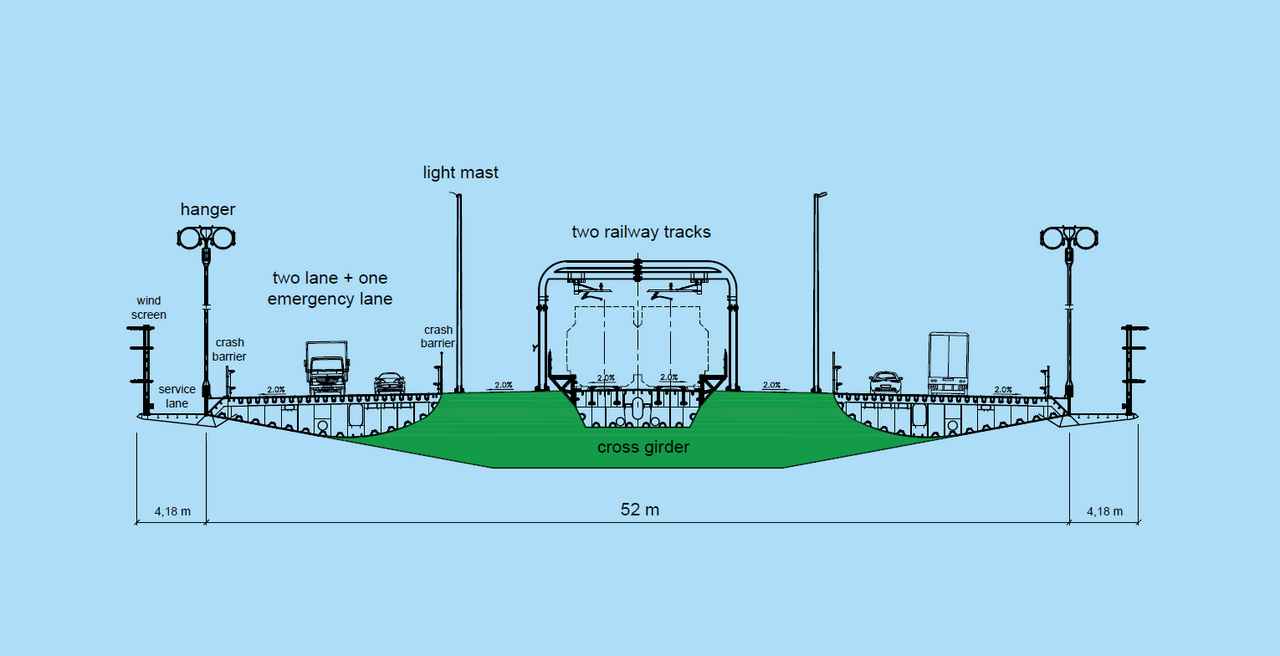
The Strait of Messina Bridge has a total deck length of 3,666 metres between expansion joints, with the central suspended section spanning the 3,300-metre gap between two towers, each reaching 399 metres. Four suspension cables, every 1.26 metres in diameter, support the deck. The combined wire length inside those cables totals 940,000 kilometres, 2.5 times the Earth-to-Moon distance. The 60-metre-wide deck accommodates three vehicle lanes in each direction, two railway tracks, and two service lanes, with a road capacity of 6,000 vehicles per hour and a rail capacity of 200 trains per day.
The Strait of Messina Bridge’s length, span, and technical specifications reflect a structure that is not a scaled-up version of known bridges: it is a new category. The record it pursues is span length, not height: China’s Huajiang Grand Canyon Bridge claims the title of the world’s highest bridge deck at 625m, a separate superlative driven by canyon depth rather than span. For Messina, those specifications determine whether the world’s longest suspension bridge facts translate into an operationally reliable crossing.
Further Reading: Huajiang Grand Canyon Bridge: Engineering the World’s Highest Bridge, 625m, in China’s Guizhou Province
Challenge 2: Aerodynamic Stability Across a Wind-Prone Strait
The funnel geometry of the Strait of Messina, channelling airflow between the Tyrrhenian and Ionian seas, produces sustained high wind speeds with rapid directional change. The Strait of Messina Bridge design specification requires aerodynamic stability at 270 kilometres per hour. This is the single most technically complex structural problem in the project.
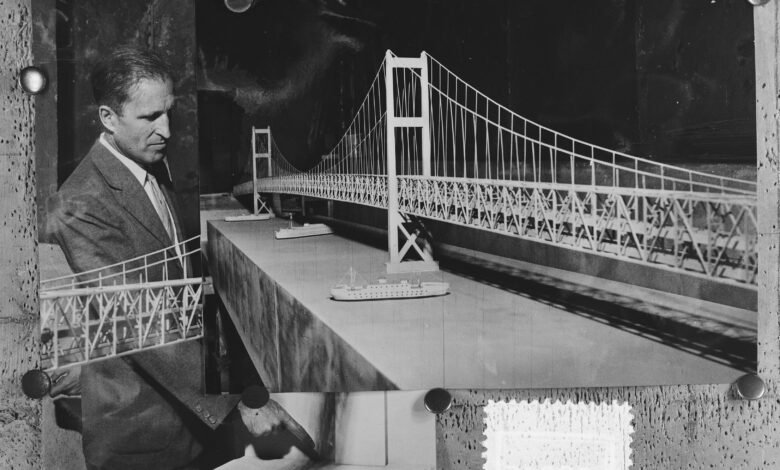
Longer spans reduce the critical wind speed for flutter onset: the self-amplifying oscillation that destroyed the original Tacoma Narrows Bridge in 1940. At 3,300 metres, a conventional closed-box deck fails in the Messina wind environment. A new deck typology was necessary. This aerodynamic constraint is the most distinctive feature of Messina Strait crossing engineering and the one that pushed the design team to undertake original research.
The Messina Type Deck: Patented Solution, Global Adoption
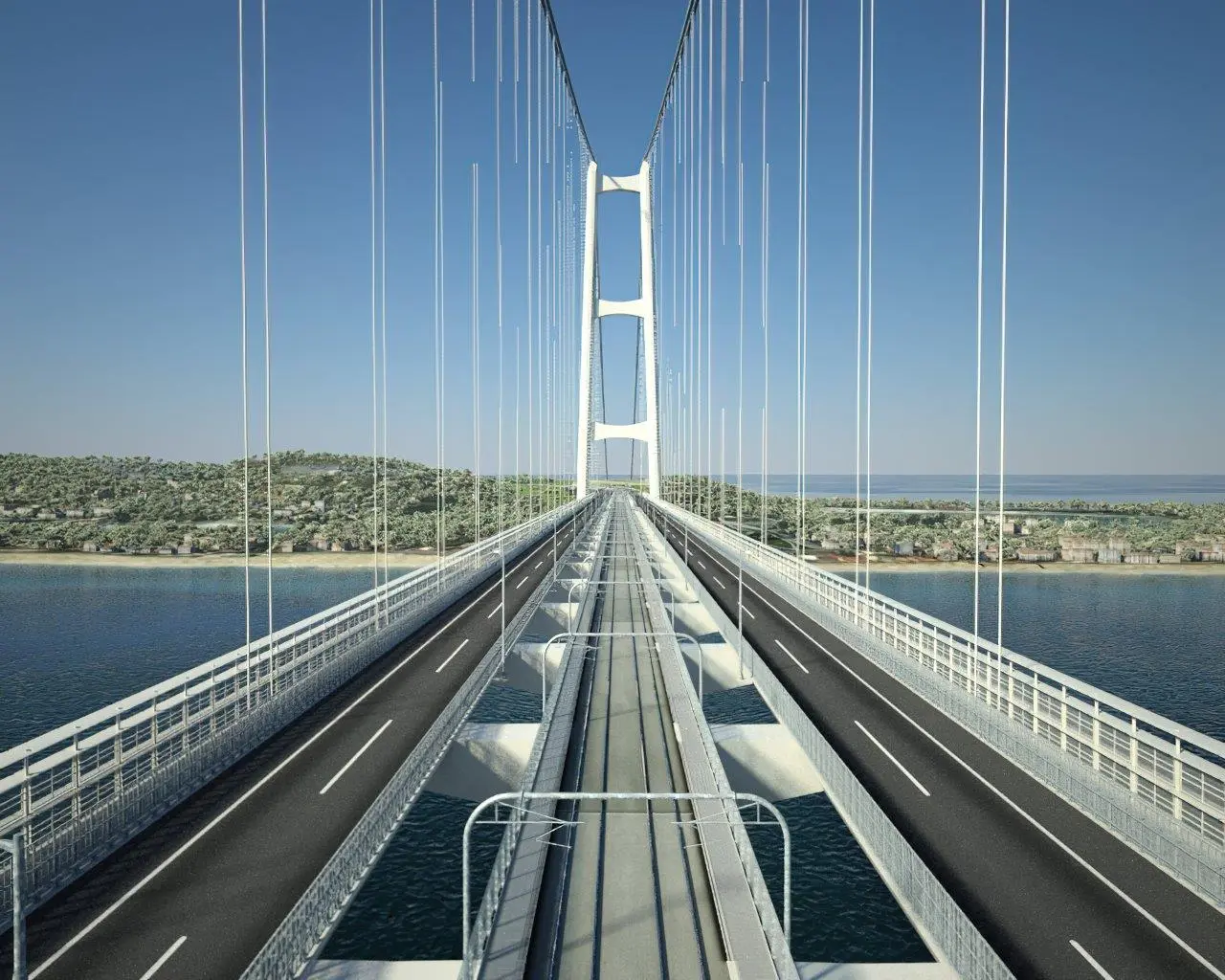
The design team resolved the aerodynamic problem with a three-part multi-box wing section, now designated the Messina Type Deck. The deck uses two outer boxes for the roadways and a central box for the railway, separated by open gaps connected at regular intervals by transverse diaphragms at hanger positions. Wind passes through the gaps rather than loading a solid panel, fundamentally changing the aerodynamic response. Wind tunnel testing, coordinated with specialists at the Polytechnic University of Milan, confirmed stability at 270 km/h. The Messina-type deck proved so effective that WeBuild applied it to the Çanakkale Bridge in Turkey before the Messina Bridge itself was built, validating the concept at 2,023 metres. When complete, the world’s longest suspension bridge in the world will carry the same deck typology to its designed operational limit at 3,300 metres.
Challenge 3: Seismic Design in Europe’s Highest Hazard Zone
The Strait of Messina sits at the convergence of the Eurasian and African plates. The December 1908 earthquake, measuring 7.1, killed more than 100,000 people and destroyed Messina and Reggio Calabria in under 40 seconds. Seismic loading is a primary structural design case for the Strait of Messina Bridge and the factor that most distinguishes this infrastructure megaproject from suspension bridges built in lower-hazard environments. The tower geometry, foundation locations, cable configuration, and energy dissipation systems all reflect this. The design question was not whether to engineer for earthquakes but how to build 399-metre towers and a 3,300-metre deck that survive the maximum credible ground motion.
Flexibility as Seismic Strategy
Suspension bridges resist earthquakes through flexibility. A rigid structure accumulates seismic force until it yields. A flexible one absorbs the motion through controlled deformation. The Strait of Messina Bridge towers oscillate at approximately 3 seconds under seismic excitation; the deck oscillates at approximately 30 seconds. Both values lie outside the short-period energy concentration range, producing accelerations of roughly 0.4g at the towers and 0.002g at the deck under the design earthquake.
Viscous dampers and tuned mass dampers manage residual energy. The design specification applies peak ground acceleration values exceeding Italy’s national building code. More than 400 geological and seismic surveys were conducted during the 2011 design phase alone, confirming stable, competent ground at both tower and anchor block locations.
Challenge 4: Cable Anchorage in Complex Shoreline Geology
Both towers of the Strait of Messina Bridge are founded on land: Torre Faro in Sicily and Villa San Giovanni in Calabria, avoiding marine foundation work under the full structural load. The cable anchor blocks, however, must absorb horizontal tension in all four main cables at a scale beyond any anchored suspension bridge ever built and sit embedded in the shoreline geology of each bank. The angle at which the cables arrive determines the split between horizontal and vertical components transferred into the ground.
Anchor Block Design and Ground Investigation
Geotechnical investigations at both anchor block sites, updated during the 2024 final design review, confirmed competent bedrock adequate to support the foundation loads. The anchor blocks use massive reinforced concrete structures embedded in the hillside geology, with geometry determined by cable angles and ground capacity. The strait’s floor reaches depths exceeding 200 metres, but no marine foundations are required. Claims that the Calabrian foundation sits on active fault lines were investigated and excluded by the updated 2024 geological report.
Challenge 5: Corrosion Management Across a 200-Year Design Life
The Strait of Messina exposes every bridge surface to an aggressive marine environment: salt spray, tidal humidity, wind-driven seawater, and seasonal temperature cycling. For a structure designed to operate for 200 years, corrosion control is a life-cycle engineering discipline, not a maintenance detail. The cables, hangers, deck boxes, and tower steelwork all require protection systems calibrated to the engineering conditions of the Messina Strait crossing. A failure in corrosion management at this scale cannot be remediated without taking the crossing out of service.
Cable Dehumidification and Structural Health Monitoring
The main cables use high-strength galvanised steel wires protected by dehumidification systems inside the cable sheaths, maintaining relative humidity below the corrosion threshold, a technique validated over multi-decade service on bridges in Japan and Scandinavia. Corrosion management at this scale is a dedicated sub-discipline of Messina Strait crossing engineering, not a maintenance afterthought.
Deck boxes use sealed construction with internal dehumidification, tower steelwork is coated with marine-grade coatings, and an embedded structural health monitoring system tracks stress, temperature, deflection, and corrosion in real time, enabling predictive maintenance. The Channel Tunnel addressed the same marine durability problem through atmospheric control; Messina applies the same logic above the waterline.
Further Reading: Channel Tunnel: 10 Proven Engineering Breakthroughs Behind the World’s Most Iconic Cross-Border Link
Challenge 6: Multimodal Load Integration on a Record-Span Deck
Most long-span suspension bridges carry either road traffic or rail, not both. Trains are substantially heavier than vehicles and generate dynamic load effects that differ fundamentally from those of highway traffic. Combining both modes on a 3,300-metre deck creates a problem with no direct precedent: the deck must limit vertical deflection under rail loads, remain aerodynamically stable at 270 km/h, and stay seismically flexible at the same time. These demands conflict, and resolving them required explicit optimisation of the deck cross-section.
Load Path Separation Within a Unified Cross-Section
The Messina Type Deck resolves the multimodal conflict through functional separation. The central box, the stiffest of the three, carries the railway tracks. The outer boxes carry the road lanes. Transverse diaphragms at each hanger position integrate all three into a single structural unit, distributing loads across the full 60-metre width and limiting differential deflection between rail and road zones.
The hanger system uses pairs of vertical high-strength steel ropes at calibrated spacing, managing dynamic load distribution and aerodynamic interference between adjacent hangers. The Strait of Messina Bridge demonstrates how Italy’s infrastructure megaproject solved a problem that will recur in every subsequent fixed crossing designed to carry both modes. The same multimodal logic appears in Europe’s next-generation tunnels and fixed crossings, where rail and road integration is increasingly a design baseline.
Challenge 7: Cost Escalation, Legal Challenge, and 50 Years of Institutional Complexity
The Messina Bridge megaproject cost controversy and engineering design are inseparable. The 2005 Eurolink contract totalled approximately EUR 3.9 billion. By 2009, the estimate reached EUR 6.35 billion. The current figure is EUR 13.5 billion, a 245 per cent increase. Italy’s Court of Auditors identified cost inflation exceeding 50 per cent of the original contract as a ground for refusing to register the CIPESS August 2025 resolution, raising a question under EU Directive 2014/24 about whether the 2005 contract remained valid or a new competitive tender was required.
The Court of Auditors Ruling
On 29 October 2025, the Court of Auditors refused to register CIPESS Resolution 41/2025, citing non-compliance with the European Habitats Directive, violations of EU procurement rules, and unresolved questions regarding financial coverage. Without registration, expropriations could not begin. Parliament passed the Commissioners’ Decree in May 2026, shifting EUR 2.787 billion in spending to 2030-2034 and appointing new commissioners. The 2032 completion target is no longer achievable on current timelines, and the Strait of Messina Bridge construction cost and completion date remain subject to the new CIPESS process.
Engineering Complete; Administration Unresolved
Italy’s mainland bridge crossing in Sicily has been fully designed for construction. The Eurolink design process mirrors the trajectory of the Brenner Base Tunnel in one respect: both projects required decades of geotechnical investigation, independent expert review, and iterative design before reaching construction readiness. The Messina Strait crossing engineering underwent independent scientific review and wind-tunnel validation. The project passed every technical test applied to it. What stopped it was not an engineering failure but procedural, legal, and environmental compliance failures in the administrative management of Italy’s infrastructure megaproject.
Anti-corruption protocols, 62 environmental pre-construction conditions from the November 2024 VIA/VAS decree, and a new CIPESS resolution must all be satisfied before the Strait of Messina Bridge moves to ground. The distinction between engineering readiness and institutional readiness is crucial to any honest assessment of whether Italy will build the world’s longest suspension bridge. The Strait of Messina Bridge’s construction cost and completion date, as well as the question of how the Sicily mainland bridge crossing will be delivered and financed, remain open. How the Strait of Messina Bridge will be engineered and built is settled. Who will authorise it, and when, is not.
Technical Block: Strait of Messina Bridge Key Specifications
The table below consolidates confirmed technical parameters from the 2024 updated final design, as accepted by Stretto di Messina SpA’s scientific committee. The engineering challenges and design decisions behind each value of the Italy-Sicily mainland bridge are addressed in the sections above. Each figure reflects the specific constraints of Messina Strait crossing engineering at a scale without direct precedent in the global suspension bridge record.
| Parameter | Specification |
| Total deck length | 3,666 m (between expansion joints) |
| Main suspended span | 3,300 m |
| Tower height | 399 m |
| Deck width | ~60 m |
| Main cables | 4 cables, each 1.26 m in diameter |
| Cable wire total length | 940,000 km (2.5x Earth-Moon distance) |
| Navigational clearance | 65 m above sea level |
| Road capacity | 6,000 vehicles per hour |
| Rail capacity | 200 trains per day |
| Wind resistance | Stable up to 270 km/h |
| Seismic design (deck) | ~0.002 g under design earthquake |
| Total project cost | EUR 13.5 billion |
| Target completion | 2032 (pending legal clearance) |
| General contractor | Eurolink, led by Webuild Group |
Every specification in the Strait of Messina Bridge length, span, and technical specifications table answers a specific site constraint: the 3,300-metre span covers the minimum navigable crossing; the 399-metre towers provide the cable geometry required by that span; the four-cable system distributes the combined rail and road load across the 60-metre deck; the 270 km/h wind rating reflects Strait of Messina crossing engineering validated through physical testing. The Sicily mainland bridge crossing at Messina is the world’s longest suspension bridge, a case study in how structural form follows physical environment. Nothing is arbitrary.
Conclusion: Resolved in Engineering, Stalled in Governance
The Strait of Messina Bridge is Italy’s most thoroughly tested infrastructure project and the most credible candidate for the world’s longest suspension bridge record. Its aerodynamic deck, seismic strategy, cable system, multimodal load integration, and foundation design have been independently validated over more than two decades. The engineering case is closed. For an infrastructure megaproject of this scale, that is an unusual position to reach.
What keeps the Strait of Messina Bridge from sinking is fifty years of institutional complexity: EU procurement disputes, cost-inflation governance failures, environmental compliance gaps, and a political commitment without a comparable multinational backstop. The obstacles are real but not permanent; the TEN-T corridor logic driving the Messina Bridge has not weakened. Until a new CIPESS resolution clears the Court of Auditors, Italy, Sicily, and Calabria continue to wait for a connection that the engineers finished building long ago. The Strait of Messina Bridge will be built. The question is which government finally authorises it.
Explore Iconic Bridges and Tunnel Megaprojects
From record-breaking bridges to extraordinary tunnel systems, dive into the engineering analysis, technical insights, and construction breakthroughs behind the world’s most ambitious infrastructure projects. Continue exploring in-depth engineering coverage with Construction Frontier: Global Mega Projects.