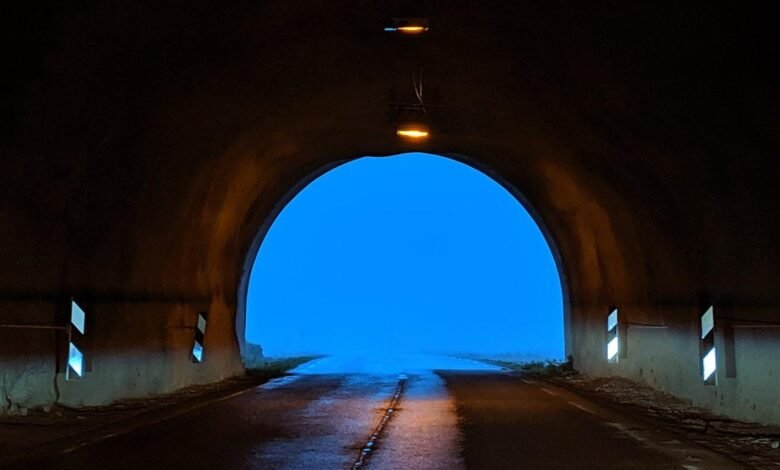
Rogfast Tunnel: 6 Remarkable Engineering Feats Defining the World’s Deepest Undersea Road Tunnel
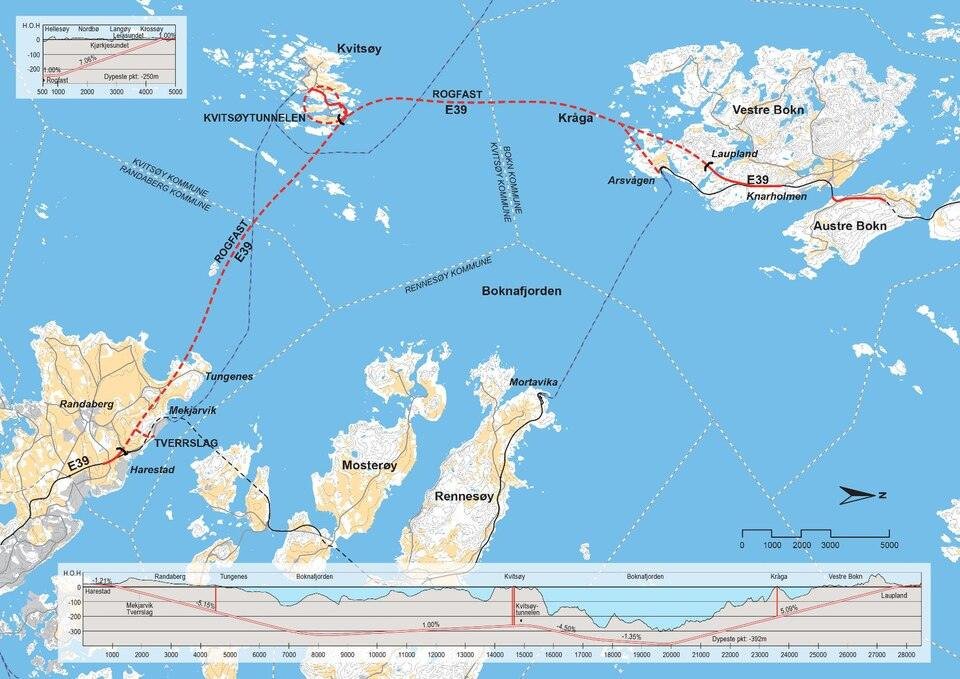
The Rogfast Tunnel is the world’s longest undersea road tunnel at 26.7 kilometres and the world’s deepest at 392 metres below sea level, stretching beneath Norway’s Boknafjorden via drill-and-blast construction through solid bedrock. Part of the E39 coastal highway, the Rogaland Fixed Link delivers a ferry-free connection between Stavanger and Bergen, cutting travel time by up to 40 minutes. Budgeted at NOK 25 billion (approximately USD 2.4 billion), the Rogfast Tunnel sets the global benchmark for subsea drill-and-blast construction and deep-rock junction engineering.
Technical Snapshot: Rogfast Tunnel Core Project Specifications
| Specification | Detail |
| Project Name | E39 Rogfast (Rogaland fastforbindelse / Rogaland Fixed Link) |
| Location | Boknafjorden and Kvitsøyfjorden, Rogaland County, western Norway |
| Total Tunnel Length | 26.7 km (Boknafjord Tunnel) + 4.1 km Kvitsøy spur |
| Maximum Depth | 392 metres below sea level |
| Tunnel Configuration | Twin bores, 10.5 m diameter, two lanes per bore |
| Construction Method | Drill and blast through solid bedrock |
| Rock Cover | Minimum 50 m between tunnel crown and seabed (regulatory requirement) |
| Design Speed | 110 km/h |
| Total Project Budget | NOK 25 billion (approximately USD 2.4 billion) |
| Funding Model | 40% government; 60% toll revenues (approx. NOK 30-40 per trip) |
| Key Contractors | Skanska (north); Implenia Norge / Stangeland Maskin JV (south and central) |
| Project Owner | Norwegian Public Roads Administration (Statens vegvesen) |
| Construction Resumed | Late 2021 (original start January 2018; paused October 2019) |
| Projected Completion | 2033 |
| Primary Function | Ferry-free E39 road link, Stavanger-to-Bergen corridor |
The Rogfast Tunnel is the centrepiece of Norway’s E39 coastal highway programme, targeting the elimination of all seven ferry crossings between Trondheim and Kristiansand before 2050. As the world’s longest road tunnel at 26.7 kilometres and the world’s deepest subsea road tunnel at 392 metres, the Rogfast Tunnel holds both records by margins no current project will challenge before the 2040s. At 392 metres below sea level, it is the world’s deepest road tunnel by a margin of more than 100 metres over its nearest competitor.
Introduction: Rogfast Tunnel and the Case for Extreme Subsea Depth
Norway has built approximately 40 subsea road tunnels using the drill-and-blast technique and accumulated technical knowledge that no academic programme replicates. Yet even against that background, the Rogfast Tunnel represents a categorical step forward. The Boknafjorden crossing is 16.5 miles wide, and the bedrock geometry required boring to 392 metres below sea level: a depth that introduces pressure differentials, geological uncertainty, and ventilation complexity that no previous undersea road tunnel project has confronted at this scale.
For engineers studying tunnel construction methods, the Rogfast Tunnel is the primary global reference for what the drill-and-blast technique can achieve with sufficient capital, geological investigation, and project governance. The twin 10.5-metre bores advance through Precambrian metamorphic rock, sealed by Norway’s mandatory 50-metre rock cover between the tunnel crown and the seabed.
The world’s longest and deepest undersea road tunnel, at 26.7 kilometres and 392 metres deep, the Rogfast Tunnel distinguishes itself across every engineering dimension: construction method, geological conditions, the Kvitsøy interchange, ventilation design, project governance, and economic rationale. Our undersea tunnel engineering analysis provides the methodological framework within which the Rogfast Tunnel sits as the definitive drill-and-blast case study.
1. Drill and Blast at World Record Depth
The Fehmarnbelt Fixed Link, crossing a shallower seaway between Germany and Denmark, uses prefabricated concrete elements lowered into a seabed trench, a method suited to soft sedimentary conditions and modest depths. The Rogfast Tunnel operates in an entirely different geological environment. Beneath the Boknafjorden, hard metamorphic bedrock and the 392-metre crossing depth rule out any trench-based approach for a subsea road tunnel on both geological and economic grounds. The drill-and-blast method is Norway’s national tunnelling tradition, and the Rogfast Tunnel applies it at an unprecedented scale.
The drill-and-blast cycle advances each bore face by drilling a pattern of holes into the rock, loading them with explosives, detonating in a calibrated sequence, and mucking out the blasted material before scaling loose rock and applying bolts and shotcrete. The drill-and-blast method has advanced the Rogfast Tunnel’s two bores simultaneously from north and south, required to meet at the centre within five centimetres of alignment across 26.7 kilometres. At 1.97 inches across a 17-mile bore, that tolerance is one of the tightest surveying specifications in international tunnelling practice.
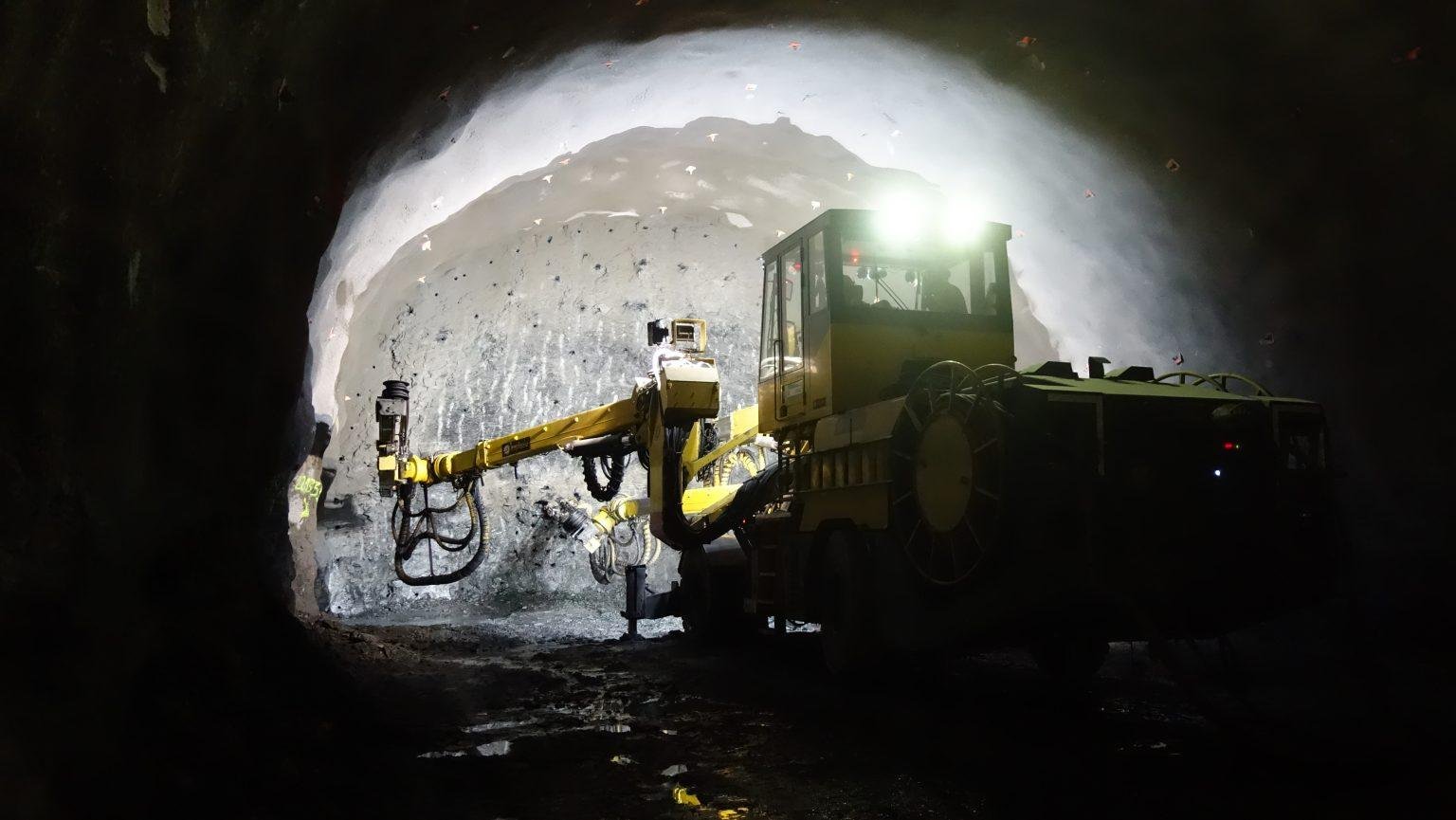
Epiroc’s Mobilaris Tunnelling Intelligence platform integrates drilling rig positioning, blast pattern design, and face advance data into a live three-dimensional model. Each drill-and-blast round advances the face three to five metres, and the digital twin updates immediately. Deviations from the design profile trigger automatic alerts, allowing survey correction before the next round loads. At 392 metres below sea level, catching a misalignment at one round rather than ten is the difference between a manageable correction and a contractual crisis.
Norwegian regulations mandate at least 50 metres of solid rock between the tunnel crown and the seabed throughout the alignment. That constraint shapes the dive profile of the Rogfast Tunnel, driving a steep descent from each portal to reach depth quickly. Drilling and blasting from each end simultaneously means the heading teams advance toward each other through bedrock, reaching full depth within the first few kilometres before maintaining the required rock cover across the full Boknafjorden crossing. The 35-minute transit reflects the extended distance and gradient constraints.
2. Geological Conditions and Water Control
At 392 metres below sea level, the Rogfast Tunnel operates under water pressures approaching 40 bar at the tunnel wall interface. Any crack or permeable zone in the rock creates a pathway for seawater ingress at pressure. The Norwegian Geotechnical Institute holds the independent verification contract covering all four construction lots, confirming that excavation and rock support meet specifications at every advance. The Boknafjord rock is Precambrian metamorphic geology, but underground conditions at this depth cannot be fully predicted from surface investigation alone. Every drill-and-blast round reveals new geological information that pre-excavation surveys could not anticipate.
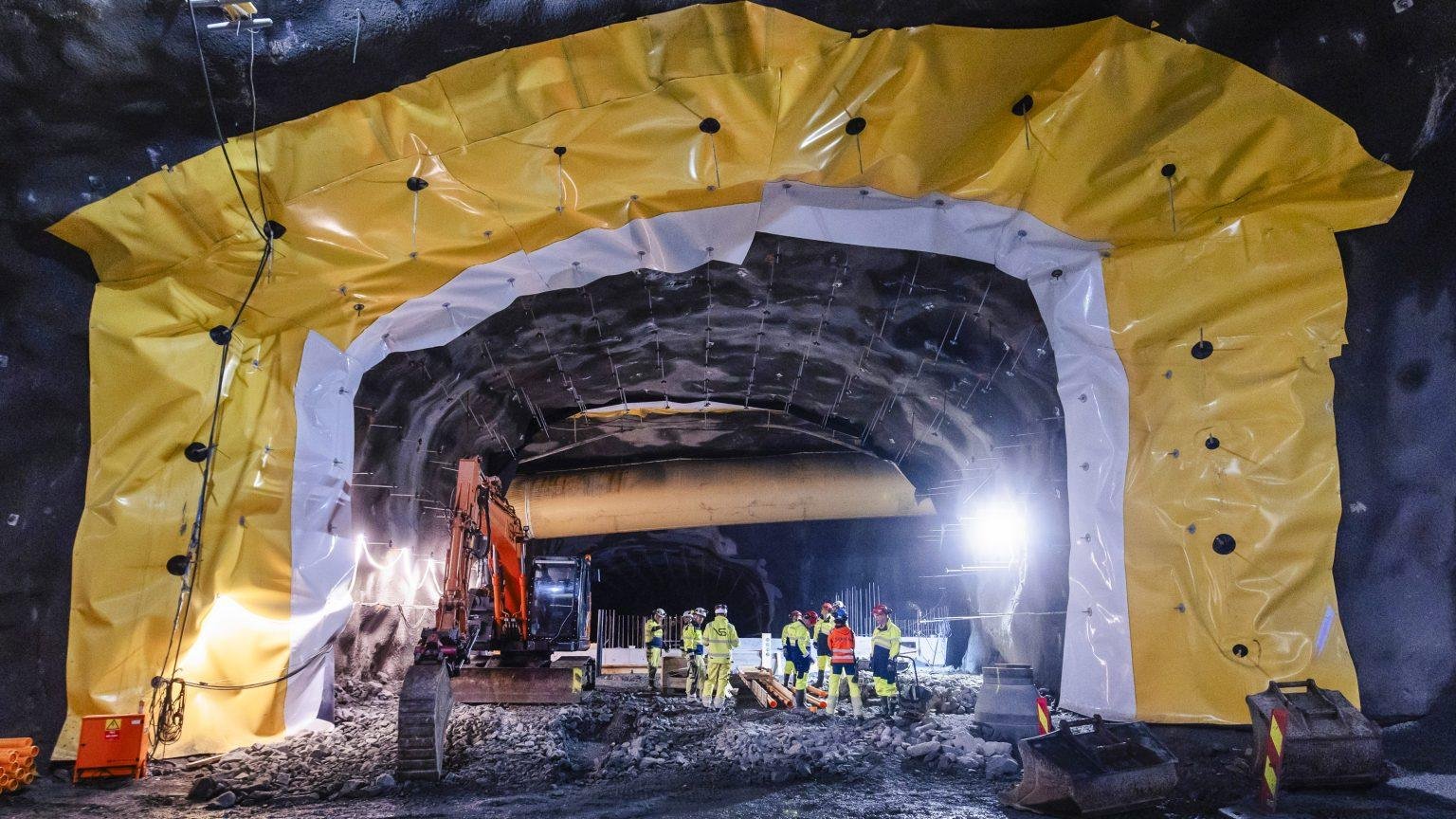
Pre-excavation grouting is the primary water control method in any drill-and-blast subsea project, and the Rogfast Tunnel applies it without exception. Before each blast advance, crews drill grout holes ahead of the face and inject cementitious or chemical grout into any permeable zone, sealing water pathways before the excavation opens them. The Rogfast Tunnel’s depth makes this protocol non-negotiable: a grouting failure at 392 metres does not permit a gradual response. Cross-passages at 250-metre intervals provide emergency evacuation routes between both bores.
Rock quality varies along the alignment, and the support system scales accordingly. Competent zones require only spot bolts and thin shotcrete. Weaker sections near the Kvitsøy geological transition need systematic bolting, steel-fibre-reinforced shotcrete, and steel arches. The Kvitsøy interchange uses precast concrete segments for its inner lining, where the complex multi-bore geometry makes cast-in-place construction impractical.
3. The Kvitsøy Interchange: The World’s Most Complex Subsea Junction
The Kvitsøy interchange is the feature that separates the Rogfast Tunnel from every other subsea road tunnel project. Norway’s smallest municipality sits on the island of Kvitsøy, midway along the Boknafjorden crossing. Rather than bypass the island, the Rogfast Tunnel includes a 4.1-kilometre spur connecting Kvitsøy to the main tunnel system via an underground junction 250 to 260 metres below sea level, giving the island’s residents mainland road access for the first time.
The junction geometry is unique. Two main tunnel bores meet a system of slip roads, two roundabouts, a link tunnel, cross-passages, access tunnels, and two 10-metre-diameter ventilation shafts, all threaded together within the rock beneath the island. Traffic heading north from Randaberg takes a slip road, navigates one of the deepest road roundabouts on earth, and climbs 4.1 kilometres up a spiral ramp to the Kvitsøy surface. The two roundabouts allow the main undersea road tunnel to continue operating with bidirectional traffic through a single bore if one bore closes for maintenance or emergency response.
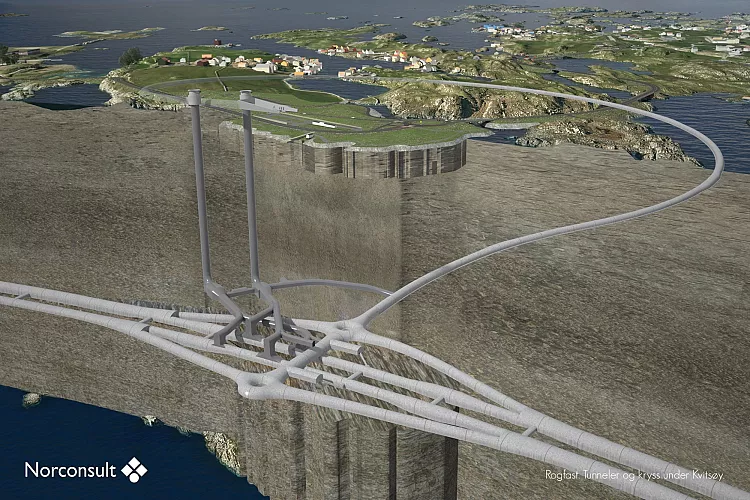
The Kvitsøy roundabout design extends a precedent set by the Eysturoy Tunnel in the Faroe Islands, which introduced the world’s first undersea roundabout. Where the Eysturoy Tunnel was built with a single roundabout at 187 metres below sea level, the Rogfast Tunnel exceeds that with two roundabouts at a 260-metre depth within a far more complex multi-bore junction geometry. Project manager Oddvar Kaarmo confirmed the novelty: this is the first known tunnel junction combining two roundabouts within the same underground cross-section area at this depth.
The Kvitsøy contract (E02) is the most technically demanding of the four construction packages and the section where the drill-and-blast technique faces its most complex geometry. The Implenia and Stangeland Maskin joint venture manages approximately 70 per cent of the Rogfast Tunnel programme. The spiral access ramp also serves construction logistics, handling the disposal of approximately two million cubic metres of excavated rock material.
Further Reading: Eysturoy Tunnel: The Bold Engineering Breakthrough Behind the World’s First Undersea Roundabout
4. Ventilation and Safety Systems for a 26.7-Kilometre Undersea Road Tunnel
A 26.7-kilometre subsea road tunnel carrying two lanes of traffic per bore produces a vehicle emission load that no passive system can manage. The Rogfast Tunnel uses longitudinal ventilation powered by jet fans along the tunnel ceiling, with fresh air supplied and exhaust expelled through vertical shafts at Kvitsøy. The two primary shafts measure 10 metres in diameter and drop 250 metres to service caverns at main tunnel elevation, where the ventilation system distributes airflow north and south through the full Boknafjord crossing. Two smaller shaft pairs at the portals supplement airflow at each end.
Fire ventilation is the most demanding operational scenario. A heavy goods vehicle fire in a subsea road tunnel at 392 metres below sea level requires the ventilation system to control smoke propagation, maintain tenable conditions in the unaffected bore, and support emergency services entry. The cross-passage geometry every 250 metres provides the evacuation framework, and the ventilation system must operate in directional fire mode to prevent smoke migration between bores. This requirement drives fan sizing and shaft capacity well above what routine air quality management demands.
Power supply at depth introduces a further constraint. Battery-powered equipment is prohibited in the deep construction sections due to fire risk in confined spaces. Power reaches the drill-and-blast equipment via heavy cables running from the surface portals through kilometres of active tunnel, a supply chain constraint that shapes equipment selection and maintenance scheduling throughout the build.
Table 1: Rogfast Tunnel Ventilation Infrastructure
| Ventilation Component | Location | Dimensions | Function |
| Primary intake shaft | Kvitsøy island | 10 m diameter, 250 m depth | Delivers fresh air to main tunnel level. |
| Primary exhaust shaft | Kvitsøy island | 10 m diameter, 250 m depth | Expels vehicle exhaust to the surface. |
| North portal shaft pair | Randaberg portal | 7 m intake / 8 m exhaust | Supplements portal-end airflow |
| South portal shaft pair | Bokn portal | 7 m intake / 8 m exhaust | Supplements portal-end airflow |
| Jet fans | Tunnel ceiling throughout | Longitudinal array | Drives unidirectional airflow; fire-mode reversal |
| Cross-passages | Every 250 m along the alignment | 8-12 m length | Emergency evacuation between bores |
Source: Norwegian Public Roads Administration / Global Highways.
5. Project Governance: The 2019 Halt and the Revised Framework
The Norwegian Storting approved the Rogfast Tunnel in May 2017 at an initial budget of NOK 16.8 billion, targeting opening in 2025 to 2026. Construction began in January 2018. In October 2019, the Norwegian Public Roads Administration halted the project after budgetary updates projected overruns exceeding the authorised framework. All outstanding contract issuances were cancelled, and the government requested a full independent review.
By April 2020, the revised estimate placed total cost at NOK 25 billion, an increase of approximately NOK 8 billion. The restructured programme divided the full 26.7-kilometre Rogfast Tunnel alignment into four contracts: Skanska’s northern Boknafjord section (signed December 2022, valued at nearly NOK 5 billion); the Implenia Norge and Stangeland Maskin southern and central Boknafjord section (signed January 2023); the Kvitsøy interchange; and the final portal works. Construction resumed in late 2021, and by mid-2025, the north side reached approximately 65 per cent completion and the southern end approximately 45 per cent. The 2033 opening target remains intact.
The governance lesson is precise: subsea tunnelling at extreme depth produces geological and logistical uncertainty that initial cost models routinely underestimate. The Rogfast Tunnel’s halt and restructuring shows the system identified the overrun early and corrected the framework before locking in an undeliverable contract.
Table 2: Rogfast Tunnel Construction Contracts
| Contract | Scope | Contractor | Value (approx.) | Signed |
| E01 – North Boknafjord | Northern main tunnel bore, Randaberg portal | Skanska AB | NOK 5 billion (USD 495 m) | December 2022 |
| E03 – South & Central | Southern and central main tunnel bores | Implenia Norge / Stangeland Maskin JV | Not disclosed | January 2023 |
| E02 – Kvitsøy Interchange | Spur tunnel, two roundabouts, vent. shafts | Implenia Norge / Stangeland Maskin JV | Not disclosed | 2024 |
| E04 – Portal Works | Portal structures, road connections | TBC | TBC | TBC |
Sources: Norwegian Public Roads Administration; tunnel-online.info.
6. Economic Rationale and the E39 Programme
The Rogfast Tunnel forms one link in the NOK 400 billion E39 coastal highway upgrade, targeting a ferry-free road corridor between Trondheim and Kristiansand by 2050. The current E39 takes 21 hours to drive and requires seven ferries. Rogfast addresses the Boknafjorden crossing, one of the widest and most weather-exposed of those seven links. The Mortavika terminal is exposed to North Sea conditions, and winter storms regularly divert or cancel the service. The undersea road tunnel eliminates weather dependency entirely.
Freight operators running perishable cargo between Bergen’s fishing industry and Stavanger’s oil services supply chain absorb ferry disruptions as a direct cost. Bergen is Norway’s second city and gateway to the fishing sector; Stavanger is the country’s oil capital. The Rogfast Tunnel reduces the Stavanger to Bergen transit by 40 minutes, a saving that aggregates to substantial logistics value across the projected daily volume of approximately 6,000 vehicles. The funding structure covers 40 per cent from government sources directly, with the remaining 60 per cent financed through a toll loan repaid at approximately NOK 30 to NOK 40 per transit. At 6,000 vehicles per day, debt service is covered without requiring optimistic traffic growth assumptions.
Technical Block: Rogfast Tunnel Engineering Parameters
The parameters below capture the engineering scale that places the Rogfast Tunnel in a separate category from all previous undersea road tunnel projects worldwide.
1. Global Undersea Road Tunnel Record Comparison
The Rogfast Tunnel surpasses all predecessor and concurrent subsea road tunnel projects in both length and depth. The table below compares the Rogfast Tunnel against the most significant benchmarks in the world’s undersea road tunnel canon.
Table 3: Global Undersea Road Tunnel Depth and Length Comparison
| Tunnel | Country | Length | Max. Depth Below Sea Level | Construction Method | Status |
| Rogfast Tunnel (Boknafjord) | Norway | 26.7 km | 392 m | Drill and blast | Under construction, opens 2033 |
| Laerdal Tunnel | Norway | 24.5 km | ~500 m total (not subsea) | Drill and blast | Operational since 2000 |
| Eiksund Tunnel | Norway | 7.8 km | 287 m | Drill and blast | Operational since 2008 |
| Bjornafjord Tunnel (planned) | Norway | ~36 km | ~550 m (proposed) | Drill and blast | Planning phase |
| Eysturoy Tunnel | Faroe Islands | 11.2 km | 187 m | Drill and blast | Operational since 2020 |
| Mastrafjord Tunnel | Norway | 4.4 km | 132 m | Drill and blast | Operational since 2013 |
2. Drill-and-Blast vs. Immersed Tube: The Design Choice Explained
The Rogfast Tunnel’s drill-and-blast construction method reflects Norway’s geological conditions and five decades of subsea tunnelling experience. Where the Fehmarnbelt Tunnel uses immersed tube elements suited to soft seabed sediments and shallow water, the Boknafjorden’s hard metamorphic bedrock and 392-metre depth make immersed tube construction structurally and financially impractical. Drilling and blasting through solid rock provides the structural integrity, watertight performance, and design life that a 26.7-kilometre subsea road tunnel at this depth requires.
The same drill-and-blast tradition powers the Seikan Tunnel in Japan, the world’s longest and deepest undersea rail tunnel at 53.85 kilometres and 240 metres below sea level. The Seikan Tunnel confirmed that drill-and-blast through hard rock can sustain operational performance over decades under extreme hydrostatic load. The Rogfast Tunnel extends that legacy to road traffic and surpasses the Seikan’s depth by 152 metres, operating in an even more demanding pressure regime.
Further Reading: Seikan Tunnel: 5 Extraordinary Engineering Achievements Beneath the World’s Deepest Sea Crossing
Table 4: Depth and Estimated Hydrostatic Pressure at Crown for Major Undersea Tunnels
| Tunnel | Type | Max. Depth | Est. Water Pressure at Tunnel Crown | Rock Cover (min.) |
| Rogfast Tunnel | Road (under construction) | 392 m | ~38 bar | 50 m (regulatory min.) |
| Seikan Tunnel | Rail (operational) | 240 m | ~24 bar | 100 m |
| Eiksund Tunnel | Road (operational) | 287 m | ~28 bar | 50 m |
| Eysturoy Tunnel | Road (operational) | 187 m | ~18 bar | ~50 m |
| Channel Tunnel | Rail (operational) | ~75 m (below seabed) | ~20 m (chalk marl) | N/A (immersed tube concept differs) |
Conclusion: The Rogfast Tunnel as Global Benchmark
The Rogfast Tunnel will open in 2033 as the world’s longest and deepest undersea road tunnel, holding both records by margins no current project will challenge before the 2040s. As the world’s longest, it surpasses the Laerdal Tunnel’s 24.5 kilometres by 2.2 kilometres; as the world’s deepest, it exceeds the Eiksund Tunnel’s 287 metres by more than 100 metres. No undersea road tunnel currently under construction will displace either record.
The Rogfast Tunnel demonstrates that the drill-and-blast method, applied with rigorous geological investigation, digital surveying, pre-excavation grouting, and proportionate ventilation design, can operate reliably at depths and distances that subsea tunnelling’s founders would not have considered achievable for road traffic. The 2019 halt avoided locking in an undeliverable contract; the revised four-contract structure distributed risk accurately. The programme is completing on a revised but credible schedule within a fully funded budget, delivering a fixed link between Stavanger and Bergen that the Norwegian economy has needed for decades. Every future undersea road tunnel project, including the remaining E39 crossings, will be designed and procured with the Rogfast Tunnel’s lessons as its primary reference.
Explore More Undersea Engineering Breakthroughs
Discover more groundbreaking projects, construction innovations, and engineering breakthroughs shaping the future of infrastructure. From megaprojects to advanced technologies, Construction Frontier: Global Mega Projects brings you the insights behind the structures transforming our world.