Sydney Opera House: Remarkable Structural Engineering Behind the World’s Most Recognised Building
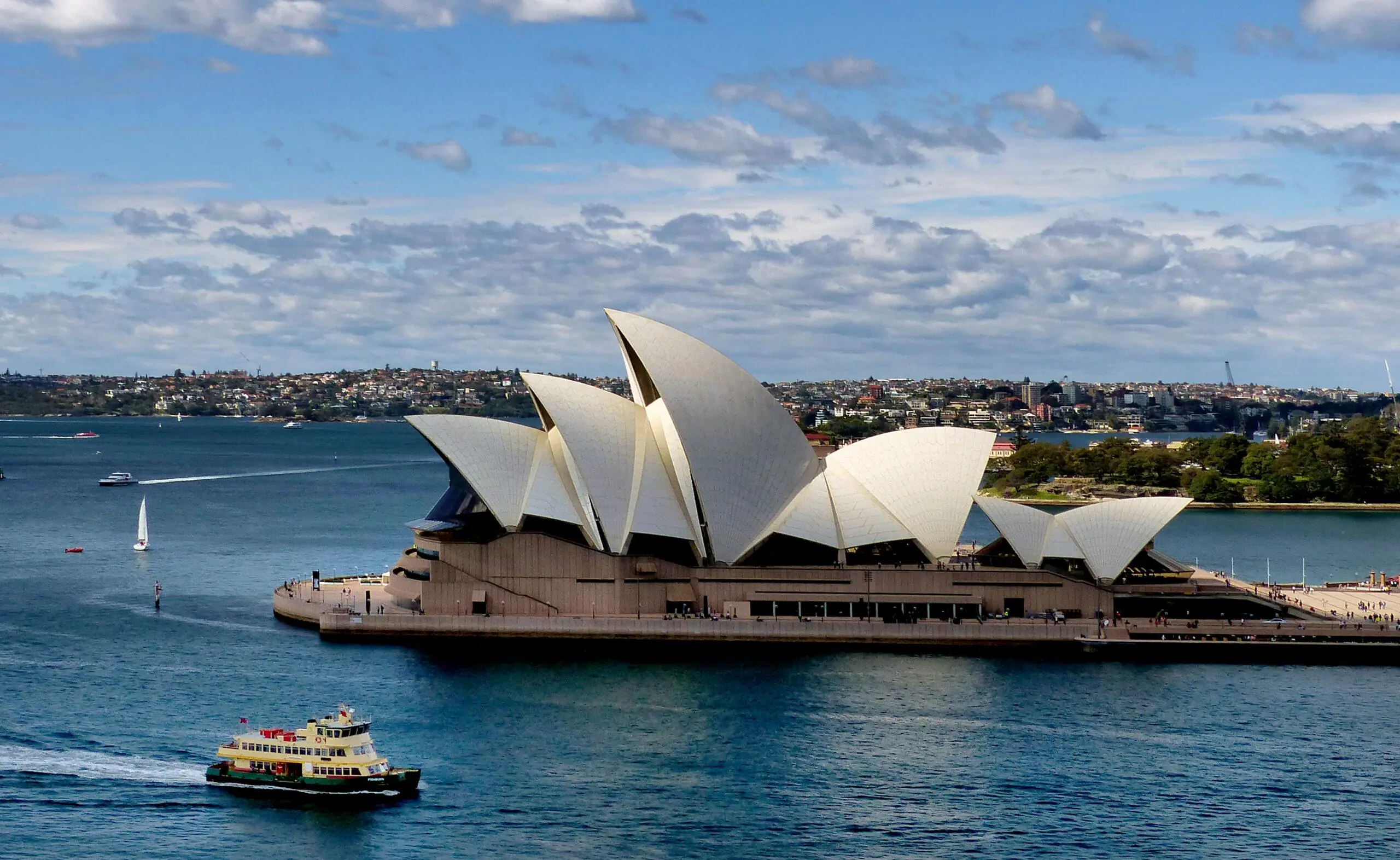
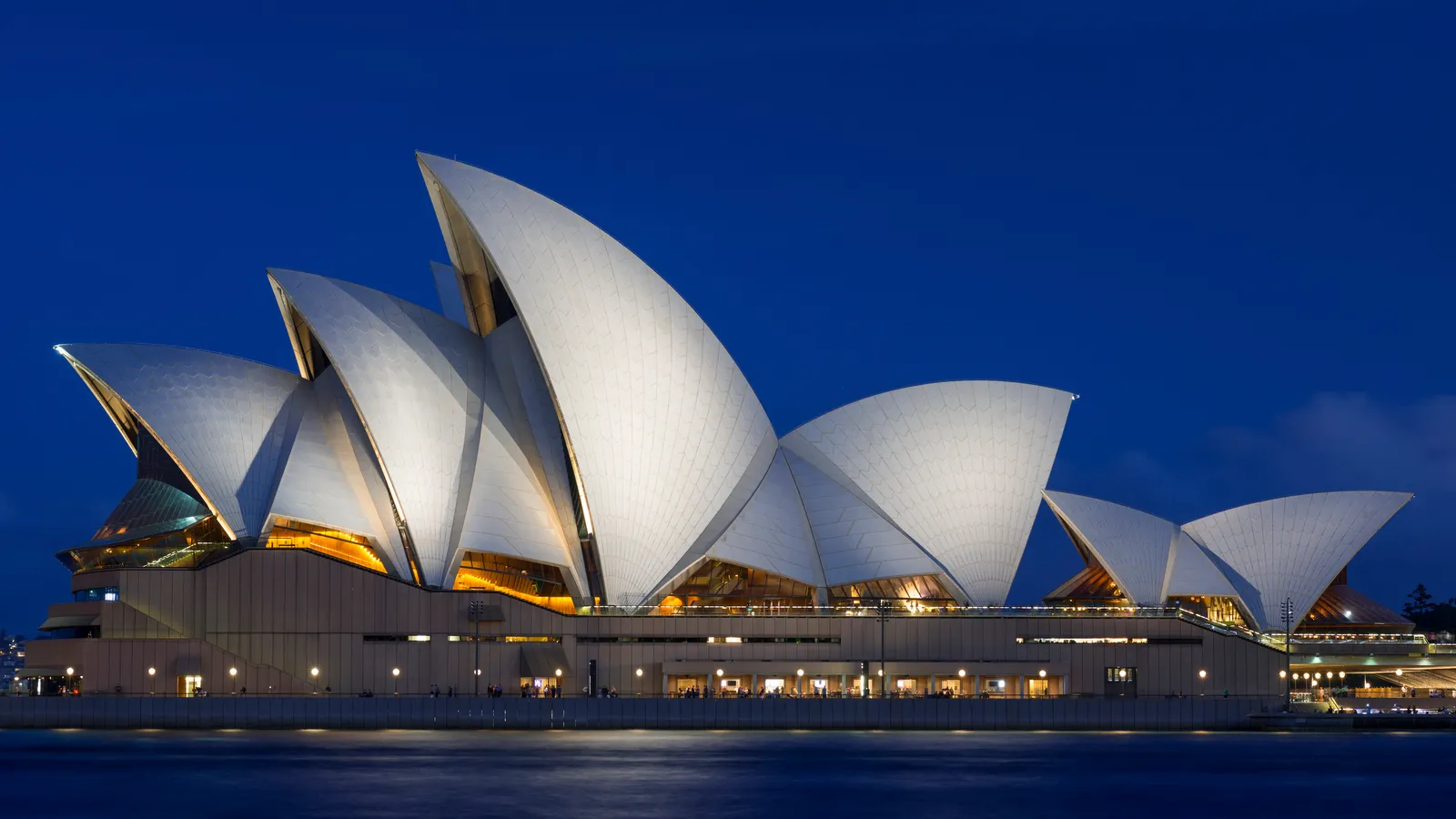
The Sydney Opera House stands on Bennelong Point in Sydney Harbour, Australia, as the most photographed performing arts facility on earth. Completed in 1973 after 14 years of construction, the structure’s interlocking precast concrete shell roofs redefined what engineers and architects could demand of each other, producing a building whose structural engineering legacy now exceeds even its cultural one.
Technical Snapshot: The Sydney Opera House Core Project Specifications
| Parameter | Detail |
| Location | Bennelong Point, Sydney Harbour, New South Wales, Australia |
| Architect | Jørn Utzon (Denmark) |
| Structural Engineer | Ove Arup & Partners |
| Main Contractors | Civil & Civic (Stage I); M.R. Hornibrook Group (Stages II & III) |
| Construction Period | 1959 to 1973 |
| Total Cost | AUD $102 million (original estimate: AUD $7 million) |
| Site Area | 4.5 acres (1.8 hectares) |
| Roof Shell Units | 2,194 precast concrete sections, each weighing 15.5 tonnes |
| Roof Tile Count | 1,056,006 Swedish-manufactured ceramic tiles |
| Foundation Piles | 588 concrete piles sunk up to 25 metres below sea level |
| UNESCO Status | World Heritage Site (inscribed 2007, Criterion i) |
| Annual Performances | Over 1,500 across six venues |
The Sydney Opera House represents the most consequential intersection of architectural ambition and structural engineering innovation of the 20th century. No other building forced engineering practice to advance so rapidly, and none has since held such singular authority as both a famous architectural landmark and a technical benchmark for shell roof construction worldwide.
Introduction: Shell Architecture and the Limits of Engineering
The Sydney Opera House did not push engineering boundaries. It exposed the fact that no adequate boundaries yet existed for what its architect was proposing. When Jørn Utzon submitted his competition entry in 1956, out of over 233 design submissions, the roof-shell geometry was undefined, the structural system was unresolved, and no computer programme capable of analysing the forces involved had yet been written. What won the competition was a sketch, a vision of sail-like concrete shells rising from a harbour promontory with no proven path to construction.
The gap between vision and buildability is the real story of Sydney Opera House engineering. Closing it consumed six years of design iteration, produced one of the first large-scale applications of computational structural analysis in construction history, and established a precast concrete methodology that influenced shell roof construction worldwide. The project’s engineering challenges were not incidental to the design: they were the design, demanding solutions with no precedent in either structural or construction practice.
The building stands among the world’s most iconic structures not for its appearance alone but for the engineering methods it forced into existence.
The Sydney Opera House Geometry Problem: From Parabola to Sphere
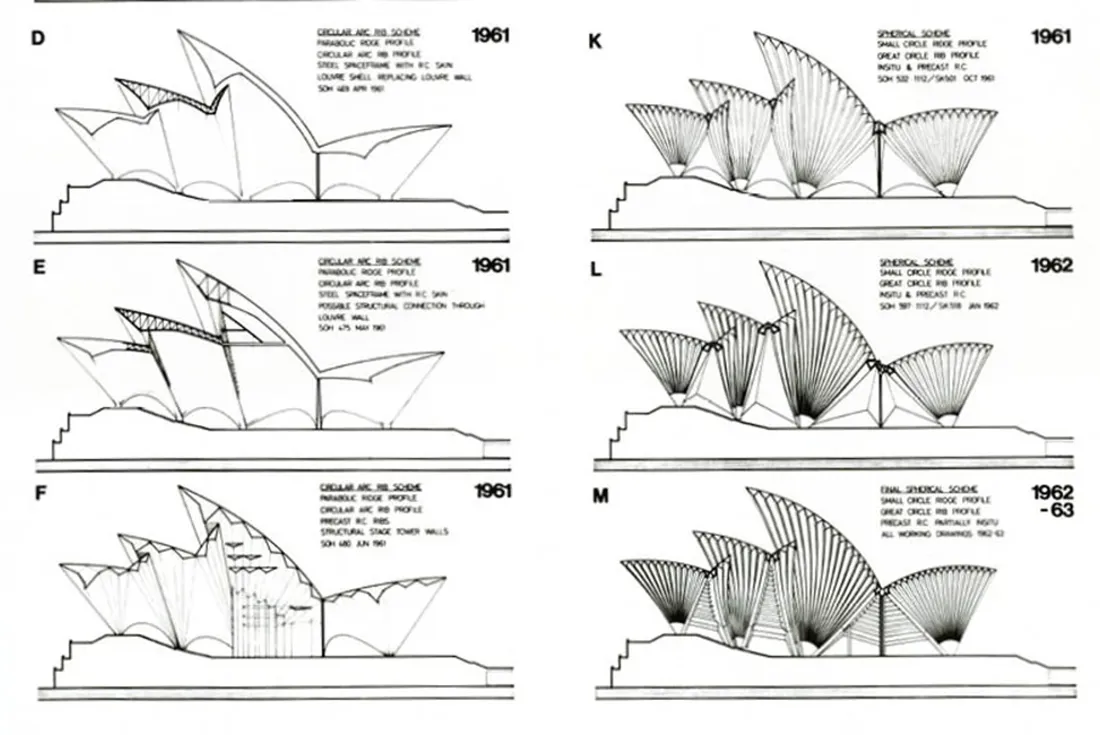
The roof geometry remained the project’s central, unresolved engineering obstacle for six years after construction began, with the failed parabolic and ellipsoidal attempts consuming twelve design iterations before the spherical breakthrough finally gave the construction team something they could actually build.
Six Years of Failed Solutions for the Sydney Opera House Roof
From 1957 to 1963, the design team cycled through at least twelve iterations of shell form, testing parabolas, circular ribs, ellipsoids, and hybrid geometries in search of a shape that could be built without custom formwork for every unit. Early development treated the shells as a series of parabolas supported by precast concrete ribs, but this approach produced a different geometric profile for each section of each shell. No two units were the same. Custom formwork per piece was prohibitively expensive; in-situ concrete poured into bespoke moulds was equally unworkable.
Ove Arup & Partners faced a three-way problem: find a geometry that was faithful to Utzon’s vision, structurally sound under wind, gravity, and dynamic loads, and manufacturable using repeatable precast elements. Every proposed solution that satisfied two criteria failed the third.
| Geometry Tested | Period | Fabrication Problem | Structural Problem | Outcome |
| Parabolic shells | 1957–1958 | Unique formwork per unit | Load path inconsistent | Rejected |
| Circular ribs (non-spherical) | 1958–1959 | Partial repeatability | Complex intersection geometry | Rejected |
| Ellipsoidal profiles | 1959–1960 | Custom panels throughout | Indeterminate force distribution | Rejected |
| Hybrid parabola/ellipsoid | 1960–1961 | Prohibitive cost | Unresolved stress concentrations | Rejected |
| Spherical sections (common radius) | 1961 | Fully repeatable moulds | Consistent compressive load path | Adopted |

The Spherical Solution
In mid-1961, Utzon solved it. All ten shells could be derived as sections cut from a single sphere of the same radius: 75.2 metres. Every arch rib across all shells became a portion of the same circular arc. The geometry was identical across every shell group; only the arc lengths and orientations varied. That single constraint reduced the entire fabrication problem to a single constraint.
With every rib sharing the same radius of curvature, a single adjustable set of steel formwork moulds could produce all 2,194 precast concrete sections by varying only the arc length. Utzon called it the “key to the shells“. Tile panels could be prefabricated as standardised units on the ground rather than applied individually at height. Structural analysis became tractable because the geometry was now mathematically consistent across the whole roof. Arup’s own project documentation describes the breakthrough as the moment when 12 trial schemes became obsolete simultaneously.
Sydney Opera House Structural Engineering: Building the Shell Roof
With geometry resolved, the engineering shifted to physical construction: fabricating 22,000 tonnes of precast concrete roof structure without precedent, validating its structural behaviour through a computational analysis programme that barely existed, and getting those loads down through a harbour site whose foundation conditions had already surprised the project once. The precast fabrication and post-tensioning programme, the computational analysis, and the foundation system each presented problems at the frontier of what 1960s engineering could handle.
Precast Fabrication and Post-Tensioning
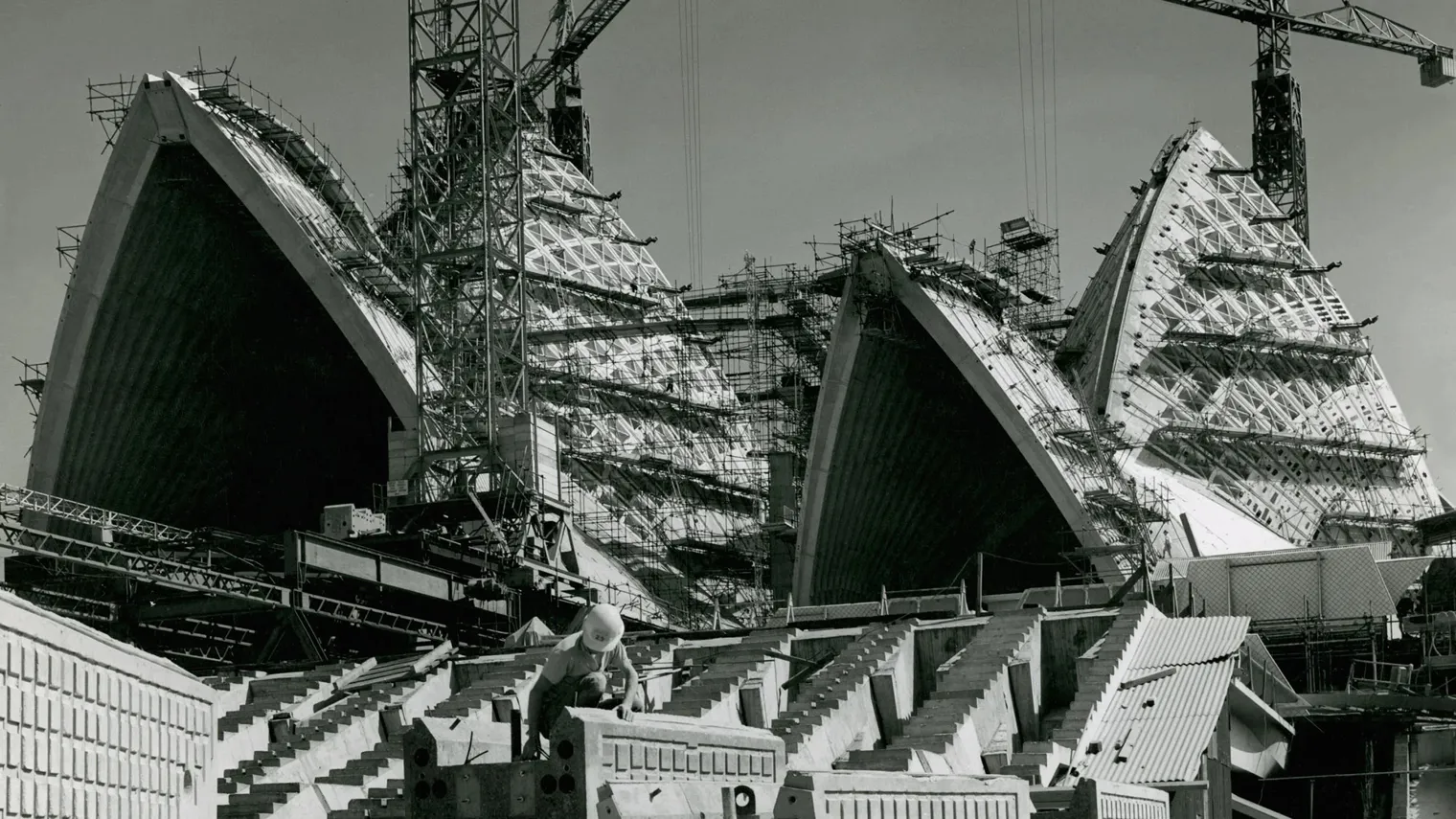
The roof structure comprises 2,194 precast concrete arch units, each weighing 15.5 tonnes and fabricated on-site. The adjoining arch segments were assembled on adjustable steel centring, then post-tensioned together laterally with site-cast joints to form stable composite ribs. Once the ribs were in place, the shells received further lateral post-tensioning to activate composite behaviour across the full system.
The stressing and de-stressing operations engineers estimated it at fourteen to fifteen times the complexity of a major bridge programme. The total roof structure weighs approximately 22,000 tonnes, all of it transferred through the ribbed shell system to the podium below.
Worth stating clearly: the shells are not, in the strictly structural sense, shell structures. They are precast concrete panels supported by precast concrete ribs, behaving compositely once post-tensioned. The load paths differ fundamentally from true thin-shell construction. The Arup team defined a system that achieved the visual character of a shell while delivering the load-carrying reliability of a ribbed precast frame.
| Structural Component | Quantity / Scale | Key Engineering Parameter |
| Precast concrete arch units | 2,194 sections | 15.5 tonnes each |
| On-site precast rib factory | Purpose-built | All sections from the common sphere radius |
| Post-tensioning ducts (steel stressing cables) | ~113 km total | Lateral and longitudinal tensioning |
| Total roof structure weight | ~22,000 tonnes | 14–15× bridge-scale stressing complexity |
| Shell sphere radius | 75.2 metres | Consistent across all 10 shell groups |
| Formwork sets required | Single set (adjustable) | Eliminated custom moulds per unit |
Computational Structural Analysis
The Sydney Opera House is one of the earliest large-scale applications of computer-aided structural analysis in construction. The force distribution through the asymmetric, intersecting shell geometries under wind from multiple directions, self-weight, and dynamic load cases exceeded the capacity of manual calculations within any realistic timeframe.
Ove Arup & Partners adapted an existing programme not designed for anything close to this task. The most complex shell model contained 136 joints; the programme had been built for a maximum of 18. Each full analysis run across five load cases took nearly four hours. Preparing input data for a single model took three weeks. Engineers estimated that the computer work saved approximately ten years of equivalent manual calculation. The project logged 2,000 computational hours alongside over 400,000 hours of structural engineering design work. The Institution of Civil Engineers identifies it as the project that normalised computer modelling as a core structural engineering tool rather than an experimental one.
| Analysis Parameter | Detail |
| Programme originally designed for | Maximum 18 joints |
| Most complex Opera House model | 136 joints |
| Load cases per analysis run | 5 |
| Processing time per full run | ~4 hours |
| Input data preparation per model | ~3 weeks |
| Estimated manual calculation saving | ~10 years of human work |
| Total computational hours | 2,000 |
| Total structural engineering hours | 400,000+ |
Sydney Opera House Foundation Engineering
The site at Bennelong Point did not cooperate. Initial site surveys underestimated the depth to competent bearing strata, and the podium foundation design had to be fully revised once construction began. Engineers specified 588 steel-cased concrete piles, each approximately one metre in diameter, bored to depths of up to 25 metres below sea level into harbour bedrock. Mass concrete fills the inter-pile voids, with the podium slab transferring shell base loads through a continuous flat slab system to the pile caps.
The podium columns installed during Stage I were later found inadequate for the roof loads that emerged from the evolving shell design and had to be rebuilt. This was a direct consequence of Premier Joe Cahill’s decision to start construction before the structural design was finalised; cost overruns were baked in before the shells were started.
Further Reading: Harbin Opera House: Stunning Organic Architecture Built for China’s Extreme Climate
Sydney Opera House Construction: Sequencing and Programme
Construction ran across three formally defined stages over 14 years, each managed by a different contractor and each shaped by decisions, some engineering and some political, that left a permanent mark on the building’s cost trajectory and performance capability.
Three Stages
Stage I (1959 to 1963) covered the podium and was executed by Civil & Civic. Stage II (1963 to 1967) covered the outer shells, executed by M.R. Hornibrook, a bridge construction firm that brought bridge-building fabrication methods directly to the shell programme. Hornibrook developed a telescoping steel arch-centring system for positioning precast rib units that, by contemporary accounts, was a genuinely novel construction tool. Stage III (1967 to 1973) covered the interior fit-out, completed after Utzon resigned in 1966 following a breakdown in his relationship with the New South Wales government over budget control and design authority.
| Stage | Period | Scope | Contractor | Key Outcome |
| Stage I | 1959–1963 | Podium construction | Civil & Civic | Completed Feb 1963; columns later rebuilt |
| Stage II | 1963–1967 | Outer shell construction | M.R. Hornibrook Group | 2,194 precast units erected; tile cladding applied |
| Stage III | 1967–1973 | Interior fit-out | M.R. Hornibrook Group | Completed without Utzon; acoustic deficiencies resulted |
| Opening | 20 Oct 1973 | Queen Elizabeth II presiding | — | 10 years late; AUD $102M final cost |
| Original estimate | 1957 | — | — | AUD $7M; targeted completion: Australia Day 1963 |
| Cost overrun | — | — | — | 1,357% over original budget |
Utzon did not attend the opening, and he never returned to Australia. Ove Arup saw it through to completion. The realistic engineering cost at the outset was closer to AUD $8 million; political pressure had compressed the stated figure to AUD $4.1 million to secure government approval, setting a baseline the project could never meet.
The Tile Cladding System
The 1,056,006 ceramic tiles were manufactured by Höganäs AB in Sweden, a firm whose main product was stoneware tiles for paper mills. From a distance, the shells appear white; up close, a chevron pattern of glossy white and matte cream tiles creates surface variation across the curves without strong chromatic contrast.
The tiles were prefabricated into panel assemblies on the ground, then bolted to the arch ribs. The spherical geometry made this possible: because every shell shares the same sphere radius, tile panels could be manufactured to repeating dimensional standards rather than custom profiles. The exterior cladding is completed with pink granite from Tarana, New South Wales. The foyer’s glass curtain walls, documented in Architectural Record’s 50th anniversary, represent the first large-scale application of structural glazing as a load-bearing envelope material in any major public building.
Sydney Opera House Acoustic Engineering: The Interior Challenges
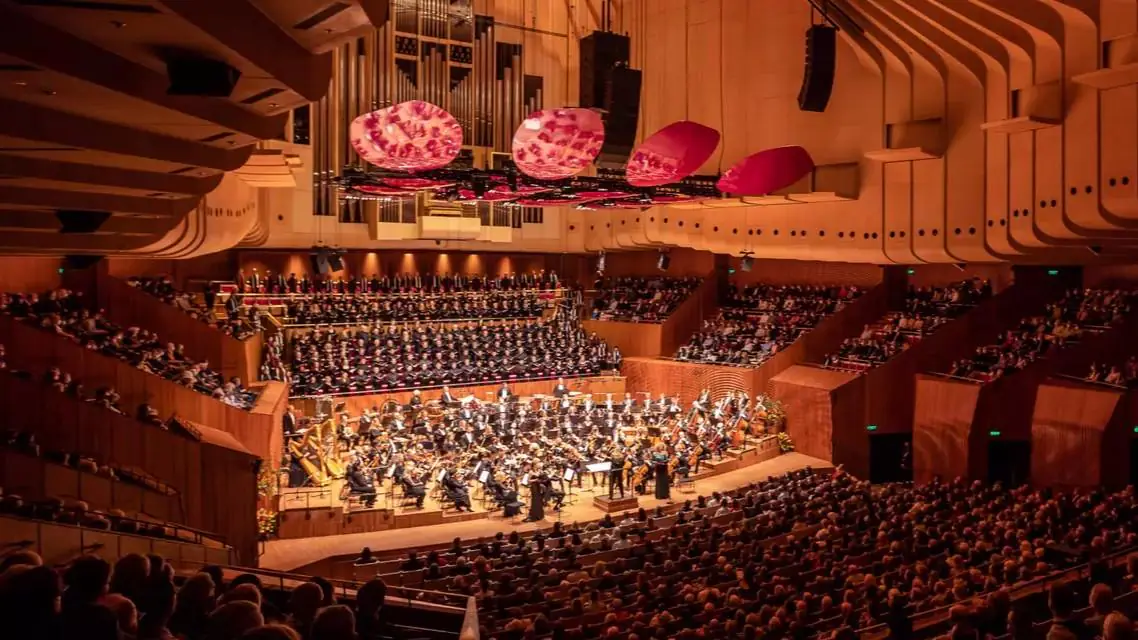
The concert hall’s acoustics were the building’s most persistent failure for nearly five decades. The great interior heights within the shell geometry produced reverberation conditions unsuitable for orchestral music, and the hall opened with deficiencies immediately apparent. The interior had been designed by Australian government architects after Utzon’s departure, without his original acoustic concept, which treated acoustic geometry as a primary design driver rather than a fit-out consideration. The Concert Hall seats 2,679 and contains the Grand Organ, with 10,154 pipes, the largest mechanical organ in the world. The organ took a decade to build and install. The hall’s acoustic character required significant intervention regardless.
In 2022, an AUD $150 million renovation by ARM Architecture finally corrected what had persisted since opening night. Eighteen petal-shaped fibreglass acoustic reflectors were suspended above the stage; new diffusing box fronts and adjustable drapes were installed; and stage machinery, flying equipment, and a new passageway between foyer levels were added. The project delivered a 2.2-second reverberation time suited to orchestral performance and won the 2023 New South Wales Architecture Medallion alongside awards for interior architecture and heritage architecture.
The lesson is blunt: structural brilliance does not carry over into acoustic performance, especially when the architect responsible for both was removed before the interior was designed. The Harbin Opera House in northeast China, opened in 2015, built acoustic geometry into the structural concept from day one, integrating waveform interior surfaces derived from the surrounding wetland landscape rather than resolving acoustics as a retrofit problem 49 years later.
Sydney Opera House Engineering Legacy and Global Influence
The Sydney Opera House’s engineering legacy operates across formal recognition and practical influence on the profession. The UNESCO inscription codified its cultural and structural authority; the methods Ove Arup’s team developed propagated through structural and computational engineering practice, outlasting the building’s novelty.
UNESCO Recognition
The Sydney Opera House was inscribed on the UNESCO World Heritage List in 2007 under Criterion i as a masterpiece of human creative genius. UNESCO described it as bringing together multiple strands of creativity and innovation in both architectural form and structural design, a daring and visionary experiment with enduring influence on the emergent architecture of the late 20th century. Ove Arup’s engineering achievements were explicitly credited as making Utzon’s vision physically realisable.
The Sydney Opera House is not a case of engineering subordinated to architecture. It is a case of architecture that could not exist without engineering as an equal creative force. The spherical geometry solution, the post-tensioning programme, the precast fabrication system, and the computational analysis methodology were all substantive intellectual contributions, not execution support for a predetermined design.
Influence on Practice
Ove Arup’s structural design methods established a working model for computational structural analysis that became standard practice in subsequent decades. The precast concrete shell fabrication approach changed how engineers handled geometrically complex structures. The iterative, constraints-first collaboration between architect and engineer became the template for high-ambition projects that followed.
The InterContinental Shanghai Wonderland Hotel (2018) is a direct descendant of that model: a 336-room hotel built into an 88-metre deep former quarry pit, with structural engineering defining the design logic from site analysis through to the cantilevered underwater suites. Projects of that character depend on the professional precedent set by Utzon and Arup.
Post-tensioned precast concrete systems refined at the Opera House now underpin construction programmes across infrastructure and building types globally. The Dubai Opera House, completed in 2016, shows how far performance architecture has moved since Sydney: a dhow-inspired steel shell enclosing 2,000 seats, with acoustic geometry built into the structural brief from the start rather than resolved through a retrofit half a century later.
Engineering Challenges That Defined the Sydney Opera House
Four failures, two engineering and two governance, shaped the Sydney Opera House as profoundly as any of its technical achievements. Each exposed a weakness in how complex, innovation-dependent projects get initiated and managed.
1. Design-Construction Sequencing Failures
Construction started in 1959, before Utzon had finalised the structural design of the roof. Premier Cahill wanted visible progress over technical readiness. The consequences were direct: podium columns built to provisional loading assumptions had to be demolished and rebuilt once the roof loads were confirmed. Stage I was 47 weeks behind schedule by January 1961, and the cost trajectory was broken before the shells were started. An incomplete design at construction commencement produces downstream costs far exceeding the time saved by an early start. The Opera House proved it conclusively.
2. Geometric Indeterminacy at the Competition Stage
Utzon’s winning design was conceptually compelling and geometrically undefined. The competition jury, including Eero Saarinen, selected a sketch rather than an engineerable proposal. Twelve rejected iterations over six years followed, an extraordinary resource consumption for a problem that existed because buildability was not part of the competition brief.
3. Political Interference and Utzon’s Departure
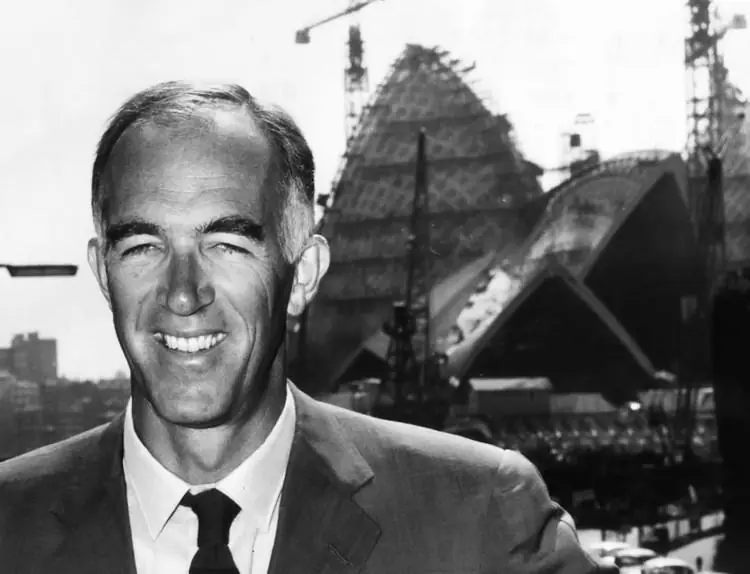
The New South Wales government’s relationship with Utzon collapsed from 1963 onwards, as cost overruns generated political pressure and the government sought to exert direct control over design decisions. Utzon resigned in 1966, Stage III incomplete, the Concert Hall interior undesigned. The acoustic deficiencies that persisted for 49 years trace directly to that rupture: Utzon’s interior concept made acoustic geometry central, and its abandonment left a structural masterpiece with an interior performance that never matched the exterior’s ambition.
4. Computational Limitations
The computers available to Ove Arup’s team in 1960 were the best available and still barely adequate. The analysis programme had been designed for structures with 18 or fewer joints. The most complex opera house model needed 136. Four hours per analysis run and three weeks of input preparation per model were the real constraints within which the entire structural design had to be validated, shaping not just the pace of design but which configurations the team could rigorously test.
Sydney Opera House Performance Venues and Technical Specifications
The Sydney Opera House operates six distinct performance spaces, each acoustically and structurally independent, collectively seating 5,738 patrons across over 1,500 annual performances, making it the busiest performing arts centre in the world by programme volume.
| Venue | Capacity | Primary Programme |
| Concert Hall | 2,679 seats | Orchestral, choral, popular music |
| Joan Sutherland Theatre (Opera Theatre) | 1,507 seats | Opera, ballet, dance |
| Drama Theatre | 544 seats | Theatre, dance |
| Playhouse | 398 seats | Chamber performances, small theatre |
| The Studio | 400 seats | Contemporary performance, experimental work |
| Utzon Room | 210 seats | Small ensembles, functions |
| Total | 5,738 seats | 6 venues |
The building’s power draw matches that of a town of 25,000 people, distributed over 401 kilometres of electrical cable. The 2012 Decade of Renewal programme committed nearly AUD $300 million to infrastructure upgrades, completing in 2022 with the concert hall acoustic renovation.
Further Reading: Dubai Opera House: Spectacular Structural and Acoustic Engineering in a Desert Megacity
Technical Block: Structural Systems and Material Engineering
The structural and material systems of the Sydney Opera House work as an integrated hierarchy: the shell roof depends on the precision of the rib fabrication, the rib system depends on the integrity of the podium, and the podium depends on a pile foundation driven through 25 metres of harbour deposits. Each layer is documented below.
1. Shell Roof Structural System
The roof comprises 10 shell groups, each a composite of precast concrete ribs and panels post-tensioned into a structural whole. The ribs are sections of a sphere with a 75.2-metre radius. Lateral post-tensioning across adjacent ribs activates composite behaviour. Load transfers through the rib system to the podium below, with stress concentrations managed through the geometry of adjacent shell intersections. The system achieves structural stability through form rather than mass: the spherical curvature puts the predominant load path in compression, which concrete carries efficiently.
2. Podium Foundation System
588 steel-cased bored piles, each 1 metre in diameter, run to depths of up to 25 metres below sea level through loose alluvial harbour deposits into competent bearing strata. Mass concrete fills the inter-pile voids. The podium slab transfers shell base loads through a continuous flat slab to the pile caps. The concourse beams beneath the monumental steps, which Ove Arup redesigned from Utzon’s proposed colonnade, use an undulating profile that disperses bending moments across the beam geometry without vertical intermediate supports; a structural solution that simultaneously became the architectural feature of the concourse underside.
3. Precast Tile Cladding System
The Höganäs AB ceramic tiles were prefabricated into standardised panel assemblies, each covering a portion of a spherical surface. A single consistent sphere radius across all shells meant tile panels could be manufactured to repeating dimensional standards. Panels were bolted to the arch ribs after the structural shell was complete. The two-colour chevron pattern, barely visible at a distance, was Utzon’s answer to the uniformity problem on large curved surfaces: enough variation to read as crafted, not enough to pull focus from the shell geometry.
Conclusion: Why the Sydney Opera House Engineering Endures
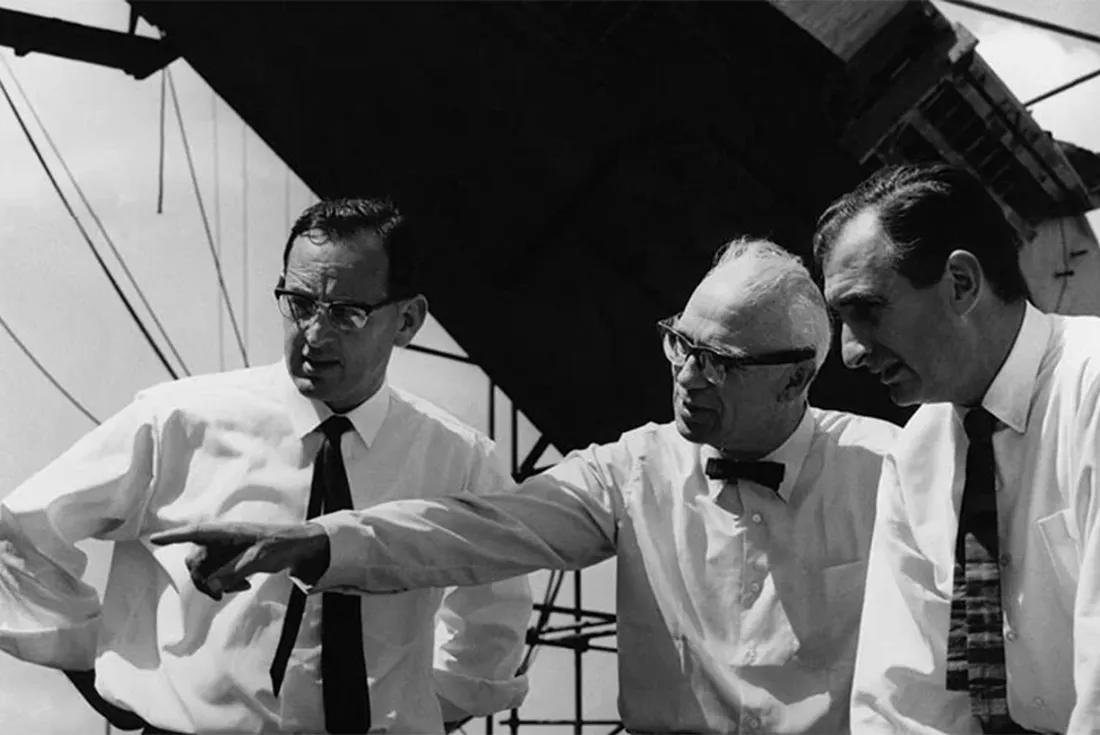
The enduring significance of the Sydney Opera House lies not only in its striking appearance but also in the engineering breakthroughs that enabled its construction. Ove Arup’s role extended far beyond solving a difficult structural problem. Together with Jørn Utzon, he helped transform an ambitious architectural vision into a buildable reality by establishing a precise geometric system based on sections of a common sphere. That decision fundamentally changed the project’s direction and enabled the complex roof shells to be standardised, analysed, fabricated, and assembled with unprecedented accuracy.
At the time, no major construction project had attempted thin-shell concrete structures of this scale using precast segments derived from a unified spherical geometry and integrated into a composite structural system through post-tensioning. The project also pushed the boundaries of computational engineering, becoming one of the earliest buildings to rely heavily on computer-based structural analysis to verify design behaviour and construction feasibility.
The engineering methods developed for the Sydney Opera House created a lasting influence across global construction and structural design practice. Its innovations in prefabrication, shell construction, digital analysis, and project coordination established technical principles that later shaped airports, stadiums, cultural buildings, and other complex megastructures worldwide. Many buildings achieve iconic status solely through their appearance. Far fewer redefine the possibilities of engineering and construction. The Sydney Opera House belongs firmly in that second category, which is precisely why its legacy continues to endure decades after completion.
Stay Updated on Iconic Structural Engineering
Stay ahead of the world’s most significant architectural and engineering developments with Construction Frontier: Global Megaprojects. Explore deep technical insights, expert analysis, and construction intelligence shaping the future of iconic structural engineering and landmark architecture worldwide.